Home
Class 11
PHYSICS
With the assumption of no slipping, dete...

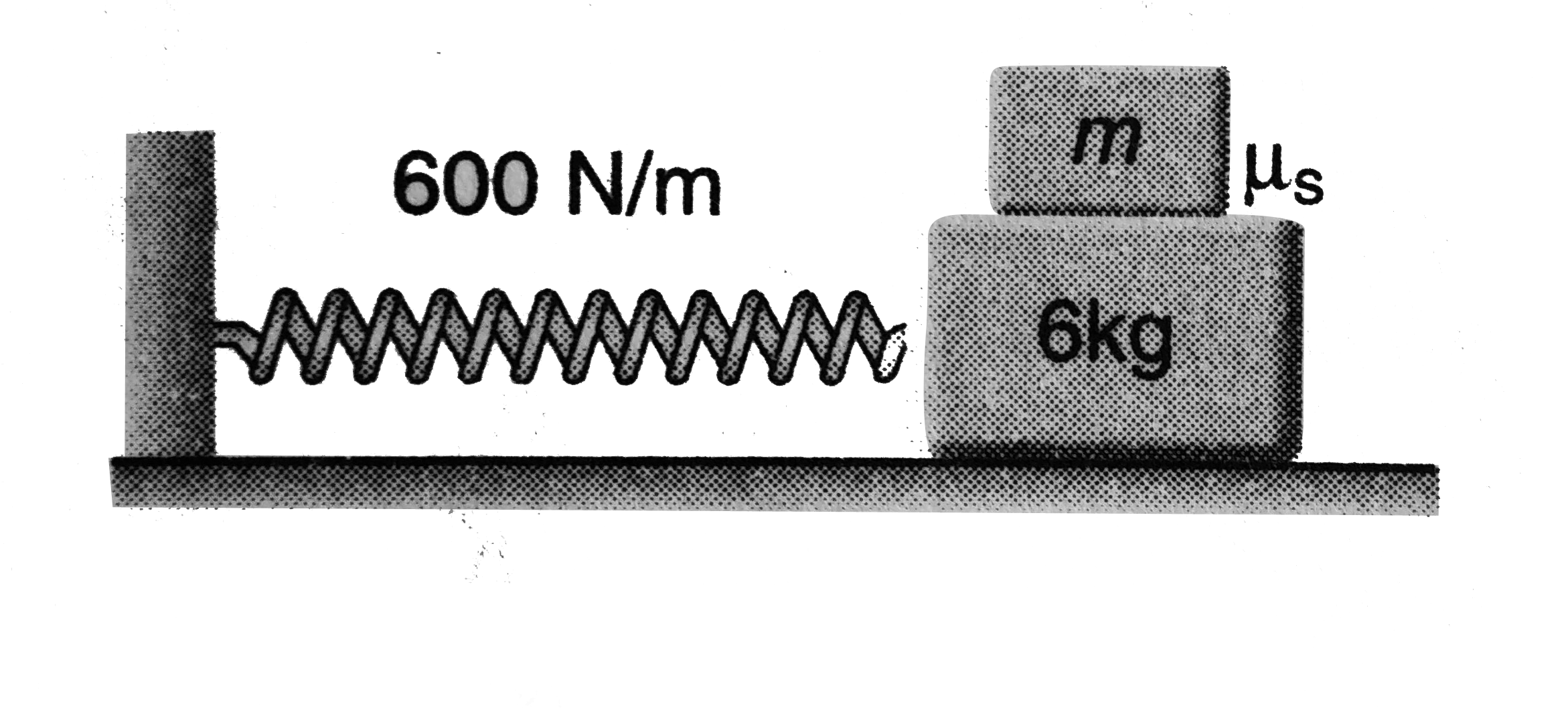
With the assumption of no slipping, determine the mass m of the block which must be placed on the top of a `6 kg` cart in order that the system period is `0.75s`. What is the minimum coefficient of static friction `mu_(s)` for which the block will not slip relative to the cart is displaced `50 mm` from the equilibrium position and released? Take `(g = 9.8 m//s^(2))`.

A

`2kg, mu_(s) = 0.4`

B

`4.2 kh, mu_(s) = 0.358`

C

`2.56 kg, mu_(s) ge 0.358`

D

`2.56 kg, mu_(s) le 0.358`

Text Solution

Verified by Experts

The correct Answer is:

C

`T = 2pi sqrt((m_(1)+m_(2))/(k))` and `mu =(A omega^(2))/(g)`
Promotional Banner

Topper's Solved these Questions

  • OSCILLATIONS

    NARAYNA|Exercise NCERT BASED QUESTIONS|1 Videos
  • OSCILLATIONS

    NARAYNA|Exercise MULTIPLE ANSWER QUESTIONS|23 Videos
  • OSCILLATIONS

    NARAYNA|Exercise LEVEL -II (C.W)|36 Videos
  • NEWTONS LAWS OF MOTION

    NARAYNA|Exercise PASSAGE TYPE QUESTION|6 Videos
  • PHYSICAL WORLD

    NARAYNA|Exercise C.U.Q|10 Videos

Similar Questions

Explore conceptually related problems

Two blocks lie on each other and connected to a spring as shown in figure. What should be the mass of blocks A placed on block B of mass 6 kg, so that the system's period is 0.75 s ? Assume no slipping, what should be the minimum value of coefficient of static friction mu_(s) for which block A will not slip relative to block B, if block B is displaced 50 mm from equilibrium position and released ?

A block A of mass m_(1) is placed on a horizontal frictionless table. It is connected to one end of a light spring of force constant k whose other end is fixed to a wall. A small block B of mass m_(2) is placed on block A. The coefficient of static friction between the blocks is mu . The system is displaced slightly from its equilibrium position and released. What is the maximum amplitude of the resulting simple harmonic motion of the system so that the upper block does not slip over the lower block ?

A marble block of mass 2 kg lying on ice when given a velocity of 6m//s is stopped by friction in 10s. Then the coefficient of friction is

A block of mass m is placed on the top of a 6kg cart such that the time period of the system is 0.75 s assuming there is no slipping. If the cart is displaced by 50 mm from its equilibrium position and released, then the coefficient of static friction mu_(s) between block and cart is just sufficient to prevent the block from sliding. The value of m and mu_(s) respectively are (Take g = 9.8 m//s^(2))

A block of mass 2 kg is at rest on a floor . The coefficient of static friction between block and the floor is 0.54. A horizonatl force of 2.8 N is applied to the block . What should be the frictional force between the block and the floor ? ( take , g = 10 m//s^(2) )

In the masses of A and B are 10 kg and 5 kg . Calculate the minimum mass of C which may stop A from slipping Coefficient of static friction between block A and table is 0.2 .

A block of mass 2 kg is placed on the floor . The coefficient of static friction is 0.4 . If a force of 2.8 N is applied on the block parallel to floor , the force of friction between the block and floor is : (Taking g = 10 m//s^(2) )

A block of mass 2 kg is placed on the floor. The coefficient of static friction is 0.4. A force F of 3 N is applied on the block as shown in figure. The force of friction between the block and the floor is (Take g=10 m s^(-2) )

A block of mass 4kg is released from the top of a rough inclines plane of height 10 m . If velocity of the block is 10 m/s at the bottom of the inclined then work done by the friction force on the block will be

NARAYNA-OSCILLATIONS-LEVEL -III
  1. A body of mass m is released from a height h to a scale pan hung from ...

    Text Solution

    |

  2. A block P of mass m is placed on horizontal frictionless plane. A seco...

    Text Solution

    |

  3. With the assumption of no slipping, determine the mass m of the block ...

    Text Solution

    |

  4. There is a spring with netural length L(0). Two masses m(1) and m(2) a...

    Text Solution

    |

  5. A pendulum of mass m and length L is connected to a spring as shown in...

    Text Solution

    |

  6. A small block is connected to a massless rod, which in turns attached ...

    Text Solution

    |

  7. In the device shown in Fig, the block m is displaced down slightly and...

    Text Solution

    |

  8. A tray of mass 12 kg is supported by two identical springs as shown in...

    Text Solution

    |

  9. A particle of mass 'm' is attached to three identical springs A,B and ...

    Text Solution

    |

  10. One end of a spring of force constant k is fixed to a vertical wall an...

    Text Solution

    |

  11. A simple pendulum of length 4.9m is immersed in a liquid of density rh...

    Text Solution

    |

  12. A simple pendulum is hanging from a peginserted in a vertical wall. It...

    Text Solution

    |

  13. A particle of mass m is allowed to oscillate near the minimum of a ver...

    Text Solution

    |

  14. In the previous problem, if tunnel is dug along a chord, find time per...

    Text Solution

    |

  15. A simple pendulm has a length L and a bob of mass M. The bob is vibrat...

    Text Solution

    |

  16. The angular amplitude of a simple pendulum is theta(0). The maximum te...

    Text Solution

    |

  17. The bob of a simple pendulum is displaced from its equilibrium positio...

    Text Solution

    |

  18. A disc of mass M is attached to a horizontal massless spring of force ...

    Text Solution

    |

  19. A block of mass 'm' collides perfectly inelastically with another iden...

    Text Solution

    |

  20. Figure shows a system consisting of a massles pulley, a spring of forc...

    Text Solution

    |
