
Home
Class 11
PHYSICS
A particle is in linear simple harmonic ...

A particle is in linear simple harmonic motion between two points `A` and `B 10cm` apart (figure). Take the direction form `A` to `B` as positive direction and choose the correct statements.
`AO =OB = 5cm`
`BC =8cm`

A

The sign of velocity, acceleration and force on the particle when it is `3cm` away from `A` going towards `B` are positive

B

The sign of velocity of the particle at `C` going towards `B` is negative

C

The sign of velocity, acceleration and force on the particle when it is `4cm` away from `B` going towards `A` are negative

D

The sign of acceleration and force on the particle when it is at point `B` is negative

Text Solution

Verified by Experts

The correct Answer is:
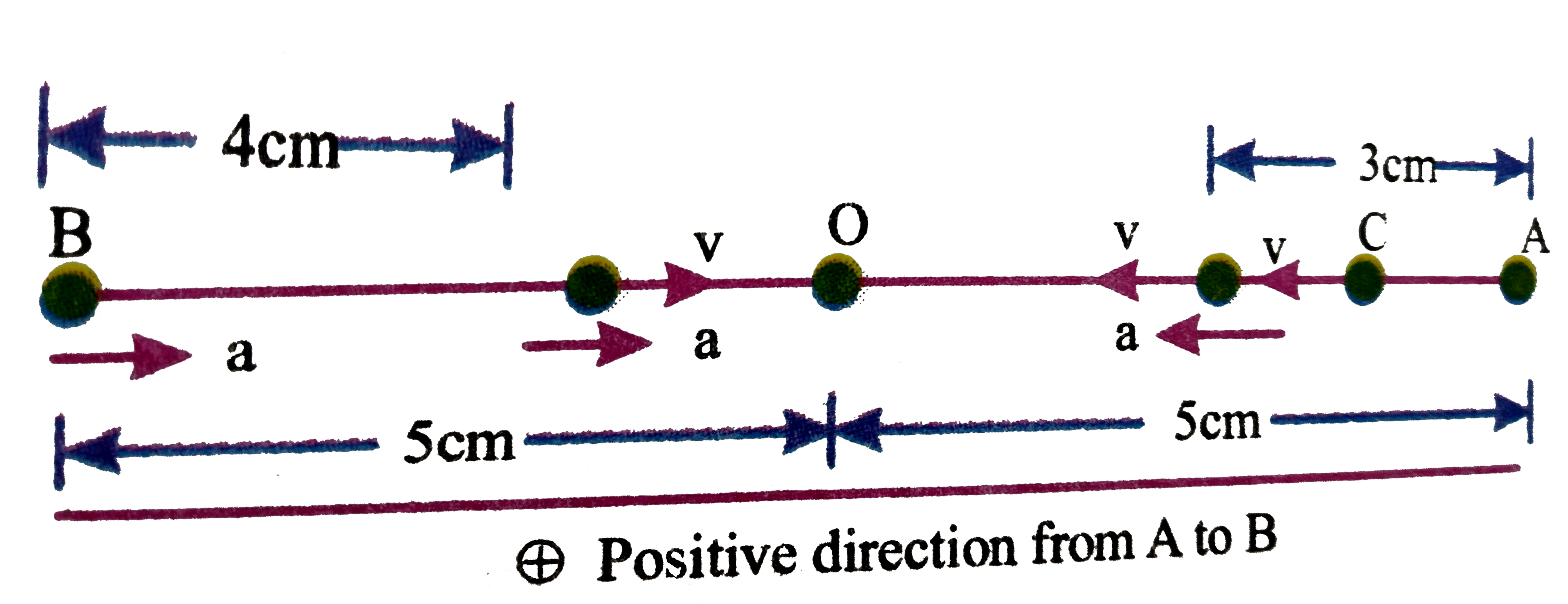
A, C, D


In option (a): When the particle is `3cm` away form `A` going towards `B`. So, velocity is towards `AB`, i.e, position. In `SHM`, Acceleration is always towards mean position `(O)` it means both force and acceleration act towards `O`, have positive sign. Hence option (a) is correct. In option (b): When the particle is at `C`, velocity is towards `B` hence positive. Hence options (b) is not correct
In option (c ): When the particle is `4cm` away form `b` going towards `A` velocity is negative and acceleration is towards mean position `(O)`, hence negative. Hence option (c ) is correct. In option (d): Acceleration is always towards mean position `(O)`. When the particle is at `B`, acceleration and force are towards `BA` that is negative. Hence option (d) is correct.
Promotional Banner

Topper's Solved these Questions

  • OSCILLATIONS

    NARAYNA|Exercise ASSERTION & REASON QUESTIONS|13 Videos
  • OSCILLATIONS

    NARAYNA|Exercise LEVEL-V|1 Videos
  • OSCILLATIONS

    NARAYNA|Exercise NCERT BASED QUESTIONS|1 Videos
  • NEWTONS LAWS OF MOTION

    NARAYNA|Exercise PASSAGE TYPE QUESTION|6 Videos
  • PHYSICAL WORLD

    NARAYNA|Exercise C.U.Q|10 Videos

Similar Questions

Explore conceptually related problems

A particle is in linear simple harmonic motion between two points A and B, 10 cm apart (figure) . Take the direction from A to B as the +ve direction and choose the correct statements.

A particle is in linear simple harmonic motion between two points. A and B, 10 cm apart (figure.) take direction from A to B as the positive direction and choose the correct statements. AO= OB= 5cm BC=8cm

A particle is in linear S.H.M. between two points A and B, 10 cm apart. Take the direction from A to B as the positive direction and give the signs of velocity, acceleration and force on the particle when it is. (a) at the end (A) at the end B, (c) at the mid point of AB going towards A, (d) at 2 cm away from B going towards A, (e) at 3 cm away from A goiing towards B, and (f) at 4 cm away from A going towards A.

A particle is executing simple harmonic motion between exterme positions given by (-1,-2,-3)cm and (1,2,1)cm . Its amplitude of oscillation is

A particle is vibrating in a simple harmonic motion with an amplitude of 4 cm . At what displacement from the equilibrium position, is its energy half potential and half kinetic

A particle executes simple harmonic motion with an amplitude of 10 cm and time period 6s. Ast t=0 it is at position x=5 cm going towasrds positive x-direction. Write the eqwuation for the displacement x at time t. Find the magnitude of the acceleration of the particle at t=4s.

A particle executes simple harmonic motion with an amplitude of 10 cm. At what distance from the mean position are the kinetic and potential energies equal?

A particle executing simple harmonic motion of amplitude 5 cm has maximum speed of 3.14 cm//s . The frequency of its oscillation is

A particle is subjected to two simple harmonic motion along x and y-directions according to equations x = 4sin 100pi t and y = 3sin 100pit Choose the correct statement –

A particle doing simple harmoonic motion amplitude = 4 cm time peiod = 12sec The ratio between time taken by it in going from its mean position to 2cm and from 2cm to exterme position is

NARAYNA-OSCILLATIONS-MULTIPLE ANSWER QUESTIONS
  1. Which of the following statements is/are true for a simple harmonic os...

    Text Solution

    |

  2. The displacement -time graph of a particle executing SHM is shown in f...

    Text Solution

    |

  3. A body is performing SHM, then its

    Text Solution

    |

  4. A particle is in linear simple harmonic motion between two points A an...

    Text Solution

    |

  5. Two blocks A and B, each of mass m, are connected by a masslesss sprin...

    Text Solution

    |

  6. A coin of mass m is placed on a horizontal platform which is undergoin...

    Text Solution

    |

  7. Function x=Asin^(2)omegat+Bcos^(2)omegat+Csinomegat cos omegat represe...

    Text Solution

    |

  8. A simple pendulm has a length L and a bob of mass M. The bob is vibrat...

    Text Solution

    |

  9. Three simle harmionic motions in the same direction having the same am...

    Text Solution

    |

  10. A thin uniform rod of length L = 100cm is to be pivoted about some poi...

    Text Solution

    |

  11. A particle performing simple harmonic motion undergoes unitial displac...

    Text Solution

    |

  12. A simple pendulum consists of a bob of mass m and a light string of le...

    Text Solution

    |

  13. Figure. (a) shows a spring of force constant k fixed at one end and ca...

    Text Solution

    |

  14. Two independent harmonic oscillators of equal mass are oscillating abo...

    Text Solution

    |

  15. A block with mass (M) is connected by a massless spring with stiffness...

    Text Solution

    |

  16. Time period for an oscillatory periodic motion without an implusive fo...

    Text Solution

    |

  17. A particle oscillates about the stable equilibrium position x(0) with ...

    Text Solution

    |

  18. Three cars of mass m each are held at rest on an inclined smooth rail...

    Text Solution

    |

  19. A bob of mass 2m hanges by a string attached to the block of mass m of...

    Text Solution

    |

  20. A body of mass m is in a field where its potential energy is given by ...

    Text Solution

    |

