Home
Class 11
PHYSICS
A block of mass m moves with a speed v t...

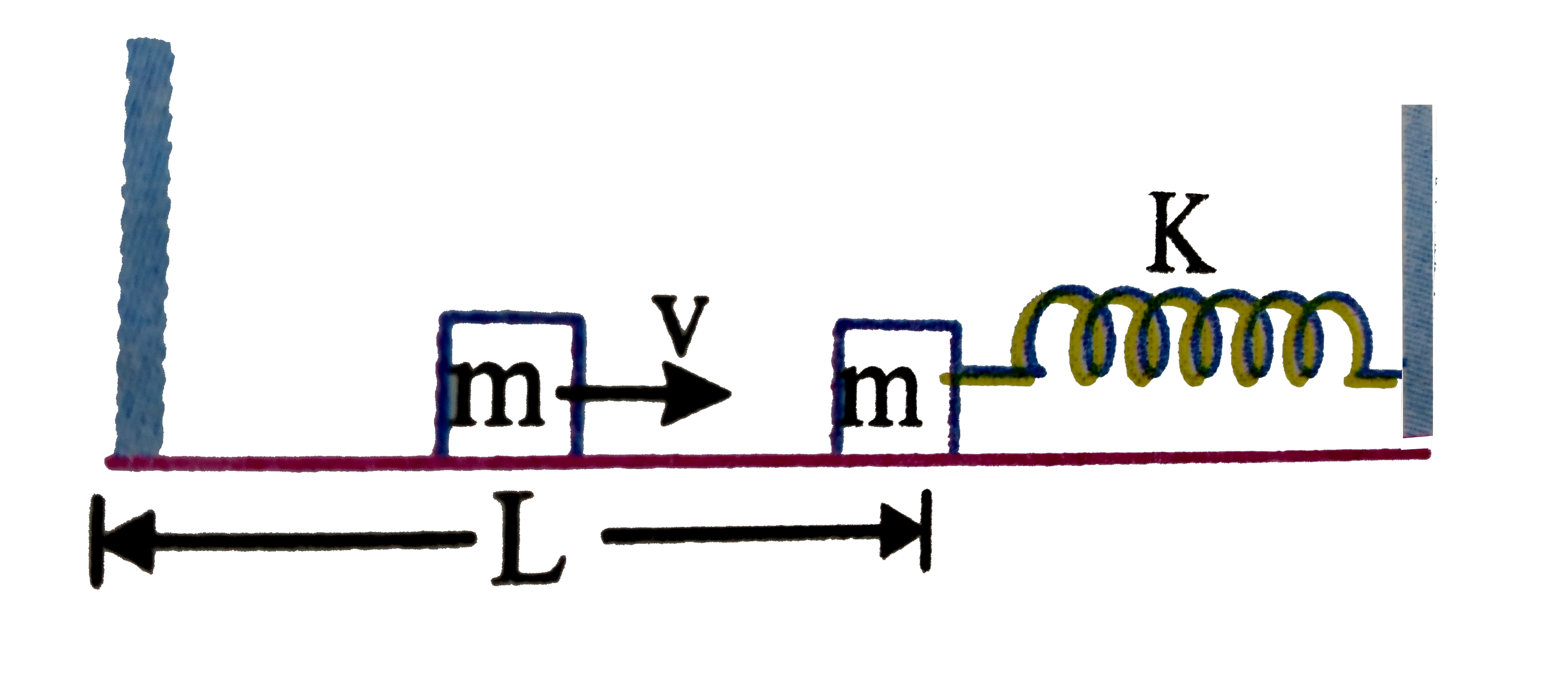
A block of mass `m` moves with a speed `v` towards the right block which is in equilibrium with a spring attached to rigid wall. If the surface is frictionless and collisions are elastic, the frequency of collisions between the masses will be:

A

`(v)/(2L)+(1)/(pi)sqrt((K)/(m))`

B

`2[(v)/(2L)+(1)/(2pi)sqrt((K)/(m))]`

C

`(2)/([(2L)/(v)+pisqrt((m)/(K))])`

D

`(v)/(2l)+(1)/(pi)sqrt((m)/(K))`

Text Solution

Verified by Experts

The correct Answer is:

C

Time taken to collide on left wall and get back to the mass attached with spring is `t_(1) = (2L)/(v)`. Time to get the spring compressed once and to come back is, `t_(2) = (T)/(2) =(2pi)/(2) sqrt((m)/(K)) =pi sqrt((m)/(K)) :.` Average time between two successive collisions, `t = (t_(1)+t_(2))/(2)` collision freqency `=(1)/(t)`
Promotional Banner

Topper's Solved these Questions

Similar Questions

Explore conceptually related problems

A ball of mass m moving with speed v towards the right strikes a wall moving towards the left with speed u . Find the change in the K.E. of the ball if the collision is elastic.

The left block in figure moves at a speed v towards the right block placed in equilibrium. All collilsions to take place are elastic and the surfaces are frictionless. Show that motion of the two blocks are periodic. Find the timepoerid of these periodic motions. Neglect the widths of the blocks.

The right block in figure moces at a speed V towards the left block placed in equilibrium. All the surfaces are smooth and all the collisions are elastic. Find the time period motion. Neglect the width of the blocks.

The right block in figure moces at a speed V towards the left block placed in equilibrium. All the surfaces are smooth and all the collisions are elastic. Find the time period motion. Neglect the width of the blocks.

Infinite blocks each of mass M are placed along a straight line with a distance d between each of them. At t = 0 the leftmost block is given a velocity V towards right. The coefficient of frication between any block and the surface is mu and all collisions are elastic. Let the total number of collisions be N then N is

Three blocks are initially placed as shown in the figure. Block A has mass m and initial velocity v to the right. Block B with mass m and block C with mass 4 m are both initially at rest. Neglect friction. All collisions are elastic. The final velocity of block A is

Three blocks are initially placed as shown in the figure. Block A has mass m and initial velocity v to the right. Block B with mass m and block C with mass 4m are both initially at rest. Neglect friction. All collisions are elastic. The final velocity of blocks A is

Two balls each of mass 'm' are moving with same velocity v on a smooth surface as shown in figure. If all collisions between the balls and balls with the wall are perfectly elastic, the possible number of collisions between the balls and wall together is

(i) A block of mass m moving towards right with a velocity V strikes (head on) another block of mass M which is at rest connected to a spring. The coefficient of restitution for collision between the blocks is e = 0.5. Find the ratio (M)/(m) for which the subsequent compression in the spring is maximum. There is not friction. Ball A collides head on with another identical ball B at rest. Find the coefficient of restitution if ball B has 80% of the total kinetic energy of the system after collision.

NARAYNA-OSCILLATIONS-SINGLE ANSWER QUESTIONS
  1. The driver of a car record a period of (pi)/(3) seconds for a pendulum...

    Text Solution

    |

  2. A bob of mass M is hung using a string of length l. A mass m moving wi...

    Text Solution

    |

  3. A block of mass m moves with a speed v towards the right block which i...

    Text Solution

    |

  4. A block of mass M is connected to a spring of force constant k and is ...

    Text Solution

    |

  5. A uniform stick of length l is mounted so as to rotate about a horizon...

    Text Solution

    |

  6. Aparticle of mass m oscillating as given by U(y) =K|y|^(3) with force ...

    Text Solution

    |

  7. A particle at the end of a spring executes S.H,M with a period t(2) I...

    Text Solution

    |

  8. A body of mass m, is attached to a vertical rod of mass M nad length L...

    Text Solution

    |

  9. A smooth semicircular wire track of radius R if fixed in a vertical pl...

    Text Solution

    |

  10. A block of mass m is attached to one end of a light inextensible strin...

    Text Solution

    |

  11. A ball is suspended by a thread of length l at the point O on an incl...

    Text Solution

    |

  12. Two masses m(1) and m(2) are suspeded togther by a massless spring of ...

    Text Solution

    |

  13. Two light spring of force constants k(1) and k(2) and a block of mass ...

    Text Solution

    |

  14. A solid sphere of radius R is floating in a liquid of density sigma wi...

    Text Solution

    |

  15. A small body attached to one end of a vertically hanging spring is per...

    Text Solution

    |

  16. The block of mass m1 shown in figure is fastened to the spring and the...

    Text Solution

    |

  17. In figure, k = 100 N//m, M = 1kg and F = 10 N (a) Find the compre...

    Text Solution

    |

  18. A rectangular plate of sides a and b is suspended fropm a ceilling by ...

    Text Solution

    |

  19. A small block oscillates back and forth on a smooth concave surface of...

    Text Solution

    |

  20. Assume that a tunnel is dug across the earth (radius=R) passing throug...

    Text Solution

    |
