Home
Class 12
PHYSICS
In a modified YDSE, the region between t...

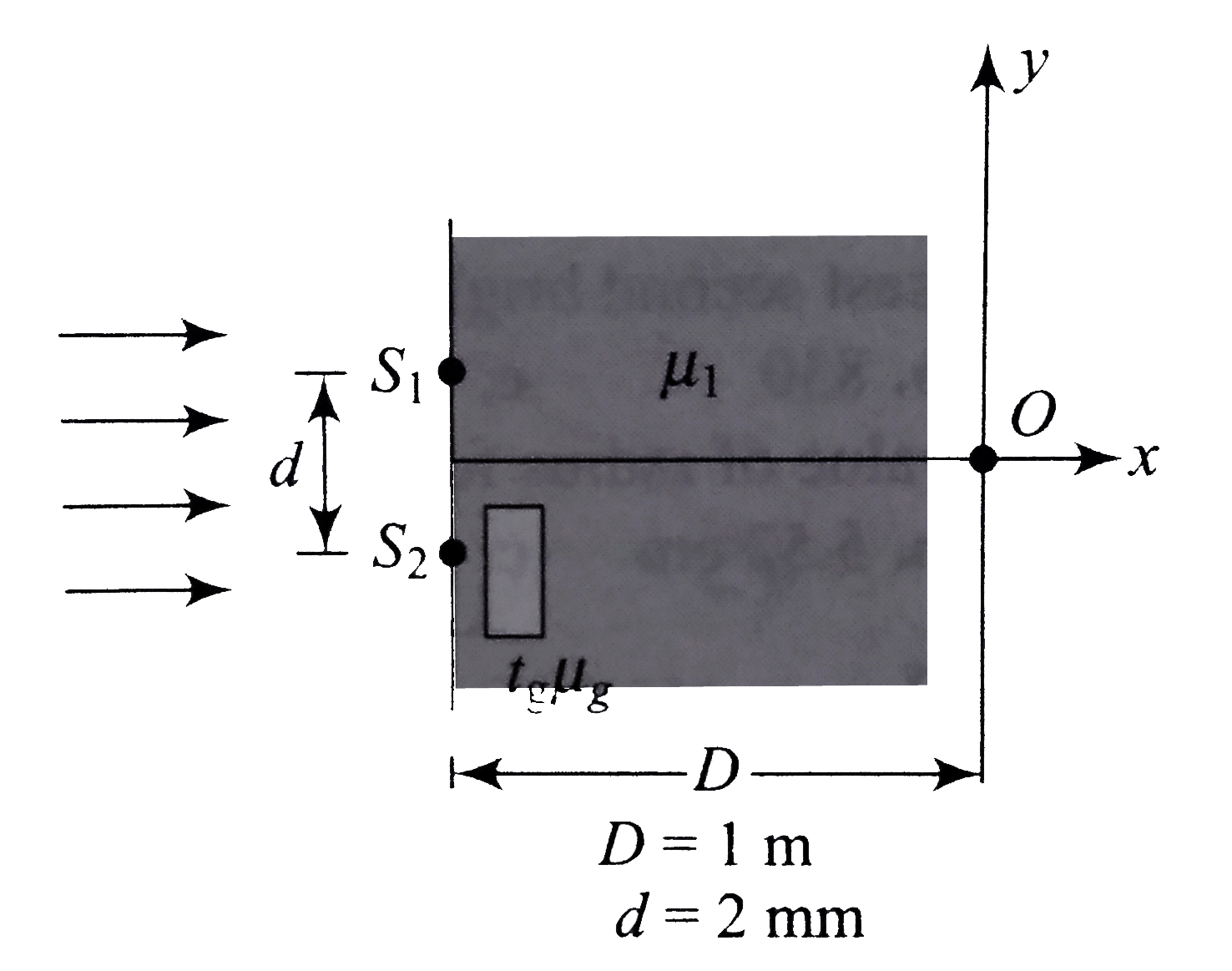
In a modified YDSE, the region between the screen and slits is immersed in a liquid whose refractive index varies with time as `mu_(1) = (5 // 2) - (T // 4)` until it reaches s steady state value of `5 // 4`. A glass plate of thickness 36 `mu m` and refractive index `3//2` is introduced in front of one of the slits.

Find the time when central maxima is at point O. located symmetrically on the x-asix.

A

`2xx10^(-3)ms^(-1)`

B

`3xx10^(-3)ms^(-1)`

C

`4xx10^(-3)ms^(-1)`

D

`5xx10^(-3)ms^(-1)`

Text Solution

Verified by Experts

The correct Answer is:
B


Path different
`(Delta x) = [(S_(2)P)_(liq) + (mu_(g) - mu_(l))t- (S_(1)P)_("liquid")]`
`(Delta x) = (S_(2)P-S_(1)P)_(liq)+(mu_(g)-mu_(l))t`
`= mu_(l)(S_(2)P-S_(1)P)_(air)+(mu_(g)-mu_(l))t`
`Delta x = mu_(l) ((yd)/(D))+(mu_(g) - mu_(l))t`
For central maxima `Delta x =0`
`0 = mu_(l)((yd)/(D))+(mu_(g)-mu_(l))t y = (-(mu_(g)-mu_(l))tD)/(d mu_(l))`
`y = -(D[(3)/(2)-((5)/(2)-(T)/(4))]t)/(d[(5)/(2)-(T)/(4)])`
`y= - (D[1-(T)/(4)]t)/(d[(5)/(2)-(T)/(4)]) = (D[4-T]t)/(d(10-T))`
The time when y becomes zero is
`0 = (D(4-T)t)/(d(10-T))`
`D(4-T)t = 0 implies 4- T = 0 implies T = 4 sec`
Speed of central maxima
`V = (dy)/(dt) = (Dt)/(d)(d)/(dT) [(4-T)/(10-T)]`
`V = (tD)/(d) = [(4-T)(10-T)^(-1)]`
`= (tD)/(d)[(-(4-T)+(10-T))/((10-T)^(2))]`
`= (tD)/(d) [(-4+T+10-T)/((10-T)^(2))] V = (6Dt)/(d(10-T)^(2))`
Central maxima is at 'O' at `T = 4 sec`
`V = (6xx1xx36xx10^(-6))/(2xx10^(-3)(10-4)^(2)) = (3xx36xx10^(-3))/(36)`
`V = 3xx10^(-3)ms^(-1)`
Promotional Banner

Topper's Solved these Questions

  • WAVE OPTICS

    NARAYNA|Exercise LEVEL - VI|40 Videos
  • WAVE OPTICS

    NARAYNA|Exercise LEVEL - I(H.W)|20 Videos
  • WAVE OPTICS

    NARAYNA|Exercise NCERT Based Questions|25 Videos
  • SEMICONDUCTOR ELECTRONICS

    NARAYNA|Exercise ADDITIONAL EXERCISE (ASSERTION AND REASON TYPE QUESTIONS :)|19 Videos

Similar Questions

Explore conceptually related problems

In a modified YDSE, the region between the screen and slits is immersed in a liquid whose refractive index varies with time as mu_(1) = (5 // 2) - (T // 4) until it reaches s steady state value of 5 // 4 . A glass plate of thickness 36 mu m and refractive index 3//2 is introduced in front of one of the slits. What is the speed of the central maxima when it is at

In YDSE when slab of thickness t and refractive index mu is placed in front of one slit then central maxima shifts by one fringe width. Find out t in terms of lambda and mu .

In YDSE , slab of thickness t and refractive index mu is placed in front of any slit. Then displacement of central maximu is terms of fringe width when light of wavelength lamda is incident on system is

A YDSE is conducted in water (mu_(1)) as shown in figure. A glass plate of thickness t and refractive index mu_(2) is placed in the path of S_(2) . The optical path difference at O is

In Young's double-slit experiment, let A and B be the two slit. A thin film of thickness t and refractive index mu is placed in front of A. Let beta = fringe width. Then the central maxima will shift

Light travels through a glass plate of thickness t and refractive index mu. If c is the speed of light in vacuum, the time taken by light to travel this thickness of glass is

In a young's double slit experiment ,let A and B be the two slits.A thin film film of thickness t and refractive index mu is pklaced in front of A .Let beta =fringe width.The central maximum will shift:

NARAYNA-WAVE OPTICS-LEVEL - V
  1. A screen is at distance D = 80 cm form a diaphragm having two narrow s...

    Text Solution

    |

  2. In figure S is a monochromatic point source emitting light of waveleng...

    Text Solution

    |

  3. In a modified YDSE, the region between the screen and slits is immerse...

    Text Solution

    |

  4. In the ideal double-slit experiment, when a glass-plate (refractive in...

    Text Solution

    |

  5. In an interference arrangement similar to Young's double-slit experime...

    Text Solution

    |

  6. In YDSE, bichromatic light of wavelengths 400 nm and 560 nm are used...

    Text Solution

    |

  7. Intensity obseverd in an interferecne pattern is I = I(0) sin^(2) thet...

    Text Solution

    |

  8. White light is used to illuminate the two slits in a Young's double sl...

    Text Solution

    |

  9. Two points nonochromatic and coherent sources of light of wavelength l...

    Text Solution

    |

  10. The minimum value of d os that there is a dark fringe at O is d(min). ...

    Text Solution

    |

  11. Fig. shows a surface XY separating two transparent media, medium 1 and...

    Text Solution

    |

  12. Fig. shows a surface XY separating two transparent media, medium 1 and...

    Text Solution

    |

  13. Fig. shows a surface XY separating two transparent media, medium 1 and...

    Text Solution

    |

  14. In the arrangement shown in Fig., slits S(1) and S(4)are having a vari...

    Text Solution

    |

  15. In the arrangement shown in Fig., slits S(1) and S(4)are having a vari...

    Text Solution

    |

  16. In the arrangement shown in Fig., slits S(1) and S(4)are having a vari...

    Text Solution

    |

  17. A monochromatic beam of light fall on YDSE apparatus at some angle (sa...

    Text Solution

    |

  18. A monochromatic beam of light falls on Young's double slit experiment ...

    Text Solution

    |

  19. A monochromatic beam of light falls on Young's double slit experiment ...

    Text Solution

    |

  20. Wave property of electron implies that they will show diffraction effe...

    Text Solution

    |

