Home
Class 12
PHYSICS
In an interference arrangement similar t...

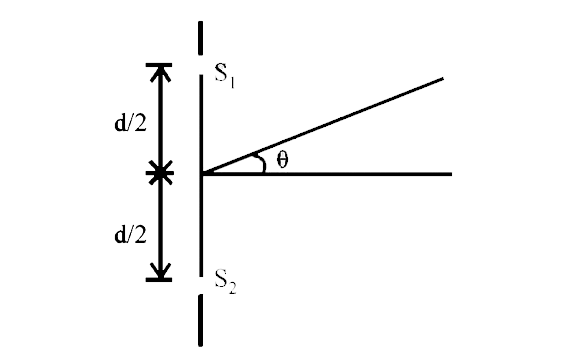
In an interference arrangement similar to Young's double-slit experiment, the slits S_1 and S_2 are illuminated with coherent microwave sources, each of frequency 10^6 Hz. The sources are synchronized to have zero phase difference. The slits are separated by a distance d=150.0 m. The intensity I (theta) is measured as a function of theta, where theta is defined as shown. If I_0 is the maximum intensity, then I (theta) for 0lethetale90degree is given by

A

`I(theta) = I_(0)//2 for theta = 45^(@)`

B

`I(theta) = I_(0)//4 fortheta = 90^(@)`

C

`I (theta) = I_(0) for theta = 0^(@)`

D

`I(theta)` is constant for all values of `theta`

Text Solution

Verified by Experts

The correct Answer is:

C

The intensity of light is `I(theta) = I_(0) cos^(@) ((delta)/(2))`
where `delta = (2pi)/(lambda) (Delta x) = ((2pi)/(lambda)) (d sin q)`
(i) For `theta = 30^(@)`
`lambda = (c )/(v) = (3xx10^(8))/(10^(6)) = 300 and d = 150 m`
`delta = ((2pi)/(300)) (150) ((1)/(2)) = (pi)/(2) (delta)/(2) = (pi)/(4)`
`I(theta) = I_(0) cos^(2) ((pi)/(4)) = (I_(0))/(2)` (option a)
(ii) For `0 = 90^(@) d = ((2pi)/(300)) (150) (1) = p`
or `(delta)/(2) = (pi)/(2) and I (theta) = 0`
(iii) For `theta = 0^(@), d = 0 or (delta)/(2) = 0`
`I(theta) = I_(0)` (option c)
Promotional Banner

Topper's Solved these Questions

  • WAVE OPTICS

    NARAYNA|Exercise LEVEL - VI|40 Videos
  • WAVE OPTICS

    NARAYNA|Exercise LEVEL - I(H.W)|20 Videos
  • WAVE OPTICS

    NARAYNA|Exercise NCERT Based Questions|25 Videos
  • SEMICONDUCTOR ELECTRONICS

    NARAYNA|Exercise ADDITIONAL EXERCISE (ASSERTION AND REASON TYPE QUESTIONS :)|19 Videos

Similar Questions

Explore conceptually related problems

In an interference arrangement similar to young's double slit experiment the slits S_(1) and S_(2) are illuminated with coherent microwave sources each of frequency 10^(6)Hz the sources are synchronized to have zero phase difference. the slits are separated by a distance d=150.0m. The intensity I(theta) is measured as a funtion of theta , where theta is defined as shown. if I_(0) is the maximum intensity then I(theta) for 0lethetale90^(@) is given by:

In an interference arrangement similar to double-slit experiment, S_(1) and S_(2) are illuminated with coherent source microwave source each of frequency 1 MHz. the sources are synchronized to have zero phase difference . This slits are separated by distance d = 150.0m The intensity I (theta) is measured as a funciton of theta , where theta is defined as shown in figure. If I_(0) is maximum intensity, calculate I (theta) For : a. theta = 0 b. theta = 30^(@) c. theta = 90^(@)

Consider an interference arrangement similar to YDSE. Slits S_(1) and S_(2) are illuminated with coherent microwave sources each of frequency 2 MHz. The sources are synchronised to have zero phase difference. The slits are separated by distance d= 75m. The intensity I_((theta)) is measured as a function of theta where theta is defined as shown in figure. if I_(0) is maximum intensity then calculated I_((theta)) for (i) theta= 0^(@), (ii) theta=pi//6 and (iii) theta = pi//2

In a interference arrangement similar to Young's double-slit experiment ,the slits S_(1) and S_(2) are illuminated with coheremt microwave source ,each of frequencies 10^(6) Hz.The source are syhronized to have zero phase difference.The slits are separated by a distance from S_(1) and S_(2) where theta is defined as shown if I_(0) is the maximum intensity then

In Young's double slit experiment, if the two slits are illuminated with separate sources, no interference pattern is observed because

In a Young’s double slit experiment, the source illuminating the slits is changed from blue to violet. The width of the fringes

In Young's double slit experiment, the ratio of maximum and minimum intensities in the fringe system is 9:1 the ratio of amplitudes of coherent sources is

In Young's double slit experiment, the intensity of central maximum is I . What will be the intensity at the same place if one slit is closed ?

S_(1) and S_(2) are two coherent sources of sound of frequency 110Hz each they have no initial phase difference. The intensity at a point P due to S_(1) is I_0 and due to S_2 is 4I_0 . If the velocity of sound is 330m//s then the resultant intensity at P is

NARAYNA-WAVE OPTICS-LEVEL - V
  1. In a modified YDSE, the region between the screen and slits is immerse...

    Text Solution

    |

  2. In the ideal double-slit experiment, when a glass-plate (refractive in...

    Text Solution

    |

  3. In an interference arrangement similar to Young's double-slit experime...

    Text Solution

    |

  4. In YDSE, bichromatic light of wavelengths 400 nm and 560 nm are used...

    Text Solution

    |

  5. Intensity obseverd in an interferecne pattern is I = I(0) sin^(2) thet...

    Text Solution

    |

  6. White light is used to illuminate the two slits in a Young's double sl...

    Text Solution

    |

  7. Two points nonochromatic and coherent sources of light of wavelength l...

    Text Solution

    |

  8. The minimum value of d os that there is a dark fringe at O is d(min). ...

    Text Solution

    |

  9. Fig. shows a surface XY separating two transparent media, medium 1 and...

    Text Solution

    |

  10. Fig. shows a surface XY separating two transparent media, medium 1 and...

    Text Solution

    |

  11. Fig. shows a surface XY separating two transparent media, medium 1 and...

    Text Solution

    |

  12. In the arrangement shown in Fig., slits S(1) and S(4)are having a vari...

    Text Solution

    |

  13. In the arrangement shown in Fig., slits S(1) and S(4)are having a vari...

    Text Solution

    |

  14. In the arrangement shown in Fig., slits S(1) and S(4)are having a vari...

    Text Solution

    |

  15. A monochromatic beam of light fall on YDSE apparatus at some angle (sa...

    Text Solution

    |

  16. A monochromatic beam of light falls on Young's double slit experiment ...

    Text Solution

    |

  17. A monochromatic beam of light falls on Young's double slit experiment ...

    Text Solution

    |

  18. Wave property of electron implies that they will show diffraction effe...

    Text Solution

    |

  19. Wave property of electron implies that they will show diffraction effe...

    Text Solution

    |

  20. Wave property of electrons implies that they will show diffraction eff...

    Text Solution

    |
