Home
Class 12
PHYSICS
In the arrangement shown in Fig., slits ...

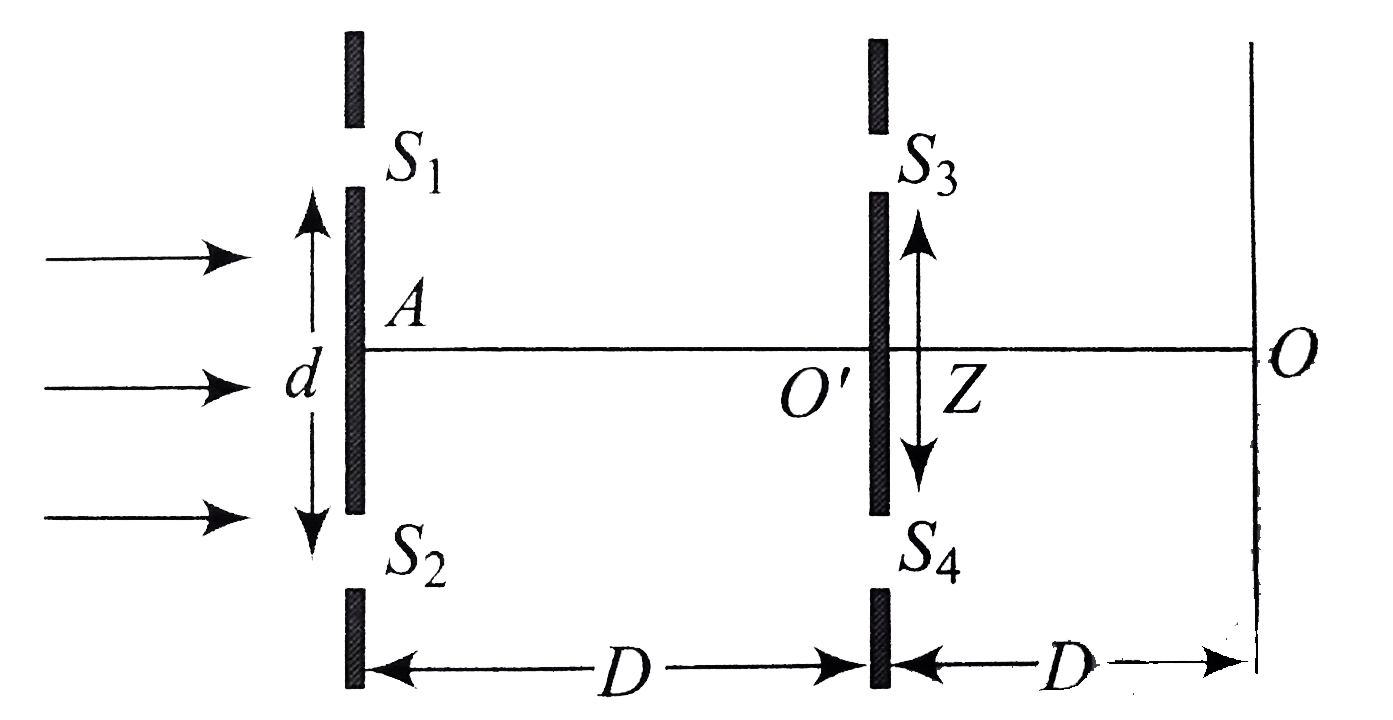
In the arrangement shown in Fig., slits `S_(1)` and `S_(4)`are having a variable separation Z. Point O on the screen is at the common perpendicular bisector of `S_(1) S_(2)` and `S_(3) S_(4)`.

If a hole is made at O' on AO' O and the slit `S_(4)` is closed, then the ratio of the maximum to minimum observed on screen at O , if `O' S_(3)` is equal to `(lambda D)/(4d)`, is

A

1

B

Infinity

C

34

D

4

Text Solution

Verified by Experts

The correct Answer is:

C

Intensity at `S_(3)` is
`I_(S_(3)) = A_(0)^(2)+ A_(0)^(2) + 2A_(0)^(2) cos phi`
Where `phi = (2pi)/(beta)xx(lambda D)/(4d) = (2pi)/(lambda D)xxdxx(lambda D)/(4d) = (pi)/(2)`
`I_(S_(3)) = 2A_(0)^(@)+2A_(0)^(2)cos phi`
`= 2A_(0)^(2)[1+cos phi] = 2 A_(0)^(2) [2cos^(2) (phi//2)]`
`I_(S_(3))= 4 A_(0)^(2) cos^(2) (phi//2) = 4A_(0)^(2)cos^(2) (pi//4)`
I_(S_(3)) = 4A_(0)^(2)xx(1)/(2) = 2 A_(0)^(2)`
Amplitude of wave at `S_(3) : A_(S_(1)) = sqrt(2) A_(0)`
Maximum intensity at `O' = (A_(0)+ sqrt(2)A_(0))`
Minimum intensity at `O = (sqrt(2) A_(0) -A_(0)-A_(0))^(2)`
`(I_(max))/(I_(min)) = [(A_(0)(sqrt(2)+1))/(A_(0)(sqrt(2)-1))]^(2) = [((sqrt(2)+1))/((sqrt(2)-1))xx(sqrt(2)+1)/(sqrt(2)-1)]^(2)`
`(I_(max))/(I_(min)) = [((sqrt(2)+1)^(2))/((sqrt(2)-1))]^(2) = (sqrt(2) + 1)^(4)`
`= (2+1+2sqrt(2))^(2) = (3+2sqrt(2))^(2)`
`= (3+2xx1.414)^(2) = (3+2.828)^(2)`
` = (5.828)^(2) = 34 , (I_(max))/(I_(min)) = 34`
Promotional Banner

Topper's Solved these Questions

  • WAVE OPTICS

    NARAYNA|Exercise LEVEL - VI|40 Videos
  • WAVE OPTICS

    NARAYNA|Exercise LEVEL - I(H.W)|20 Videos
  • WAVE OPTICS

    NARAYNA|Exercise NCERT Based Questions|25 Videos
  • SEMICONDUCTOR ELECTRONICS

    NARAYNA|Exercise ADDITIONAL EXERCISE (ASSERTION AND REASON TYPE QUESTIONS :)|19 Videos

Similar Questions

Explore conceptually related problems

In the arrangement shown in Fig., slits S_(1) and S_(4) are having a variable separation Z. Point O on the screen is at the common perpendicular bisector of S_(1) S_(2) and S_(3) S_(4) . The minimum value of Z for which the intensity at O is zero is

In the arrangement shown in Fig., slits S_(1) and S_(4) are having a variable separation Z. Point O on the screen is at the common perpendicular bisector of S_(1) S_(2) and S_(3) S_(4) . When Z = (lambda D)/(2d) , the intensity measured at O is I_(0) . The intensity at O When Z = (2 lambda D)/(d) is

In arrangement shown in figure, plane wavefront of monochromatic light of wavelength lamda is incident on identical slits S_(1) and S_(2) . There is another pair of indentical slits S_(3) and S_(4) which are having separation Z = (lamda D)/(2d) Point O is on the screen at the common perpendicular bisector of S_(1)S_(2) and S_(3) S_(4).I_(1) is the intensity at point O Now the board having slits S_(3)S_(4) is moved upward parallel to itself and perpendicular to line AO till slit S_(4) is on line AO and it is observed that now intensity at point O is I_(2) then (I_(2))/(I_(1)) is :

In the set up shown in figure, the two slits S_1 and S_2 are not equidistant from the slit S. The central fringe at O is then

Parallel monochromatic beam is falling normally on two slits S_(1) and S_(2) separated by d as shown in figure. By some mechanism, the separation between the slits S_(3) and S_(4) can be changed. The intensity is measured at the point P which is at the common perpendicular bisector of S_(1)S_(2) and S_(3)S_(4) . When z=(Dlambda)/(2d) , the intensity measured at P is I. and when z is equal to (4Dlambda)/(d) , Intensity is x l. Find x.

In the arrangement shown in the following figure, the wavelength of light used is lambda . The distance between slits S_(1) and S_(2) is d (« D). The distance between S_(3) and S_(4) is u=lambda D // 3d . If the ratio of maximum to minimum intensity observed on screen is k. Find k.

Consider the situation shown in fig. The two slits S_(1) and S_(2) placed symmetrically around the central line are illuminated by monochromatic light of wavelength lambda . The separation between the slit is d. The ligth transmitted by the slits falls on a screen S_(0) placed at a distance D form the slits. The slit S_(3) is at the central line and the slit S_(4) is at a distance z from S_(3) Another screen S_(c) is placed a further distance D away from S_(c) Find the ratio of the maximum to minimum intensity observed on S_(c) If z = (lambda D)/(4 d)

Consider the situation shown in fig. The two slits S_(1) and S_(2) placed symmetrically around the central line are illuminated by monochromatic light of wavelength lambda . The separation between the slit is d. The ligth transmitted by the slits falls on a screen S_(0) placed at a distance D form the slits. The slit S_(3) is at the central line and the slit S_(4) is at a distance z from S_(3) Another screen S_(c) is placed a further distance D away from S_(c) Find the ratio of the maximum to minimum intensity observed on S_(c) If z = (lambda D)/(2 d)

Consider the situation shown in fig. The two slits S_(1) and S_(2) placed symmetrically around the central line are illuminated by monochromatic light of wavelength lambda . The separation between the slit is d. The ligth transmitted by the slits falls on a screen S_(0) placed at a distance D form the slits. The slit S_(3) is at the central line and the slit S_(4) is at a distance z from S_(3) Another screen S_(c) is placed a further distance D away from S_(c) Find the ratio of the maximum to minimum intensity observed on S_(c) If z = (lambda D)/(d)

Consider the situation shown in figure-6.35. The two slits S_(1) and S_(2) placed symmetrically around the central line are illuminated by a monochromatic light of wavelength lambda . The separation between the slits is d. The light transmitted by the slits falls on a screen E_(1) placed at a distance D from the slits. The slit S_(3) is at the central line and the slit S_(4) is at a distance z from S_(3) . Another screen E_(2) is placed a further distance D away from E_(1) . Find the ratio of the maximum to minimum intensity observed on E_(2) if z is equal is : (a) (lambdaD)/(2d) " "(b) (lambdaD)/(d)" " (c )(lambdaD)/(4d)

NARAYNA-WAVE OPTICS-LEVEL - V
  1. Fig. shows a surface XY separating two transparent media, medium 1 and...

    Text Solution

    |

  2. Fig. shows a surface XY separating two transparent media, medium 1 and...

    Text Solution

    |

  3. Fig. shows a surface XY separating two transparent media, medium 1 and...

    Text Solution

    |

  4. In the arrangement shown in Fig., slits S(1) and S(4)are having a vari...

    Text Solution

    |

  5. In the arrangement shown in Fig., slits S(1) and S(4)are having a vari...

    Text Solution

    |

  6. In the arrangement shown in Fig., slits S(1) and S(4)are having a vari...

    Text Solution

    |

  7. A monochromatic beam of light fall on YDSE apparatus at some angle (sa...

    Text Solution

    |

  8. A monochromatic beam of light falls on Young's double slit experiment ...

    Text Solution

    |

  9. A monochromatic beam of light falls on Young's double slit experiment ...

    Text Solution

    |

  10. Wave property of electron implies that they will show diffraction effe...

    Text Solution

    |

  11. Wave property of electron implies that they will show diffraction effe...

    Text Solution

    |

  12. Wave property of electrons implies that they will show diffraction eff...

    Text Solution

    |

  13. A Young's double slit experiment is conducted with slit separation 10m...

    Text Solution

    |

  14. A Young's double slit experiment is conducted with slit separation 10m...

    Text Solution

    |

  15. A Young's double slit experiment is conducted with slit separation 10m...

    Text Solution

    |

  16. An inteference is observed due to two coherent sources A and B separat...

    Text Solution

    |

  17. Two coherent light sources, each of wavelength lambda, are separated b...

    Text Solution

    |

  18. In Young's experiment inteference bands are produced on the screen pla...

    Text Solution

    |

  19. In YDSE, the sources is red ligth of wavelength 7 xx 10^(-7) m. When a...

    Text Solution

    |

  20. In a modified Young's double-slit experiment, a monochromatic uniform ...

    Text Solution

    |
