Home
Class 11
CHEMISTRY
The aqueous solution of aluminium chlori...

The aqueous solution of aluminium chloride is acidic due to the

A

formation of `AI(OH)_(3)`

B

hydrolysis of cation and anion

C

hydrolysis of anion

D

hydrolysis of cation

Text Solution

Verified by Experts

The correct Answer is:
D

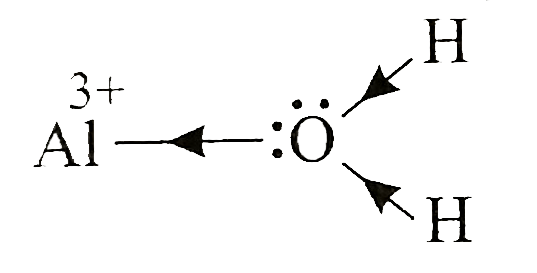
Salts that contain small, highly charged metal cations (for example, `AI^(3+), Cr^(3+), Fe^(3+), Bi^(3+)`, and `Be^(2+)`) and the conjugate bases of strong acids (e.g, `CI^(-))` produce an acidic solution because these cations hydrolyze to produce excess hydronium ions. Consider aluminium chloride `(AICI_(3))` as a typical example. When solid anhydrous `AICI_(3)` is added to water, the becomes very warm as the `AI^(3+)` ions become hydrated in solution to form the hydrated ion `[AI(H_(2)O)_(6)]^(3+)`. Each of these species is octahedral, meaning that the metal ion `(AI^(3+))` is located at the center of a regular octachedron, and the O atoms in six `H_(2)O` molecules are located at the corners. Consider one bond between the metal ion and the oxygen atom of one of the six water molecules in `[AI(H_(2)O)_(6)]^(3+)`:

The attraction of the small `AI^(3+)` ion for the lone pairs on the oxygen atoms is so greater that in the metal-oxygen bonds of the hydrated cation, electron density is decreased around the O end of each `H_(2)O` molecule (as `AI^(3+)` ion draws electron density towards itself). The O atom in turn draw electron density of the `O-H` bond toward itself. This weakens the O-H bonds in coordinated `H_(2)O` molecules relativer to the O-H bond in noncoordinated `H_(2)O` molecules. Consequently, the coordinated `H_(2)O` molecule `H_(2)O` molecule can donate `H^(+)` to the solvent `H_(2)O` molecules to form `H_(3)O^(+)` ions. This produces acidic solutions. The equation for the hydrolysis of hydrated `AI^(3+)` solutions. The equation for the hydrolysis of hydrated `AI^(3+)` is written as follows:
`[A(H_(2)O)_(6)]^(3_)(aq.)+H_(2)O(I)hArr[AI(OH)(H_(2)O)_(5)]^(2+)(aq.)H_(3)O^(+)(aq.)`
or simply `[AI(H_(2)O)_(6)]^(3+)(aq.)hArr[AI(OH)(H_(2)O)_(5)]^(2+)(aq.)+H^(+)(aq.)`
The hydrolysis of hydrated small, highly charged cations may occur beyound the first step, i.e., the `[AI(OH)(H_(2)O)_(5)]^(2+)` species can undergo further ionization as
`[AI(OH)(H_(2)O)_(5)^(2+)](aq.)hArr[AI(OH)_(2)O)_(4)]^(+)+H^(+)(aq.)` and so on. The extent of hydrlysis is the greatest for the smallest and most highly charges ions because a compact highly charged ion is more effective in polarizing the O-H bond and facilitating ionization. This is the reason that relatively large ions of low charge such as `Na^(+)` and `K^(+)` do not undergo hydrolysis.
Promotional Banner

Topper's Solved these Questions

  • EQUILIBRIUM

    R SHARMA|Exercise Follow-up Test 13|10 Videos
  • EQUILIBRIUM

    R SHARMA|Exercise Follow-up Test 14|12 Videos
  • EQUILIBRIUM

    R SHARMA|Exercise Follow-up Test 11|16 Videos
  • CLASSIFICATION OF ELEMENTS AND PERIODICITY IN ELEMENTS

    R SHARMA|Exercise ARCHIVES|37 Videos
  • GENERAL ORGANIC CHEMISTRY

    R SHARMA|Exercise Archives|36 Videos

Similar Questions

Explore conceptually related problems

Aluminium chloride is a/an

Aqueous solution of sodium chloride is called.

Of the following statements which is true? (i) Baeyer's process is employed for purification of bauxite containing silica (ii) All the Al-Cl bonds in Al_(2)Cl_(6) are equivalent (iii) An aqueous solution of aluminium chloride is acidic

The aqueous solution of potash alum is acidic due to hydrolysis of

Convey the following information in the form of balanced chemical equations (i) An aqueous of ferrous sulphate reacts with an aqueous solution of sodium hydroxide to form precipitate of ferrous hydroxide and sodium sulphate remains in solution. (ii) Potassium metal reacts with water to give potassium hydroxide solution and hydrogen gas is evolved in the reaction. (iii) Solid potassium chlorate upon heating forms potassium chloride and liberates oxygen gas. (iv) An aqueous solution of aluminium chloride reacts with an aqueous solution of ammonium hydroxide solution to form aluminium hydroxide and ammonium chloride.

