Home
Class 12
CHEMISTRY
Which of the following reaction of (S)-C...

Which of the following reaction of `(S)-CH_(3)CHD(OH)` proceeds with retention of configuration ?

A

Reaction with `HCl`

B

Reaction with `SOCl_(2)` in the presence of pyridine

C

Reaction with `SOCl_(2)` in a nonpolar solvent with no added base

D

both (1) and (2)

Text Solution

Verified by Experts

The correct Answer is:
C

The given alcohol is a `1^(@)` alcohol. With `HCl` , it undergoes `S_(N)2` mechanism . Thus , the product is `R` with inversion of configuration.
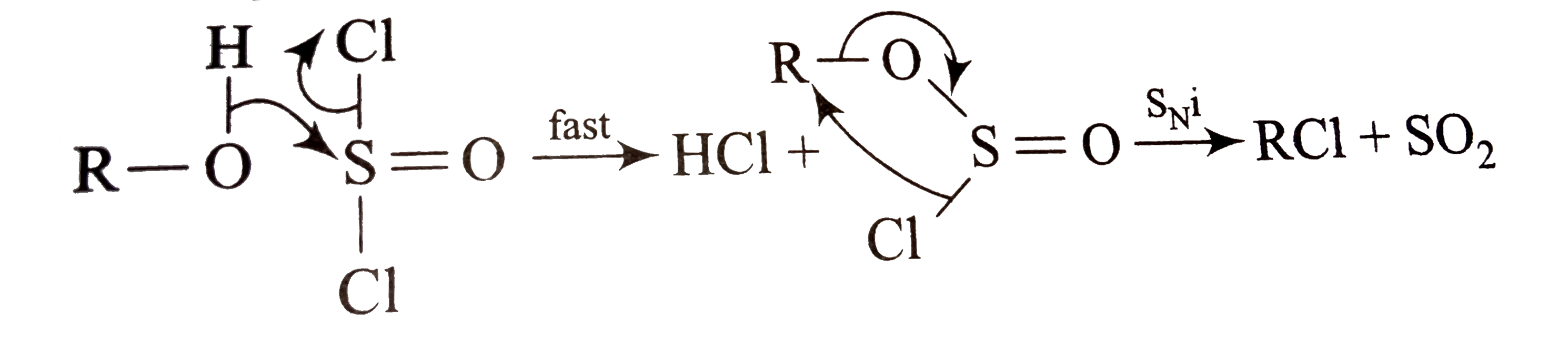
With `SOCl_(2)` , reaction proceeds via chlorosulphite. In the absence of base as pyridine, the reaction proceeds with retention of configuration , i.e.,`S_(N)i` type (subsitution , nucleopilic , internal):

In the presence of pyridine, the chloride has the inverted configuration as `S_(N)2` mechanism is operating through the involvement of a pyridine complex :
`ROSOCl + underset("Pyridine")(C_(5)H_(5)N)overset("fast")rarrCl^(-)+ROSOoverset(+)(N)C_(5)H_(5)underset(S_(N)2)overset("slow")rarr`
`[overset(delta-)(Cl)* * *R* * *overset(delta-)OSOoverset(+)NC_(5)H_(5)]overset("fast")rarrCl - R+SO_(2)+C_(5)H_(5)N`
Promotional Banner

Topper's Solved these Questions

  • ALCOHOL, PHENOL AND ETHERS

    R SHARMA|Exercise Follow -Up Test -7|10 Videos
  • ALCOHOL, PHENOL AND ETHERS

    R SHARMA|Exercise Follow -Up Test -8|8 Videos
  • ALCOHOL, PHENOL AND ETHERS

    R SHARMA|Exercise Follow -Up Test -5|14 Videos
  • AMINES

    R SHARMA|Exercise Archives|36 Videos

Similar Questions

Explore conceptually related problems

Find out number of reactions those proceed with retention of configuration.

Which of the following reactions cannot proceed by S_(N)1 mechaism ?

Which of the following compound will show retention in configuration on nucleophic substitution by OH^(-) ion ?

Consider the following statements : (1)Brideherated halides are inert towards both S_(N^(1)) and S_(N^(2)) reaction till one of the ring size is eoght member ring ) (2) The first step in both S_(N^(1)) and E_(1) reactions is the same (3) S_(N^(2)) reactions proceed with total retention of configuration (4) E_(2) elimination s are by the use of a solvent of low polarity and high concentration of a stromng base Which of the above statements are correct?

Consider the ollowing statement about SN^(1) reaction (i) it is a bimolecular reaction (ii) it proceeds with retention as well as inversion of the configuration. (iii) It involves the fomrationn of an intermediate cabocation (iv) The reaction is carried in the presence of polar aprotic solvents

R SHARMA-ALCOHOL, PHENOL AND ETHERS-Follow -Up Test -6
  1. (R ) -hexan -2-ol overset("conc.HX ") rarr under S(N)2 conditions t...

    Text Solution

    |

  2. The major product formed in the reaction CH(3)-underset(OH)underse...

    Text Solution

    |

  3. Trityl chloride (Ph(3)C Cl) is allowed to react with ethyl alcohol in ...

    Text Solution

    |

  4. Lucas reagent produces cloudiness immediately with

    Text Solution

    |

  5. What will be the order of reactivity of the following alcohols towards...

    Text Solution

    |

  6. By which of the following sequence of steps can the alcohol RCH(2)CH(...

    Text Solution

    |

  7. Ethyl alcohol is heated with conc.H(2)SO(4).The product formed is

    Text Solution

    |

  8. HBr reacts slowest with

    Text Solution

    |

  9. 3-Methylbutan-2-ol on reaction with HCl gives predominantly

    Text Solution

    |

  10. In the reaction CH(3)-underset(CH(3))underset(|)overset(CH(3))overse...

    Text Solution

    |

  11. Which of the following reaction of (S)-CH(3)CHD(OH) proceeds with rete...

    Text Solution

    |

  12. Which of th efollowing alcohols are excepted to react with hydrogen ha...

    Text Solution

    |

  13. Which of the following statements is not correct ?

    Text Solution

    |

  14. Which of the following reagents is preferred to synthesize neopentryl ...

    Text Solution

    |

  15. When but -3-en-2-ol reacts with aq HBr , we get

    Text Solution

    |

  16. The product of the reaction of Ph(2)CHCh(2)OH with HBr is

    Text Solution

    |

  17. Place the following alcohols in decreasing order of rate of dehydratio...

    Text Solution

    |

  18. Place the following benzyl alcohols in decreasing order of reaction ra...

    Text Solution

    |

