Home
Class 12
CHEMISTRY
Solutions of accurately known concentrat...

Solutions of accurately known concentrations are called

A

standard solutions

B

normal solutions

C

molar solution

D

perfect solutions

Text Solution

Verified by Experts

The correct Answer is:
1

Often we prepare solutions of substances and then determine their concentrations by titration with a standard solution.
Standardization is the process by which one determines the concentration of a solution by measuring accurately the volume of the solution required to react with an exactly known amount of a primary standard. The standardized solution is then known as a secondary standard and is used in the analysis of unknowns.
The properties of an ideal primary standard include the following:
1. It must not react with or absorb the components of the atmosphere, such as `CO_(2)(g), O_(2)(g) and H_(2)O` vapour.
2. It must react according to one invariable reaction
3. It must have a high percentage purity
4. It should have formula weight to minimize the effect of error in weighing.
5. It must be soluble in the solvent of interest
6. It should be nontoxic
7. It should be readily available (inexpensive).
8. It should be environmentally friendly
The first five of these characteristics are essential to minize the errors involved in analytical methods. The last three characteristics are just as important as the first five in most analytical labories. Because primary standards are often costly and difficult to prepare, secondary standards are often used in day-to-day work.
One primary standard for solutions of acids is sodium carbonate `(Na_(2)CO_(3))`, a solid compound. Sodium carbonate is basically a salt but in the following reaction
`H_(2)SO_(4)+Na_(2)CO_(3)rarrNa_(2)SO_(4)+CO_(2)+H_(2)O`
`Na_(2)CO_(3)` can be thought of as a base, because a base can be broadly defined as a substance that reacts with hydrogen ions.
Most inorgainc bases are metal hydroxides, all of which are solid. However, even in the solid state, most inorganic bases react rapidly with `CO_(2)` (an acid anhydride) from the atomosphere. Most metal hydroxides also absorb `H_(2)O` form the air. These properties make it very difficult to accurately weight out samples of pure metal hydroxides.
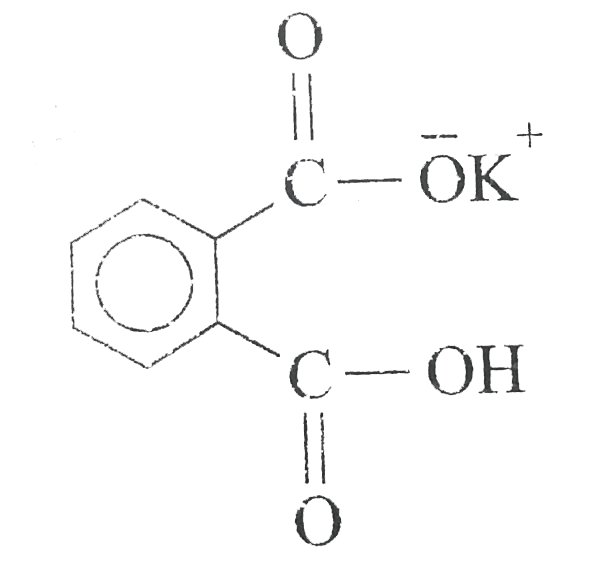
Chemists obtain solutions of bases of accurately known concentration by standardizing the solution against an acidic salt, potassium hydrogen phthalate:

This is produced by netralization of the two ionizable hydrogens of an organic acid, phthalic acid `(C_(6)H_(4))_(2)(COOH)_(2)`.
This acid salt, known simply as KHP, has one acidic hydrogen that reacts with bases. `KHP` is easily obtained in a high state of purity and and is soluble in water. It is used for a primary standard for bases.
Note that "ph" in phthalate is silent. Thus, phthalate is pronounced as "thalate". Also not that P in KHP stands for phthlate ion, `C_(6)H_(4)(COO)_(2)^(2-)`, not phosphorus.
Impure samples of acids can be titrated with standard solutions of bases. The results can be used to determine percentage purity of the samples.
Promotional Banner

Topper's Solved these Questions

Similar Questions

Explore conceptually related problems

A solution of known concentration is known as

In the laboratory we often measure the volume of one solution that is required to react with a given volume of another solution of known concentration. Then we calculate the concentration of the first solution. The process is called

Read the passage given below and answer the question: The cell constant is usually determined by measuring the resistance of the cell containing a solution whose conductivity is already known. For this purpose, we generally use KCl solutions whose conductivity is known accurately at various concentrations and at different temperatures. consider the resistance of a conductivity cell filled with 0.1 M KCl solution is 200 Ohm. if the resistance of the same cell when filled with 0.02 M KCl solution is 420 Ohm. (Conductivity of 0.1 M KCl solution is 1.29 S m^(-1) ). Q. SI unit for conductivity of a solution is

Read the passage given below and answer the question: The cell constant is usually determined by measuring the resistance of the cell containing a solution whose conductivity is already known. For this purpose, we generally use KCl solutions whose conductivity is known accurately at various concentrations and at different temperatures. consider the resistance of a conductivity cell filled with 0.1 M KCl solution is 200 Ohm. if the resistance of the same cell when filled with 0.02 M KCl solution is 420 Ohm. (Conductivity of 0.1 M KCl solution is 1.29 S m^(-1) ). Q. Which of the following is not true ? The conductivity of solutions of different electrolytes in the same solvent and at a given temperature differs due to

Read the passage given below and answer the question: The cell constant is usually determined by measuring the resistance of the cell containing a solution whose conductivity is already known. For this purpose, we generally use KCl solutions whose conductivity is known accurately at various concentrations and at different temperatures. consider the resistance of a conductivity cell filled with 0.1 M KCl solution is 200 Ohm. if the resistance of the same cell when filled with 0.02 M KCl solution is 420 Ohm. (Conductivity of 0.1 M KCl solution is 1.29 S m^(-1) ). Q. What is the conductivity of 0.02 M KCl solution ?

Read the passage given below and answer the question: The cell constant is usually determined by measuring the resistance of the cell containing a solution whose conductivity is already known. For this purpose, we generally use KCl solutions whose conductivity is known accurately at various concentrations and at different temperatures. consider the resistance of a conductivity cell filled with 0.1 M KCl solution is 200 Ohm. if the resistance of the same cell when filled with 0.02 M KCl solution is 420 Ohm. (Conductivity of 0.1 M KCl solution is 1.29 S m^(-1) ). Q. What will happen to the conductivity of the cell with the dilution ?

Read the passage given below and answer the question: The cell constant is usually determined by measuring the resistance of the cell containing a solution whose conductivity is already known. For this purpose, we generally use KCl solutions whose conductivity is known accurately at various concentrations and at different temperatures. consider the resistance of a conductivity cell filled with 0.1 M KCl solution is 200 Ohm. if the resistance of the same cell when filled with 0.02 M KCl solution is 420 Ohm. (Conductivity of 0.1 M KCl solution is 1.29 S m^(-1) ). Q. The cell constant of a conductivity cell_____.

Substances which behave as normal electrolytes in solution at low concentration and exhibit colloidal properties at higher concentration are called

R SHARMA-SOLUTIONS-QUESTION BANK (Building the knowledge)
  1. Molarity of K^(+) ions in 0.33 M potassium sulphate aqueous solution i...

    Text Solution

    |

  2. In the laboratory we often measure the volume of one solution that is ...

    Text Solution

    |

  3. Solutions of accurately known concentrations are called

    Text Solution

    |

  4. A solution is 0.150 mole fraction glucose (C(6)H(12)O(6)) and 0.850 mo...

    Text Solution

    |

  5. When an aqueous solution containing a nonvolatile solute freezes,

    Text Solution

    |

  6. The main ingredient of automobile antifreeze mixtures is

    Text Solution

    |

  7. The vapor pressure of acetone at 20^(@)C is 185 torr. When 1.2 g of a ...

    Text Solution

    |

  8. Consider separate solutions of 0.500 M C(2)H(5)OH(aq),0.100 M Mg(3)(PO...

    Text Solution

    |

  9. A compound H(2)X with molar mass of 80 g is dissolved in a solvent hav...

    Text Solution

    |

  10. The molarity of a solution obtained by mixing 750 mL of 0.5 (M) HCl wi...

    Text Solution

    |

  11. The degree of dissociation (alpha) of a weak electrolyte, A(x)B(y) is ...

    Text Solution

    |

  12. Ethylene glycol is used as an antifreeze in a cold cliamate Mass of et...

    Text Solution

    |

  13. The vapour pressure of water at 20^(@) is 17.5 mmHg. If 18 g of glucos...

    Text Solution

    |

  14. At 80^@C, the vapour pressure of pure liquid A is 520 mm Hg and that o...

    Text Solution

    |

  15. 25 mL of a solution of barium hydroxide on titration with 0.1 "molar" ...

    Text Solution

    |

  16. To neutralize completely 20 mL of 0.1M aqueous solution of phosphorus ...

    Text Solution

    |

  17. How many grams of a dibasic acid (mol. Mass 200) should be present in ...

    Text Solution

    |

  18. The vapour pressure of benzene at a certain temperature is 640 mm Hg. ...

    Text Solution

    |

  19. If solution containing 0.15 g of solute dissolved in 15 g of solvent b...

    Text Solution

    |

  20. The vapour pressure of a solvent decreased by 10 mm of Hg when a non-v...

    Text Solution

    |

