

Home
Class 12
PHYSICS
In the figure, CDEF is a fixed conductin...

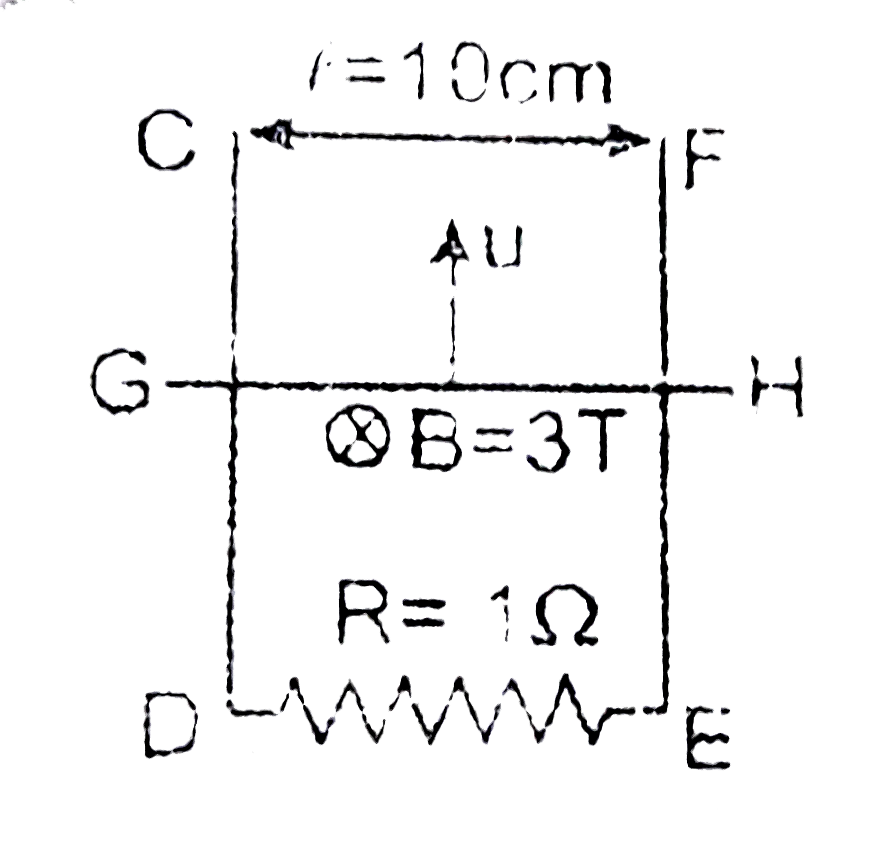
In the figure, `CDEF` is a fixed conducting smooth frame in vertical plane.A conducting uniform rod `GH` of mass `m=1 g` can move vertically and smoothly without losing contact with the frame.`GH` always remains horizontal.It is given velocity `u=1m//s` upwards and released.Taking the acceleration due to gravity as `g` and assuming that no resistance is present other than `R`.Time taken by rod to reach the highest point is equal to `(ln10)/x` second.Find out value of `x`.

Promotional Banner

Similar Questions

Explore conceptually related problems

CDEF is a fixed conducting smooth frame in vertical plane. A conducting uniform rod GH of mass m can move vertically and smoothly without losing contact with the frame. Gh always remains horizontal and is given velocity u upward and released. Taking the acceleration due to gravity as g and present other than R . Find out the time tasken by the rod to reach the highest point.

CDEF is a fixed conducting smooth frame in vertical plane. A conducting uniform rod GH of mass m can move vertically and smoothly without losing contact with the frame. Gh always remains horizontal and is given velocity u upward and released. Taking the acceleration due to gravity as g and present other than R . Find out the time tasken by the rod to reach the highest point.

A particle is projected vertically upwards from ground with velocity 10 m // s. Find the time taken by it to reach at the highest point ?

A particle is projected vertically upwards from ground with velocity 10 m // s. Find the time taken by it to reach at the highest point ?

A particle is projected vertically upwards from ground with velocity 10 m // s. Find the time taken by it to reach at the highest point ?

A body is projected vertically upward with an initial velocity u. If acceleration due to gravity is g, find the time for which it remains in air.

A uniform rod of mass m and length L is free to rotate in the vertical plane about a horizontal axis passing through its end. The rod initially in horizontal position is released. The initial angular acceleration of the rod is:

A ball is thrown vertically upwards. It goes to a height 20 m and then returns to the ground. Taking acceleration due to gravity g to be 10 "m s"^(-2) ?, find the final velocity of ball on reaching the ground