

Home
Class 11
PHYSICS
The velocity (u)-time (t) graph of an ob...

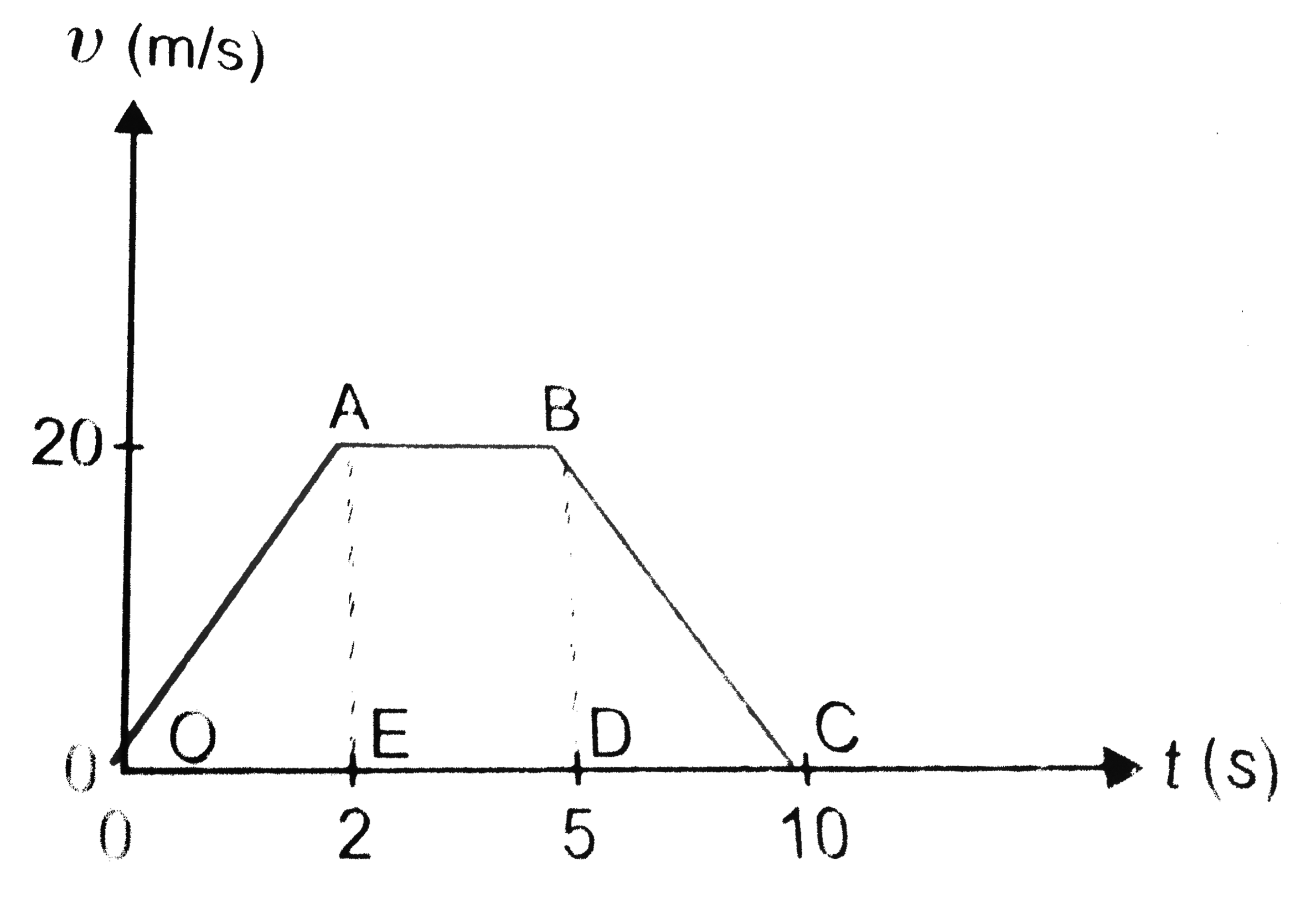
The velocity (u)-time (t) graph of an object moving alon a straight line is as shown is Fig. 2 (b) . 30. Calculate the distance covered by object between ` (i) t =0 to t=5 s` (ii) ` t=0 to t=10 s`.
.

Promotional Banner

Similar Questions

Explore conceptually related problems

The velocity-time graph of a particle moving along a straight line is shown id Fig. 2 (b) . 33. Calculate the distance covered between t= 0 to t= 10 seconds . Also find displacement tn time 0 to 10 seconds . .

The velocity-tiem graph of a particle movitgn along a straight line is shown in the Fig. 2 ( b) . 34 be curve OABCD . Calculate the distance covered by the particle between (i) t =zero to t=18 seconds (ii) t= 2 s to t= 12 s . And the maximum value of acceleration during this interval. .

The velocity-time graph of an object moving along a straight line is as shown in Fig. 3.37. Find the net distance covered by the object in time interval between t=0 to t=10s. Also find the displacement in time 0 to 10 s.

The velocity versus time graph of a body moving along a straight path is shown below. (i) Calculate the distance covered by the body from t=0 to t=8s. (ii) find its net displacement from t=0 to 8 s.

The velocity (v)-time (t) graph of a partide moving along a straight line is as shown in the figure. The displacement of the particle from t = 0 to t = 4 is

The position - time graph for a particle moving along a straight line is shown in figure. The total distance travelled by it in time t = 0 to t = 10 s is

The position - time graph for a particle moving along a straight line is shown in figure. The total distance travelled by it in time t = 0 to t = 10 s is

The speed-time graph of a particle moving along a fixed direction as shown in the figure. The distance traversed by the particle between t = 0 s to t = 10 s is