

Home
Class 12
PHYSICS
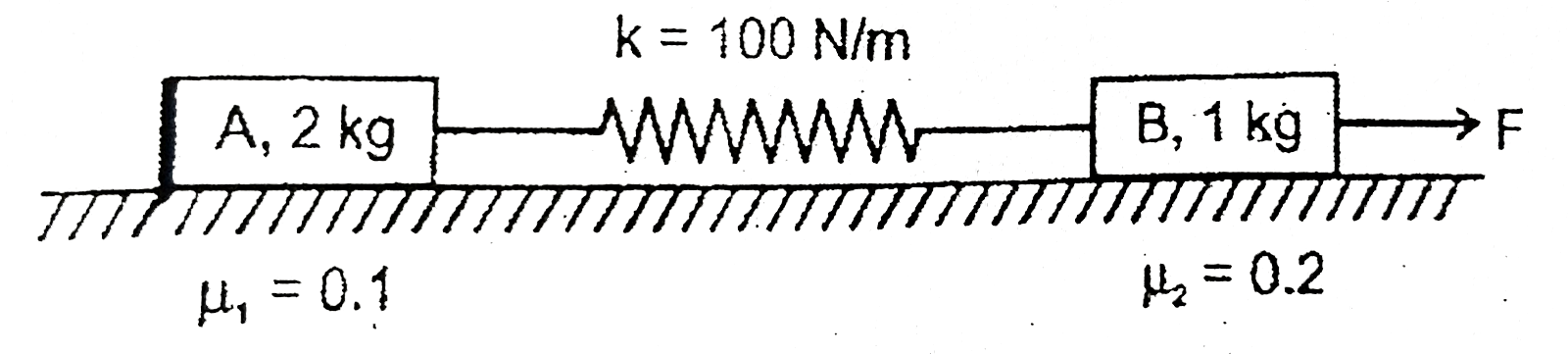
Initialy spring is in the natural length...

Initialy spring is in the natural length and blocks `A & B` are at rest. Find maximum value of constant force `F` that can be applied on `B` such that block `A` remains at rest. `(g = 10 m//s^(2))` (given answer in Newton)

Promotional Banner

Similar Questions

Explore conceptually related problems

Initialy spring in its natural length now a block at mass 0.25 kg is released then find out maximum force by system on floor ?

Initialy spring in its natural length now a block at mass 0.25 kg is released then find out maximum force by system on floor ?

The block is always at rest, the maximum force which can be applied for this is 24x. Find the value of x. Take g = 10 m//s^(2) {coefficient of friction = 0.3}

The block is always at rest, the maximum force which can be applied for this is 24x. Find the value of x. Take g = 10 m//s^(2) {coefficient of friction = 0.3}

Block A of mass m is placed on a plank B . A light support S is fixed on plank B and is attached with the block A with a spring of spring constant K. Consider that initialy spring is in the natural length, and the system is at rest. Find the maximum compression in the spring, if the plank B is moved with a constant acceleration 'a' . (All the surface are smooth) :

A block of mass m = 1 kg is kept pressed against a spring on a rough horizontal surface. The spring is compressed by 10 cm from its natural length and to keep the block at rest in this position a horizontal force (F) towards left is applied. It was found that the block can be kept at rest if 8 Nle F le 18 N . Find the spring constant (k) and the coefficient of friction (mu) between the block and the horizontal surface.

In the arrangement shown in figure, m_A = m_B = 2kg. String is massless and pulley is frictionless. Block B is resting on a smooth horizontal surface, while friction coefficient beteen block A and B is mu=0.5 . the Maximum horizontal force F that can be applied so that block A does not slip over block B is.

A block of mass 4 kg is placed on another block of mass 5 kg and the block B rests on a smooth horizontal table. If the maximum force that can be applied on A so that both the blocks move together is 12N, find the maximum force that can be applied on B for the blocks to move together.

A block of mass m is connected to a spring (spring constant k ). Initially the block is at rest and the spring is in its natural length. Now the system is released in gravitational field and a variable force F is applied on the upper end of the spring such that the downward acceleration of the block is given as a=g-alphat , where t is time elapses and alpha=1m//s^(2) , the velocity of the point of application of the force is: