

Home
Class 11
PHYSICS
In the previous problem, find the magnit...

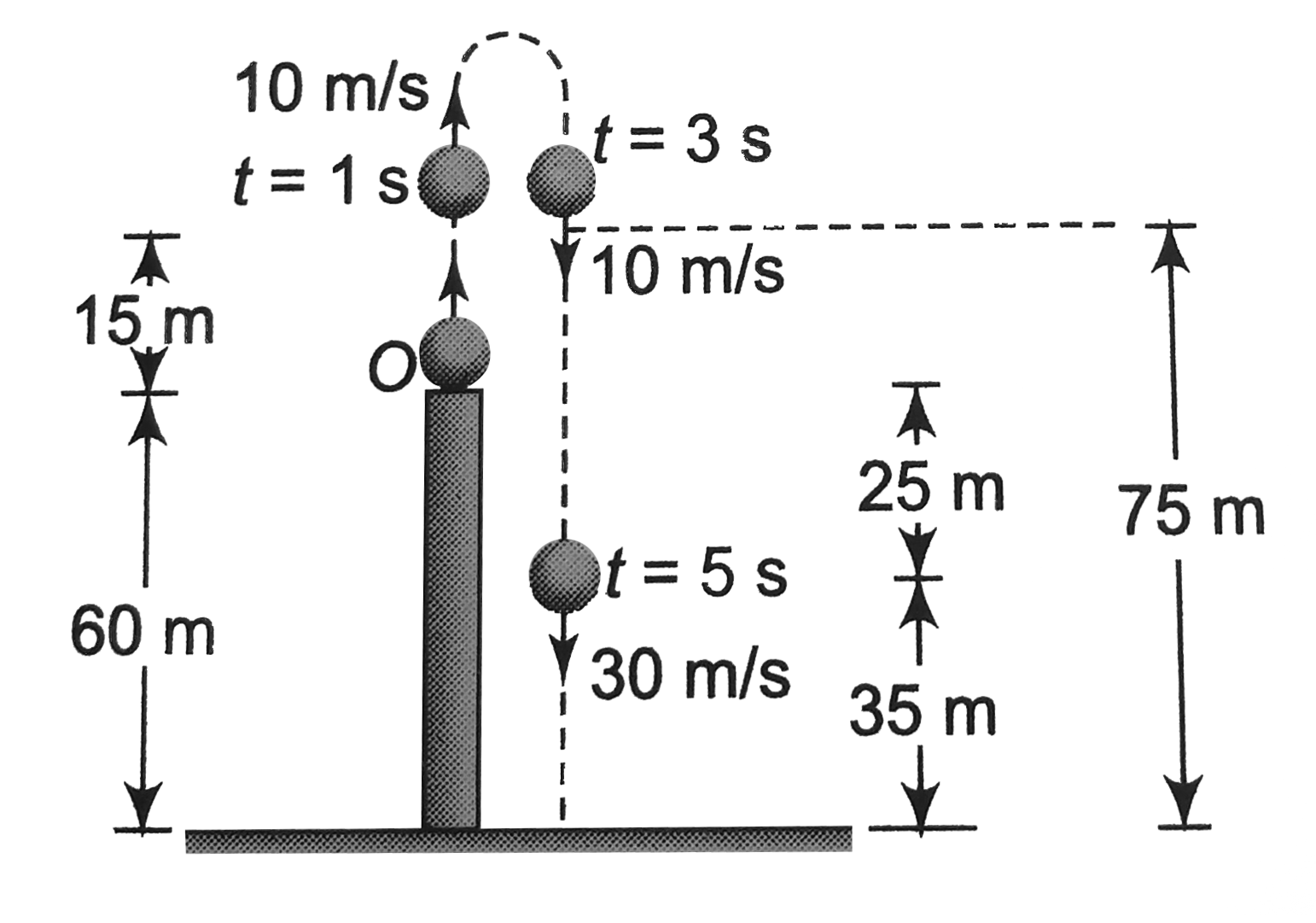
In the previous problem, find the magnitude and direction of velocity after `1 s, 3 s` and `5 s`. Also find the distance of the ball from the ground at these instances.

Text Solution

Verified by Experts

Continuing from the previous problem,
`v=u-g t=20-10t`
`h=ut-1/2g t^(2)=10t-5t^(2)`
(h is the displacement from the origin)
At `t=1 s`, `v=20-10xx1=10 m//s`, +ve velocity, i.e. ball is moving in upward direction.
At `h=20xx1-5xx1^2=15m`, +ve displacement, i.e. ball is `15 m` above the origin (top of the tower).
distance of ball above the ground `=60+15=75 m` (Height of tower= 60 m)
At `t=3 s, v=20-10xx3=-10 m//s`, -ve velocity, i.e. ball is moving in downward direction.
At `h=20xx3-5xx3^(2)=15 m`, +ve displacement, i.e. ball is `15 m` above the origin.
Distance of ball above the ground`=60+15=75 m`
At `t=5 s, v=20-10xx5=-30 m//s`, -ve velocity, i.e. ball is moving in downward direction.
At `h=20xx5-5xx5^(6)=-25 m`, -ve displacement, i.e. ball is `25 m` below the origin.
Distance of ball above the ground `=60-25=35 m`
Promotional Banner

Topper's Solved these Questions

  • MOTION IN A STRAIGHT LINE

    CP SINGH|Exercise EXERCISES|128 Videos
  • MOTION IN A PLANE

    CP SINGH|Exercise Exercises|69 Videos
  • NEET PREVIOUS YEAR

    CP SINGH|Exercise Solved Questions|64 Videos

Similar Questions

Explore conceptually related problems

The coordinates of a bird flying in the xy -plane are x = 2 - alpha t and y = beta t^(2) , where alpha = 3.6m//s and beta = 1.8 m//s^(2) . Calculate 'the velocity and acceleration vectors and their magnitude as a functions of time .Also find the magnitude and direction of bird's velocity and acceleration at t = 3.0s . From the given data can you find whether at this instant, bird is speeding up, speeding down or it is taking a turn. If so in which direction

A ball is thrown horizontally with speed 20 m//s from a tower of height 80 m . (a) After how much time and at what horizontal distance from the foot of tower it strikes the ground. (b) Find the magnitude and direction of the velocity with which it strikes the ground. ( c) Find the velocity vector of ball after 1 s . (d) Trajectory followed by the ball.

A particle travels with constant speed along a circle of radius 3 m and completes one revolution in 20 s . Starting with the lowest point as origin, find (a) the magnitude and direction of the displacement vectors 5 s, 7.5s and 10 s later , (b) the magnitude and direction of the displacement in the 5 s interval from the fifth to the lenth second, (c) average velocity in this interval, (d) the instantaneous velocity at the begining and at the end of the interval.

An object is moving with a uniform acceleration. Its velocity after 5 s 25 ms^(-1) and after 8 s is 34 ms^(-1) Find the distance travelled by the object in 10 th second.

In the previous problem , if the collision is head - on elastic , find (a) the velocities of balls immediately after the collision and (b) the maximum height attained by eacl ball.

In the previous problem if the car is moving with a constant acceleration of 2 m//s^(2) , the ball will fall behind the person at a distance

A ball falls from a height of 5 m and strikes a lift which is moving in the upward direction with a velocity of 1 m s^(-1) , then the velocity with which the ball rebounds after collision will be

An observer standing between two cliffs fires a gun. He hears one echo after 1.5 s and another after 3.5 s . If the speed of sound is 340 m//s , find. (a) the distance of the observer from the first cliff and. (b) distance between the cliffs.

CP SINGH-MOTION IN A STRAIGHT LINE-EXERCISES
  1. In the previous problem, find the magnitude and direction of velocity ...

    Text Solution

    |

  2. The ratio of the numerical values of the average velocity and average ...

    Text Solution

    |

  3. Which of the following is a one-dimensional motion ?

    Text Solution

    |

  4. A point traversed half a circle of radius r during a time interval t(0...

    Text Solution

    |

  5. A particle moves 3 m north, then 4 m east, and then 12 m vertically up...

    Text Solution

    |

  6. A person travelling on a straight line moves with a uniform velocity v...

    Text Solution

    |

  7. A car moves from X to Y with a uniform speed vu and returns to Y with ...

    Text Solution

    |

  8. A particle moves in a straight line from A to B (a) for the first ha...

    Text Solution

    |

  9. If a car covers (2)/(5)^(th) of the total distance with v1 speed and (...

    Text Solution

    |

  10. A car travels half the distance with a constant velocity of 40 m//s an...

    Text Solution

    |

  11. One car moving on a staright road covers one-third of the distance wit...

    Text Solution

    |

  12. A particle moving in a straight line covers half the distance with spe...

    Text Solution

    |

  13. A body starts from rest. What is the retio of the distance traveled by...

    Text Solution

    |

  14. A partical is moving in a straight line under constant acceletation. I...

    Text Solution

    |

  15. A particle is moving in a straight line under constant acceleration of...

    Text Solution

    |

  16. A body is moving with a uniform acceleration coverss 40 m in the first...

    Text Solution

    |

  17. A particle starts its motion from rest under the action of a constant ...

    Text Solution

    |

  18. A body travels for 15 s starting from rest with a constant acceleratio...

    Text Solution

    |

  19. A body moving with a uniform acceleration crosses a distance of 15 m i...

    Text Solution

    |

  20. A 150 m long train is moving with a uniform velocity of 45 km//h. The ...

    Text Solution

    |

  21. Speeds of two identical cars are u and 4u at at specific instant. The ...

    Text Solution

    |