Home
Class 11
PHYSICS
A car accelerates from rest at a constan...

A car accelerates from rest at a constant rate ` alpha ` for some time after which it decelerates at a constant rate ` beta` to come to rest. If the total time lapse is ` t` seconds , evauate.
(i) maximum velocity reached , and
(ii) the total distance travelled .

Text Solution

Verified by Experts
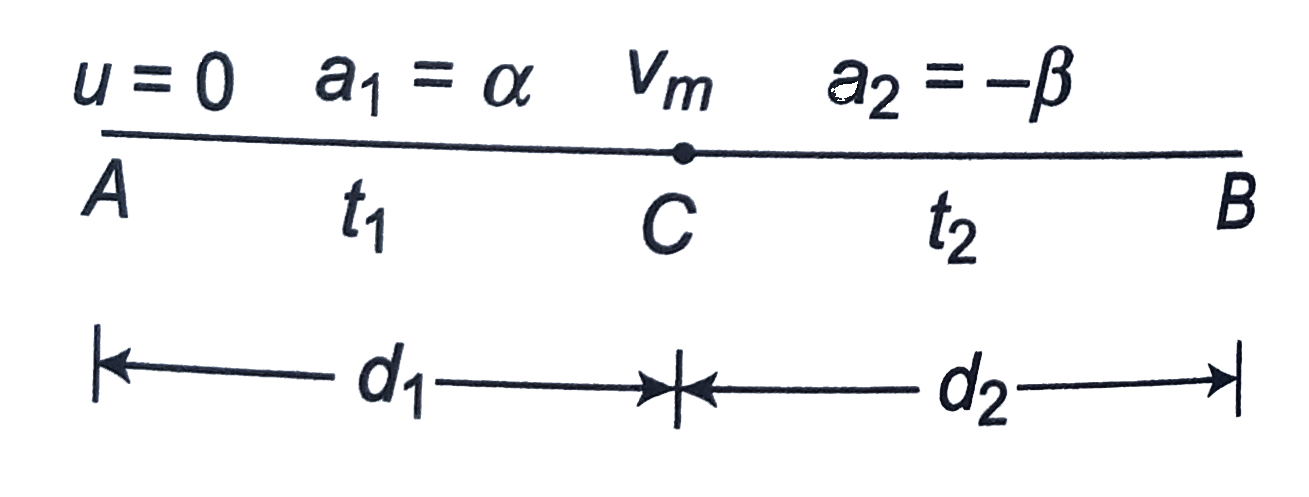

`t_(1)+t_(2)=t_(0),t_(2)=t_(0)-t_(1)`
`v_(m)`: Maximum velocity
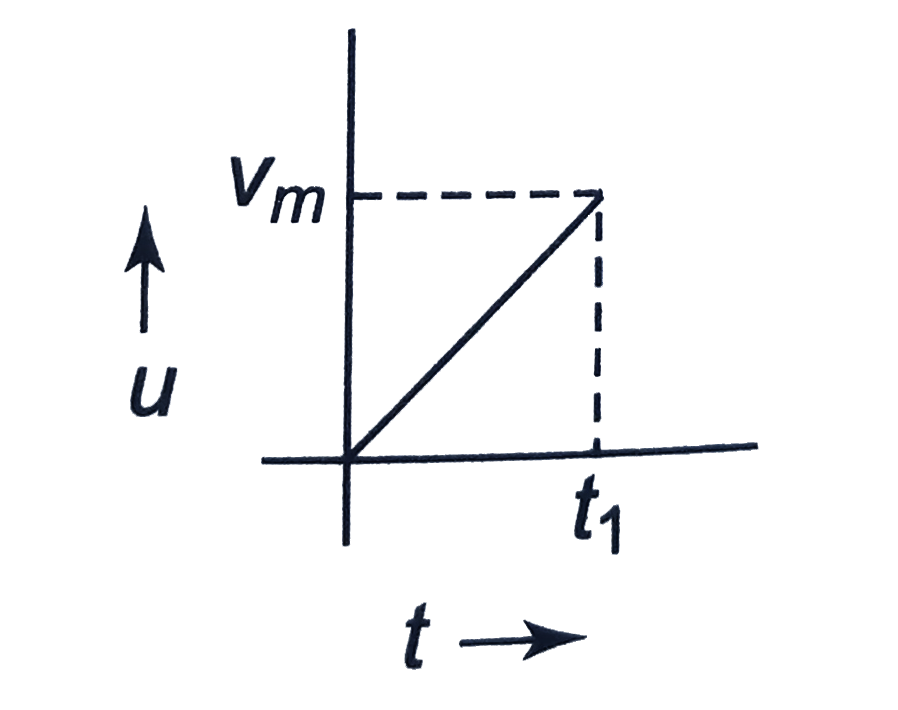
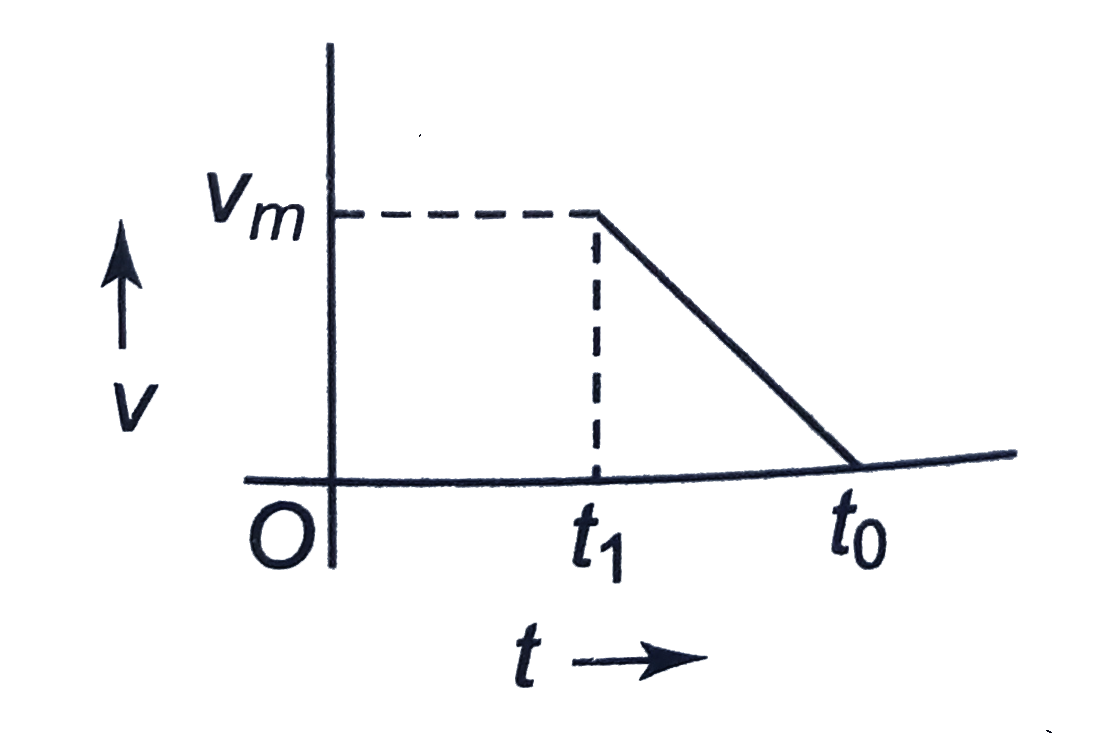
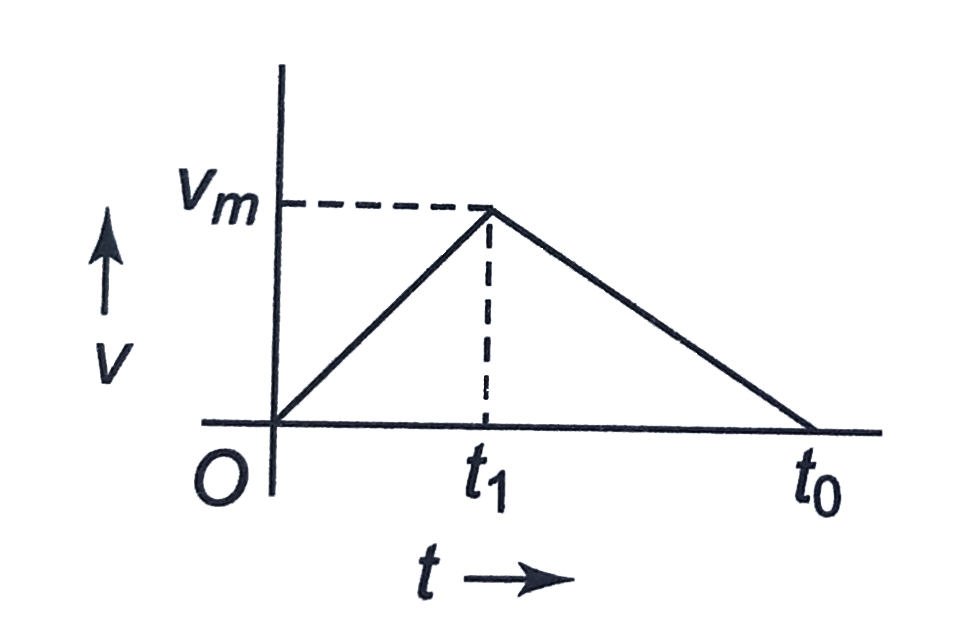
v-t graph:
`A` to `C`: `v=u+a t=0+alphat=alphat`
`t=0, v=0`
`t=t_(1), v=v_(m)`
Shape: `y=alphax` (straight line)

`C` to `B`: `v=u+at=v_(m)-betat`
`t=t_(1), v=v_(m)`
`t=t_(0), v=0`
Shape: `y=v_(m)-betax` (straight line)
`y=c+mx`
`c=v_(m)+ve`
`m=-beta, -ve`

A to B:

(a) Slope of the v-t graph gives acceleration
A to C: `v_(m)/t_(1)=alphaimpliest_(1)=v_(m)/alpha ...(i)`
C to B: `v_(m)/(t_(0)-t_(1))=betaimpliest_(0)-t_(1)=v_(m)/beta ...(ii)`
Adding (i) and (ii), we get
`t_(0)=v_(m)/alpha+v_(m)/betaimpliesv_(m)=(alphabetat_(0))/(alpha+beta)`
(Thought this part of the problem can be solved easily by analytical method, but here we want to show the procedure by graphical method.)
(b) Area of the v-t graph gives the displacement//distance.
`t=0 to t=t_(0)`, Area`=1/2 v_(m)t_(0)`
`=1/2(alphabetat_(0)^(2))/((alpha+beta))`=Distance
Promotional Banner

Topper's Solved these Questions

  • MOTION IN A STRAIGHT LINE

    CP SINGH|Exercise EXERCISES|128 Videos
  • MOTION IN A PLANE

    CP SINGH|Exercise Exercises|69 Videos
  • NEET PREVIOUS YEAR

    CP SINGH|Exercise Solved Questions|64 Videos

Similar Questions

Explore conceptually related problems

A car accelerates from rest at a constant rate alpha for some time, after which it decelerates at a constant rate beta, to come to rest. If the total time elapsed is t seconds. Then evalute (a) the maximum velocity reached and (b) the total distance travelled.

A car acceleration form rest at a constant rate alpha for some time, after which it decelerates at a constant rate beta , to come to rest. If the total time elapsed is t evaluate (a) the maximum velocity attained and (b) the total distance travelled.

A car accelerates from rest at a constant rate for some time after which it decelerates at a constant rate beta to come to rest. If the total time elapsed is t, the maximum velocity acquired by the car is given by :

A car accelerates from rest at a constant rate alpha for sometime , after which it decelerates at a constant rate beta and comes to rest. If T is the total time elapsed, the maximum velocity acquired by the car is

A car accelerates from rest at a constant rate alpha for some time, after which it decelerates at a constant rate beta and ultimately comes to rest.If the total time-lapse is t, what is the total distance described and maximum velocity reached ?

A bus accelerated from rest at a constant rate alpha for some time, after which it decelerates at a constant rate beta to come to rest. If the total time elapsed is t seconds. Then evaluate following parameters from the given graph (a) the maximum velocity achieved. (b) the total distance travelled graphically and (c) Average velocity.

A car accelerates from rest at acionstant rate 36 km h^@ to comet to rest. If the total time elapsed id 1 hour, calculate (i) the maximum velocity attained by the car and (ii) the total distance travelled by car.

A car accelerates from rest at a constant rate of 2 m s^(-2) for some time. The it retatds at a constant rate of 4 m s^(-2) and comes to rest. It remains in motion for 6 s .

A particle accelerates from rest at a constant rate for some time and attains a velocity of 8 m/sec. Afterwards it decelerates with the constant rate and comes to rest. If the total time taken is 4 sec, the distance travelled is

CP SINGH-MOTION IN A STRAIGHT LINE-EXERCISES
  1. A car accelerates from rest at a constant rate alpha for some time a...

    Text Solution

    |

  2. The ratio of the numerical values of the average velocity and average ...

    Text Solution

    |

  3. Which of the following is a one-dimensional motion ?

    Text Solution

    |

  4. A point traversed half a circle of radius r during a time interval t(0...

    Text Solution

    |

  5. A particle moves 3 m north, then 4 m east, and then 12 m vertically up...

    Text Solution

    |

  6. A person travelling on a straight line moves with a uniform velocity v...

    Text Solution

    |

  7. A car moves from X to Y with a uniform speed vu and returns to Y with ...

    Text Solution

    |

  8. A particle moves in a straight line from A to B (a) for the first ha...

    Text Solution

    |

  9. If a car covers (2)/(5)^(th) of the total distance with v1 speed and (...

    Text Solution

    |

  10. A car travels half the distance with a constant velocity of 40 m//s an...

    Text Solution

    |

  11. One car moving on a staright road covers one-third of the distance wit...

    Text Solution

    |

  12. A particle moving in a straight line covers half the distance with spe...

    Text Solution

    |

  13. A body starts from rest. What is the retio of the distance traveled by...

    Text Solution

    |

  14. A partical is moving in a straight line under constant acceletation. I...

    Text Solution

    |

  15. A particle is moving in a straight line under constant acceleration of...

    Text Solution

    |

  16. A body is moving with a uniform acceleration coverss 40 m in the first...

    Text Solution

    |

  17. A particle starts its motion from rest under the action of a constant ...

    Text Solution

    |

  18. A body travels for 15 s starting from rest with a constant acceleratio...

    Text Solution

    |

  19. A body moving with a uniform acceleration crosses a distance of 15 m i...

    Text Solution

    |

  20. A 150 m long train is moving with a uniform velocity of 45 km//h. The ...

    Text Solution

    |

  21. Speeds of two identical cars are u and 4u at at specific instant. The ...

    Text Solution

    |