

Home
Class 11
PHYSICS
A rocket is launched from the suface of ...

A rocket is launched from the suface of the earth vertically upward from rest. It moves under acceleration `8 m//s^(2)`. After 15 s the fuel is finished, the rocket moves under gravity and ultimately strickes the ground. Assuming upward direction position and launching point as the origin, sketch the v-t, s-t and a-t graph.

Text Solution

Verified by Experts

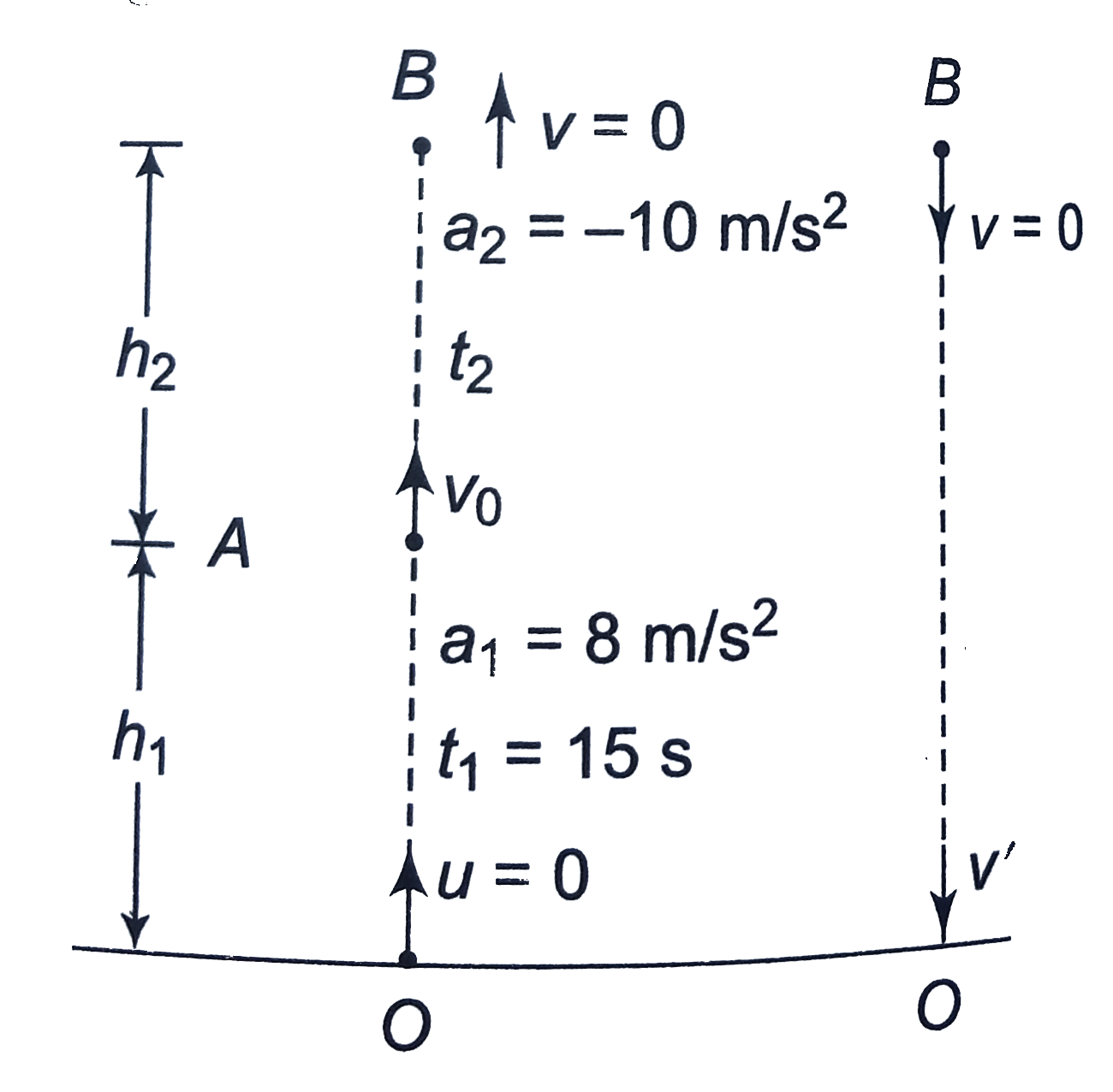
Here the motion is in two parts: first acceleration and then motion under gravity.

Acceleration motion
O to A: `h_(1)=0+1/2a_(1)t_(1)^(2)=1/2xx8xx(15)^(2)=900 m`
A to O through B
A: Origin
Displacement`=-900 m`
`S=ut-1/2 at^(2)`
`-900=v_(0)t_(2)-1/2 a^(2)t_(2)^(2)=120 t_(2)-5t_(2)^(2)`
`t_(2)^(2)-24t_(2)-180=0`
`t_(2)=(24+-sqrt((-24)^(2)-4(1)(-180)))/2`
`=(24+-36)/2`
`t_(2)=30 s`, the rocket will strike the ground after 30 s (after the fuel is finished)
`v^(')=u-g t_(2)`
`=v_(0)-g t_(2)`
`=120-10xx30=-180 m//s`
The velocity of the rocket will be zero after time `t_(3)`. So,
`0=120-10t_(3)impliest_(3)=12 s`
To obtain the maximum height attained by the rocket above A, we have
`0=(v_(0))^(2)-2xx10xxh_(2)impliesh_(2)=720 m` at time
`t^(')=12 s`
Total time of journey `=15+30=45 s`
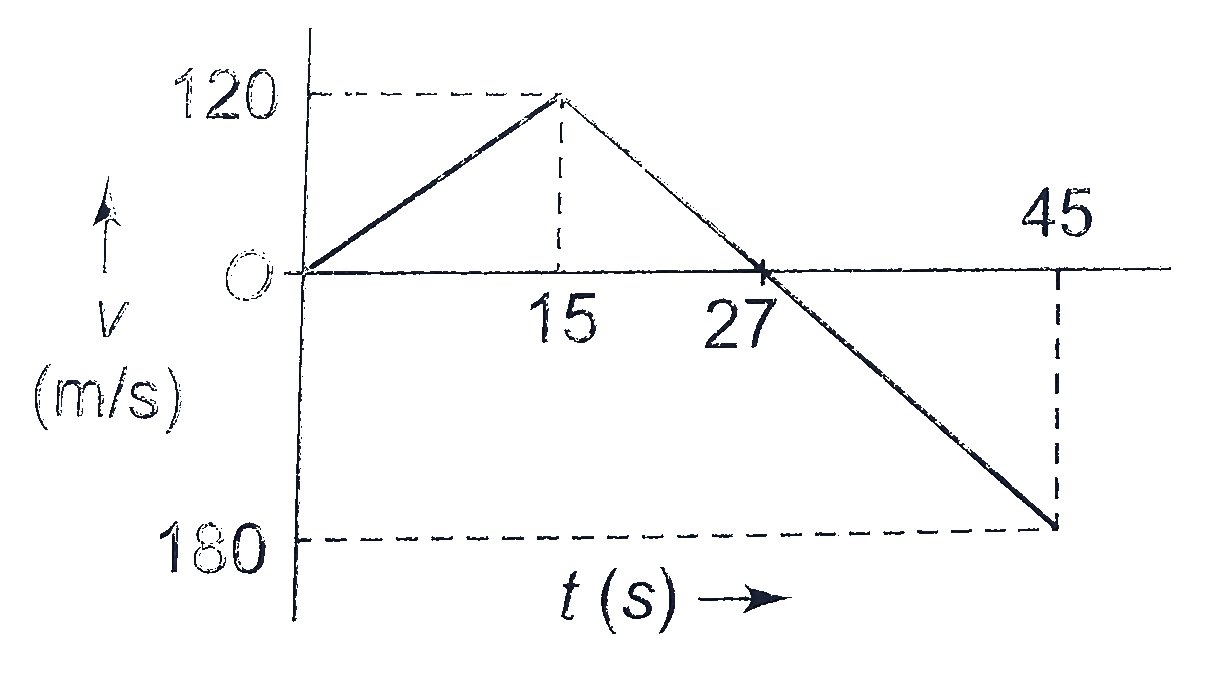
v-t graph
`t=0, v=0`
`t=15 s, v=120 m//s`
`t=27 s, v=0`
`t=45 s, v=-180 m//s`
`t=0` to `t=15 s`, `v=8t` (straight line)
`t=15` to `t=45s`
`v=120-10(t-15)` (straight line) `[15 s lt = t lt = 45 s]`

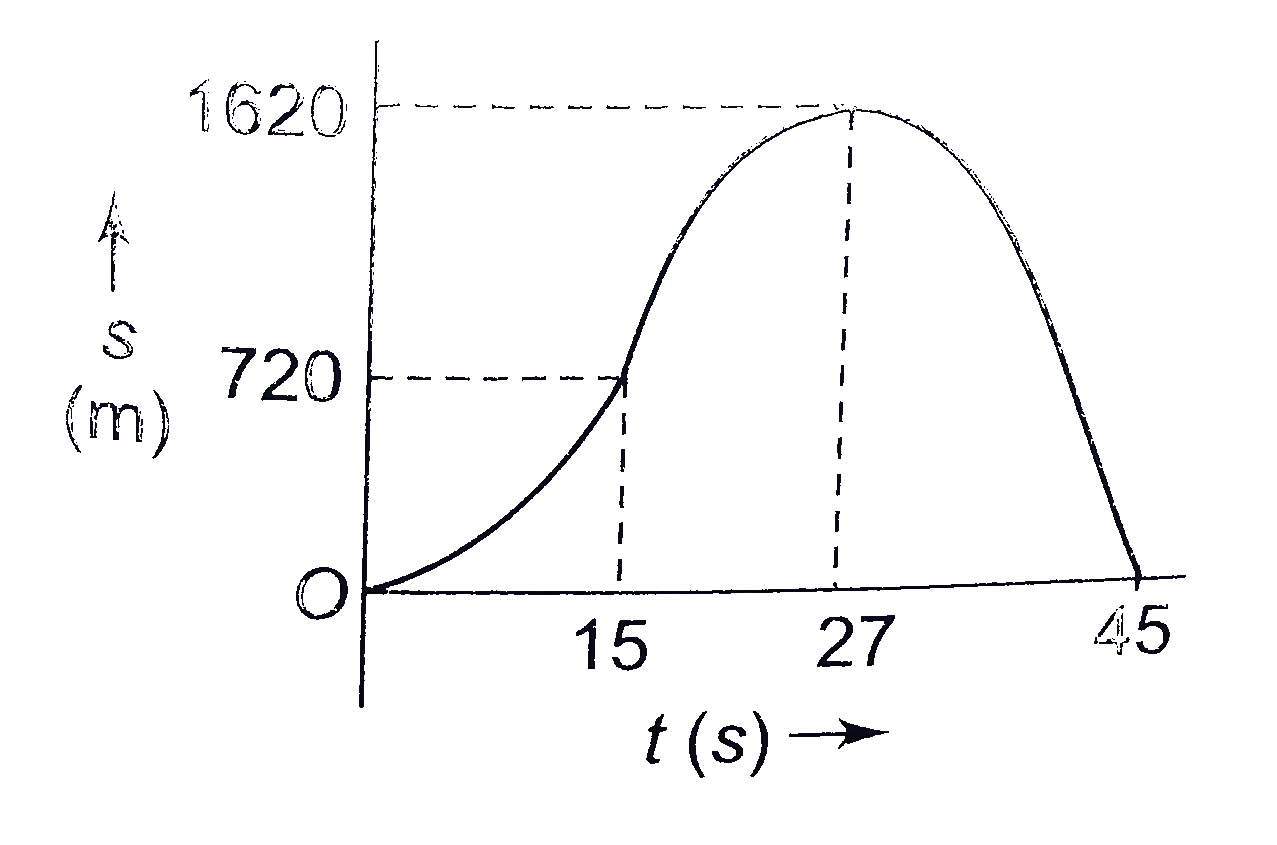
s-t graph
`t=0, s=0`
`t=15 s, s=900 m`
`t=27 s, s, s=900+720=1620 m`
`t=45 s, s=0`
`t=0` to `t=15 s`, `s=1/2 a_(1)t^(2) implies s=4t^(2)`
Shape: `y=4x^(2)` (parabola, open upward)
`t=15 to 45 s`
`s=900+v_(0)(t-15)-1/2a_(2)(t-15)^(2)`
`=900+120(t-15)-5(t-15)^(2)`
Shape: `y=900+120x-5x^(2)` (parabola, open downward)
Promotional Banner

Topper's Solved these Questions

  • MOTION IN A STRAIGHT LINE

    CP SINGH|Exercise EXERCISES|128 Videos
  • MOTION IN A PLANE

    CP SINGH|Exercise Exercises|69 Videos
  • NEET PREVIOUS YEAR

    CP SINGH|Exercise Solved Questions|64 Videos

Similar Questions

Explore conceptually related problems

A rocket is fired vertically upwards and moves with net acceleration of 10 m//s^(2) . After 1 min the fuel is exhausted. The time taken by it to reach the highest point after the fuel is exhausted will be:

A particle starts from rest and moves with an acceleration of a={2+|t-2|}m//s^(2) The velocity of the particle at t=4 sec is

A balloon starts rising from ground from rest with an upward acceleration 2m//s^(2) . Just after 1 s, a stone is dropped from it. The time taken by stone to strike the ground is nearly

A rocket is fired vertically from the ground. It moves upwards with a constant acceleration 10m//s^(2) after 30 sec the fuel is finished. After what time from the instant of firing the rocket will attain the maximum height? g=10m//s^(2) :-

A rocket is fired upward from the earth's surface such that it creates an acceleration of 20 m//s^(2) . If after 5 s its engine is switched off, the maximum height of the rochet from the earth's surface would be

A particle is dropped from the top of a tower of height 80 m. Assuming the dropping point as the origin and the downward direction position, sketch v-t, s-t and a-t graph. (g=10 m//s^(2))

A rocket is fired vertically upward from the ground with a resultant vertical acceration of 5 m//s^(2) . The fuel is finished in 100 s and it continues to move up. After how much time from then will the maximum height be reached and what is the maximum height?

The maximum height is reached is 5s by a stone thrown vertically upwards and moving under the equation 10s=10ut-49t^(2) , where s is in metre and t is in second. The value of u is

CP SINGH-MOTION IN A STRAIGHT LINE-EXERCISES
  1. A rocket is launched from the suface of the earth vertically upward fr...

    Text Solution

    |

  2. The ratio of the numerical values of the average velocity and average ...

    Text Solution

    |

  3. Which of the following is a one-dimensional motion ?

    Text Solution

    |

  4. A point traversed half a circle of radius r during a time interval t(0...

    Text Solution

    |

  5. A particle moves 3 m north, then 4 m east, and then 12 m vertically up...

    Text Solution

    |

  6. A person travelling on a straight line moves with a uniform velocity v...

    Text Solution

    |

  7. A car moves from X to Y with a uniform speed vu and returns to Y with ...

    Text Solution

    |

  8. A particle moves in a straight line from A to B (a) for the first ha...

    Text Solution

    |

  9. If a car covers (2)/(5)^(th) of the total distance with v1 speed and (...

    Text Solution

    |

  10. A car travels half the distance with a constant velocity of 40 m//s an...

    Text Solution

    |

  11. One car moving on a staright road covers one-third of the distance wit...

    Text Solution

    |

  12. A particle moving in a straight line covers half the distance with spe...

    Text Solution

    |

  13. A body starts from rest. What is the retio of the distance traveled by...

    Text Solution

    |

  14. A partical is moving in a straight line under constant acceletation. I...

    Text Solution

    |

  15. A particle is moving in a straight line under constant acceleration of...

    Text Solution

    |

  16. A body is moving with a uniform acceleration coverss 40 m in the first...

    Text Solution

    |

  17. A particle starts its motion from rest under the action of a constant ...

    Text Solution

    |

  18. A body travels for 15 s starting from rest with a constant acceleratio...

    Text Solution

    |

  19. A body moving with a uniform acceleration crosses a distance of 15 m i...

    Text Solution

    |

  20. A 150 m long train is moving with a uniform velocity of 45 km//h. The ...

    Text Solution

    |

  21. Speeds of two identical cars are u and 4u at at specific instant. The ...

    Text Solution

    |