

Home
Class 12
PHYSICS
Find the net electric force on charge q ...

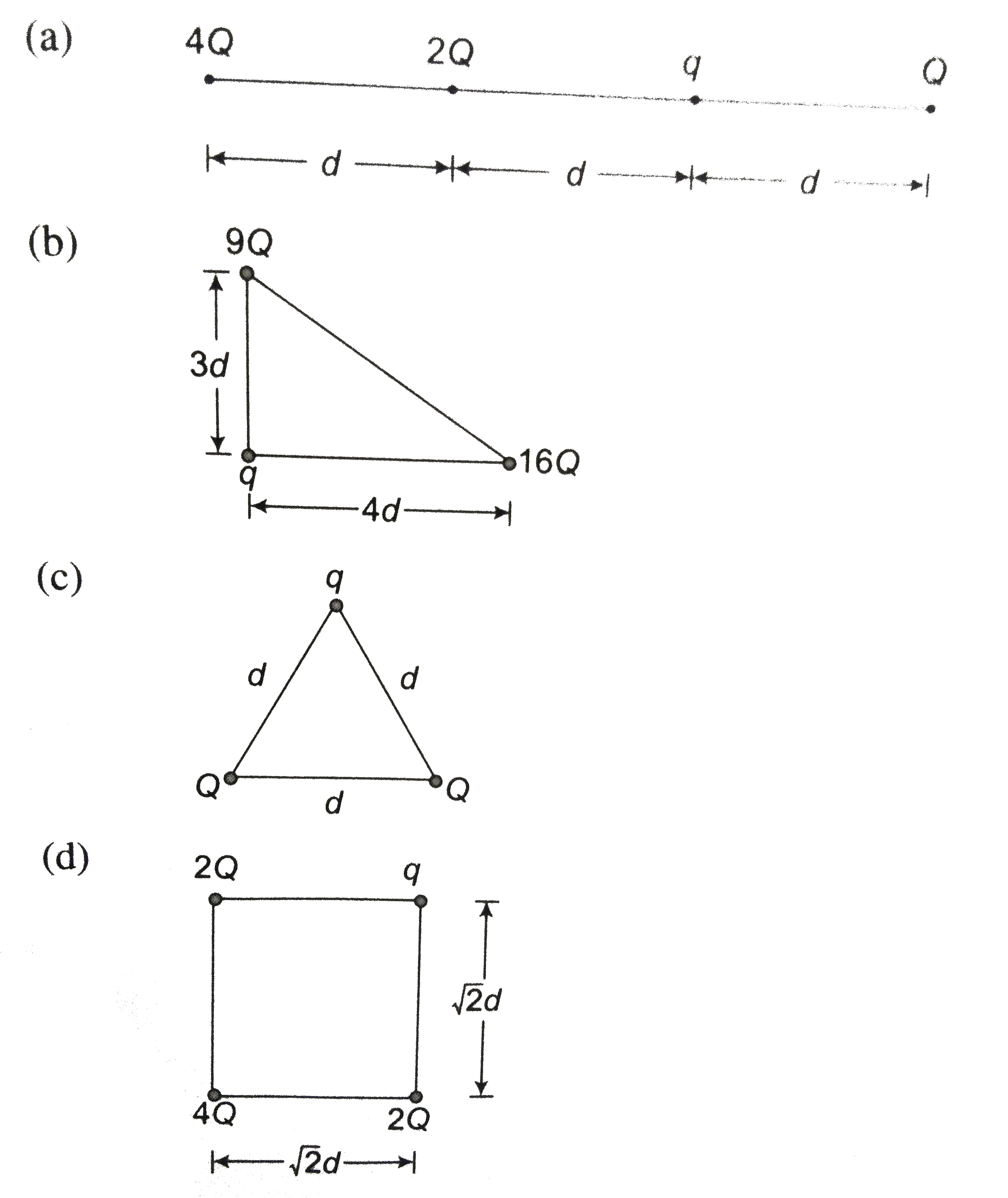
Find the net electric force on charge `q` in the following cases , take `(1)/(4 pi in_(0)) (Qq)/(d^(2)) = F_(0)`.
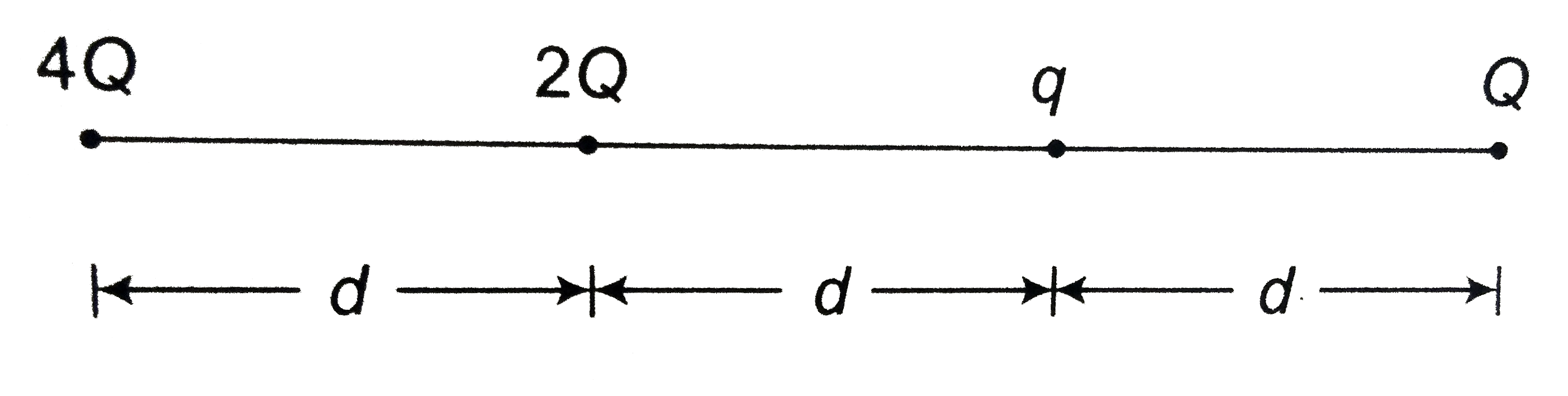
(a)
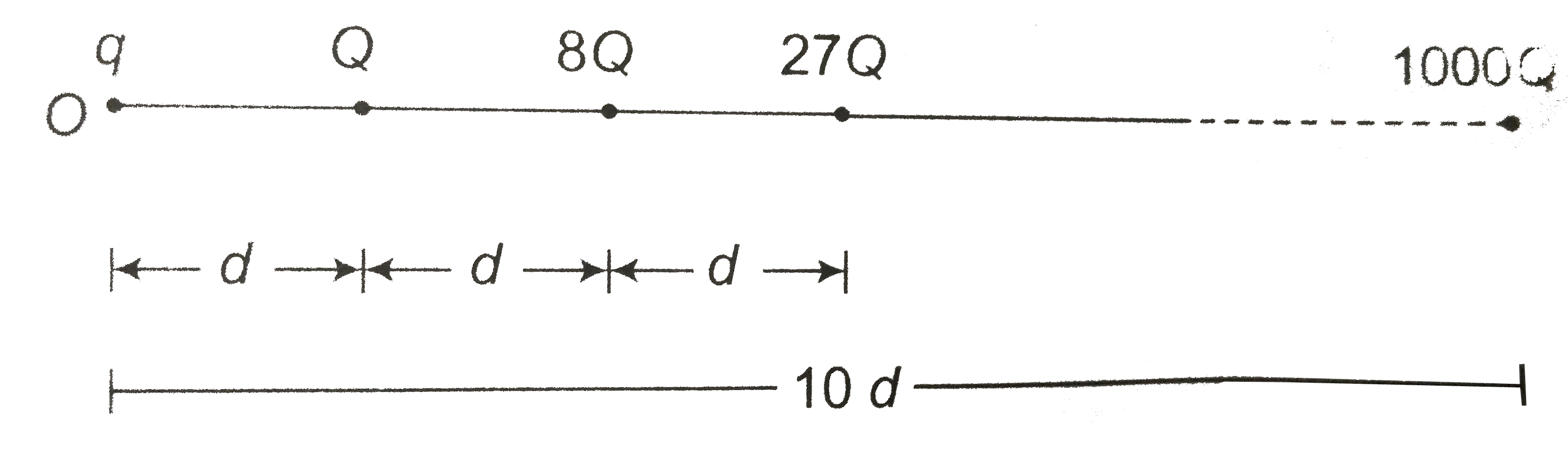
(e) The point charges `Q , 80 Q , 27 Q ,... , 1000 Q` are placed at `x = d , 2d , 3d , .... , 10 d`. A point charge `q` is placed at origin.

Text Solution

Verified by Experts

Electric force on `q`:
Due to `4 Q , F_(1) = (1)/( 4 pi in_(0)) (4 Qq)/((2d)^(2)) = F_(0)`, towards right
Due to `2 Q, F_(2) = (1)/( 4 pi in_(0)) (2 Qq)/(d^(2)) = 2 F_(0)` , towards right
Due to `Q , F_(3) = (1)/( 4 pi in_(0)) (Qq)/(q^(2)) = F_(0)` , towards left
Resultant force on `q`:
`F = F_(1) + F_(2) - F_(3) = F_(0) + 2 F_(0) - F_(0) = 2 F_(0)` , towards right
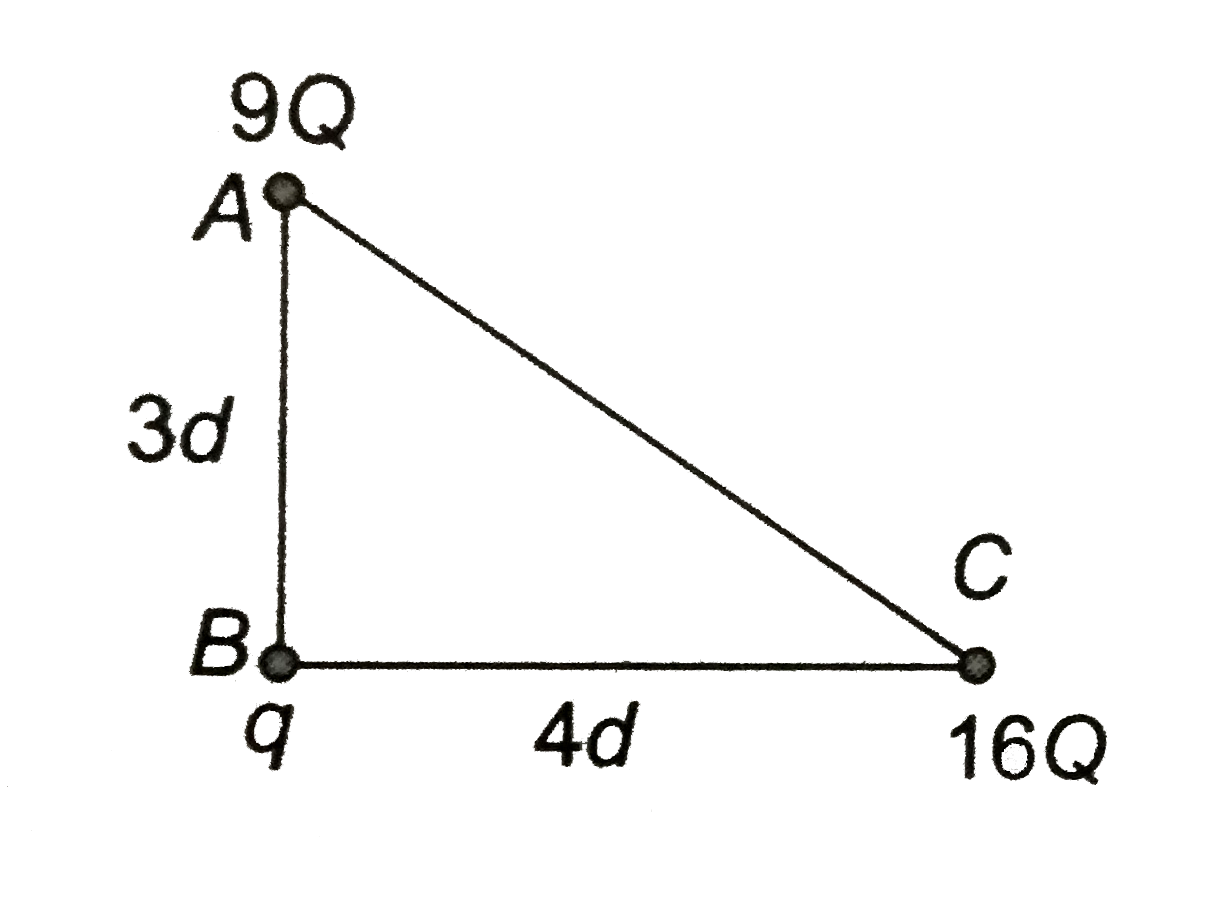
(b) Electric force on `q` :
Due to `9 Q, F_(1) = (1)/( 4 pi in_(0)) (9 Qq)/((3d)^(2)) = F_(0)`, along `AB`
Due to `16 Q , F_(2) = (1)/(4 pi in_(0)) (16 Qq)/((4 d)^(2)) = F_(0)`, along `CB`
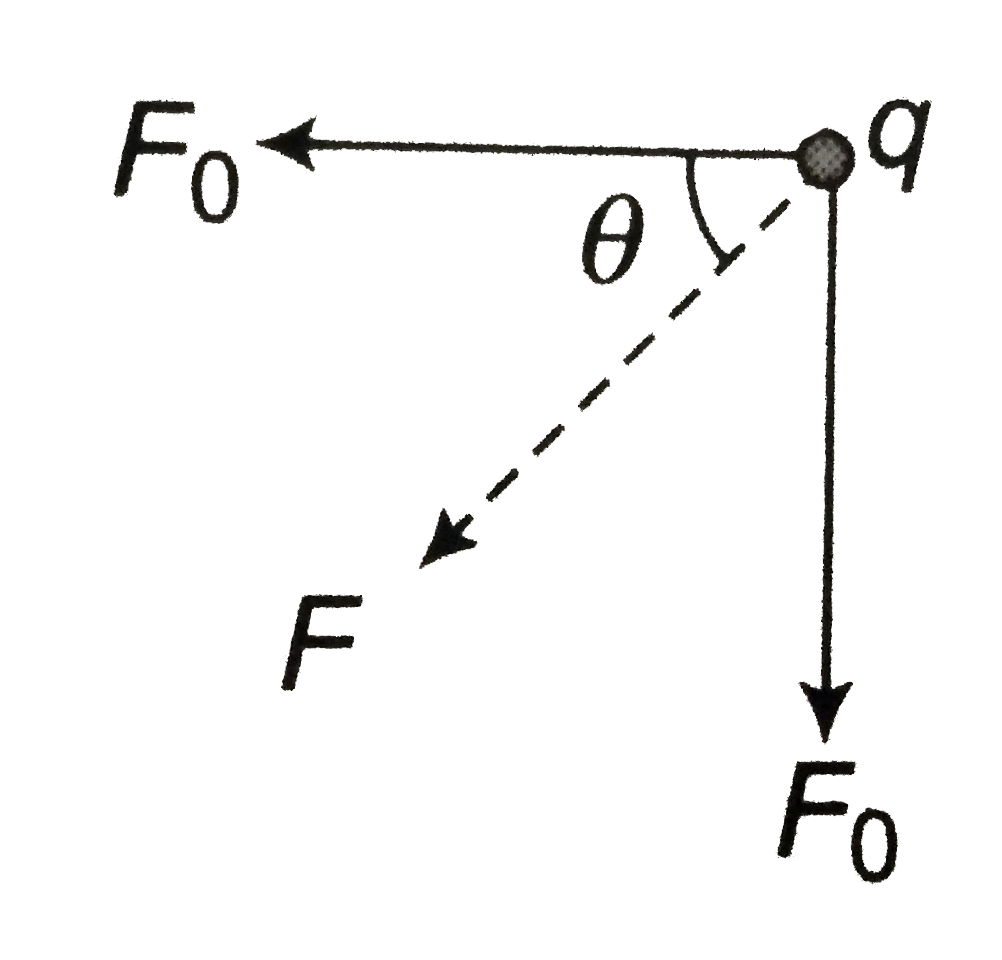
Resultant force on `q`:
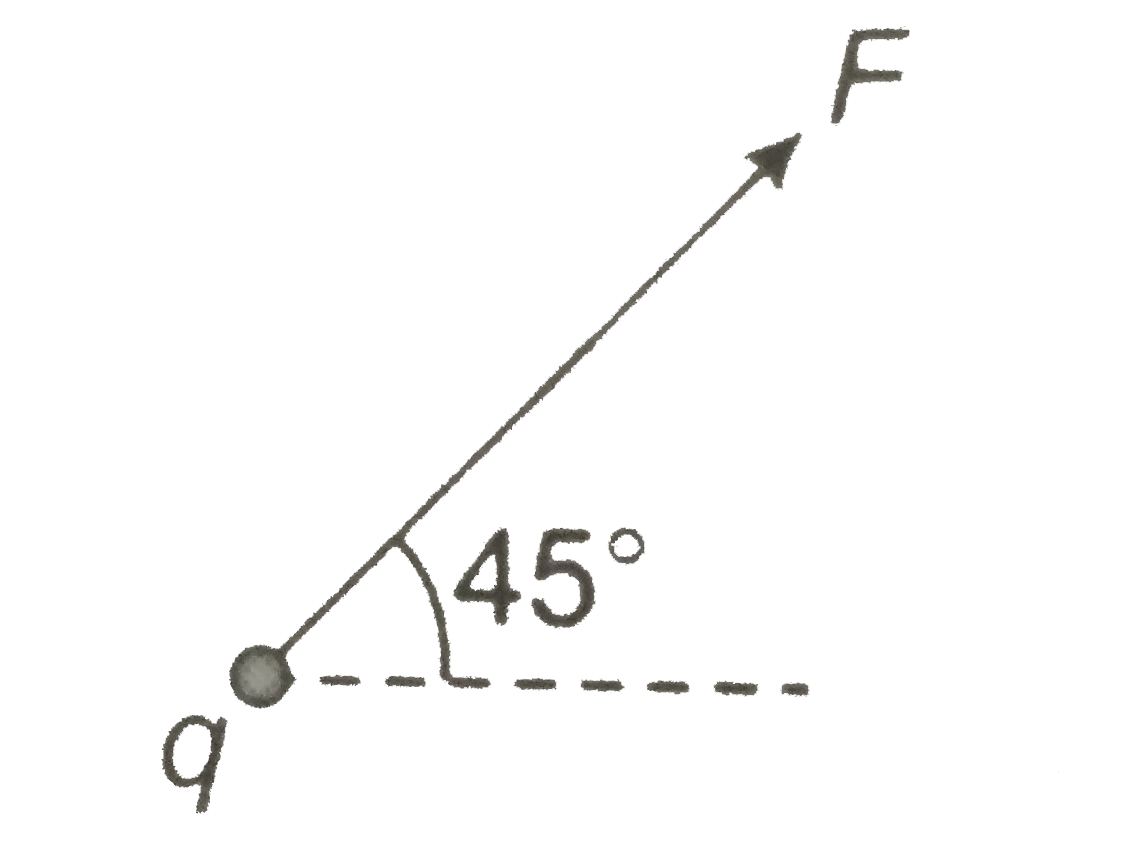
`F = sqrt(F_(0)^(2) + F_(0)^(2)) = sqrt(2 F_(0))`
`tan theta = (F_(0))/(F_(0)) rArr theta = 45^(@)`
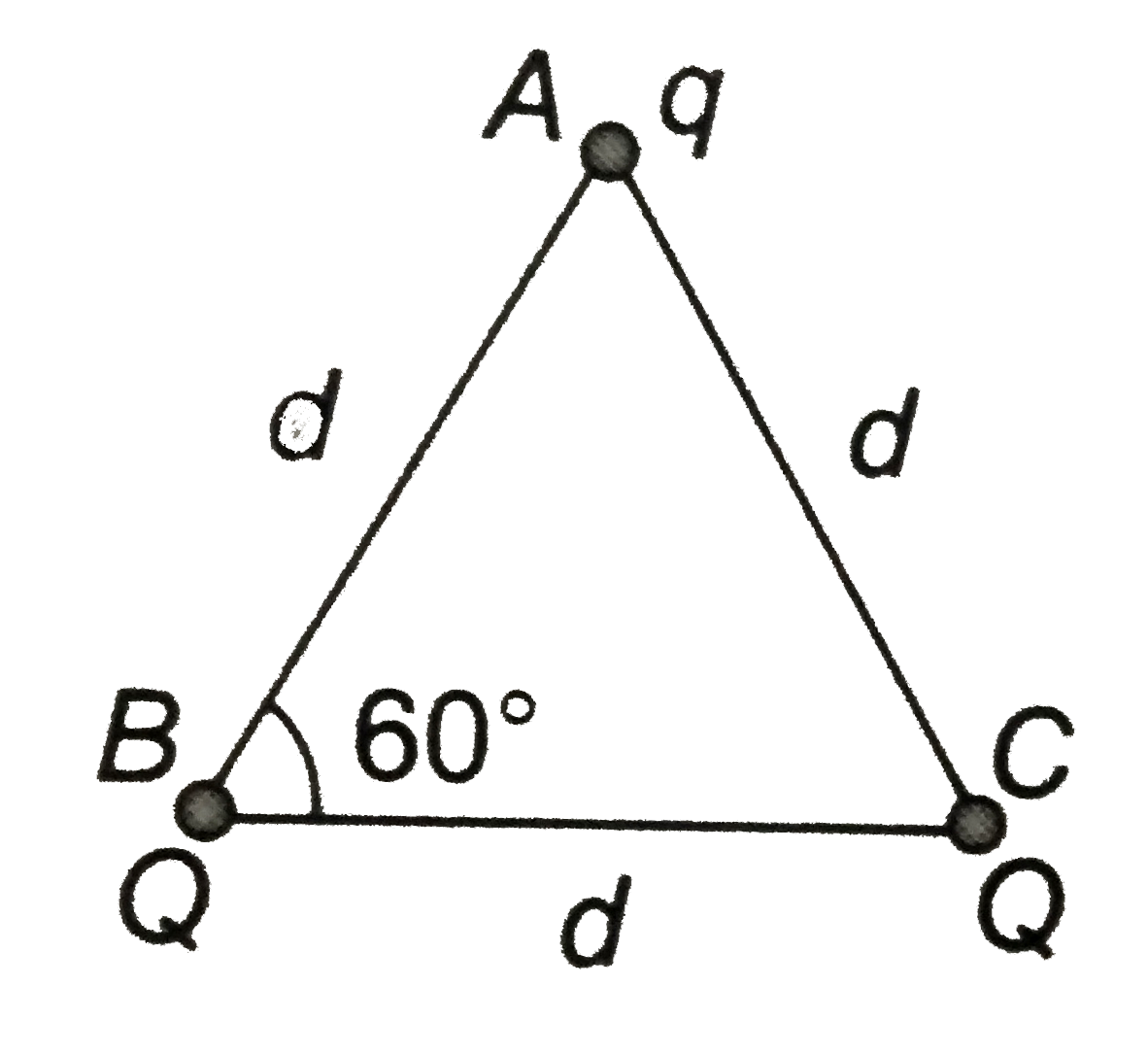
(c) Electric force on `q`:
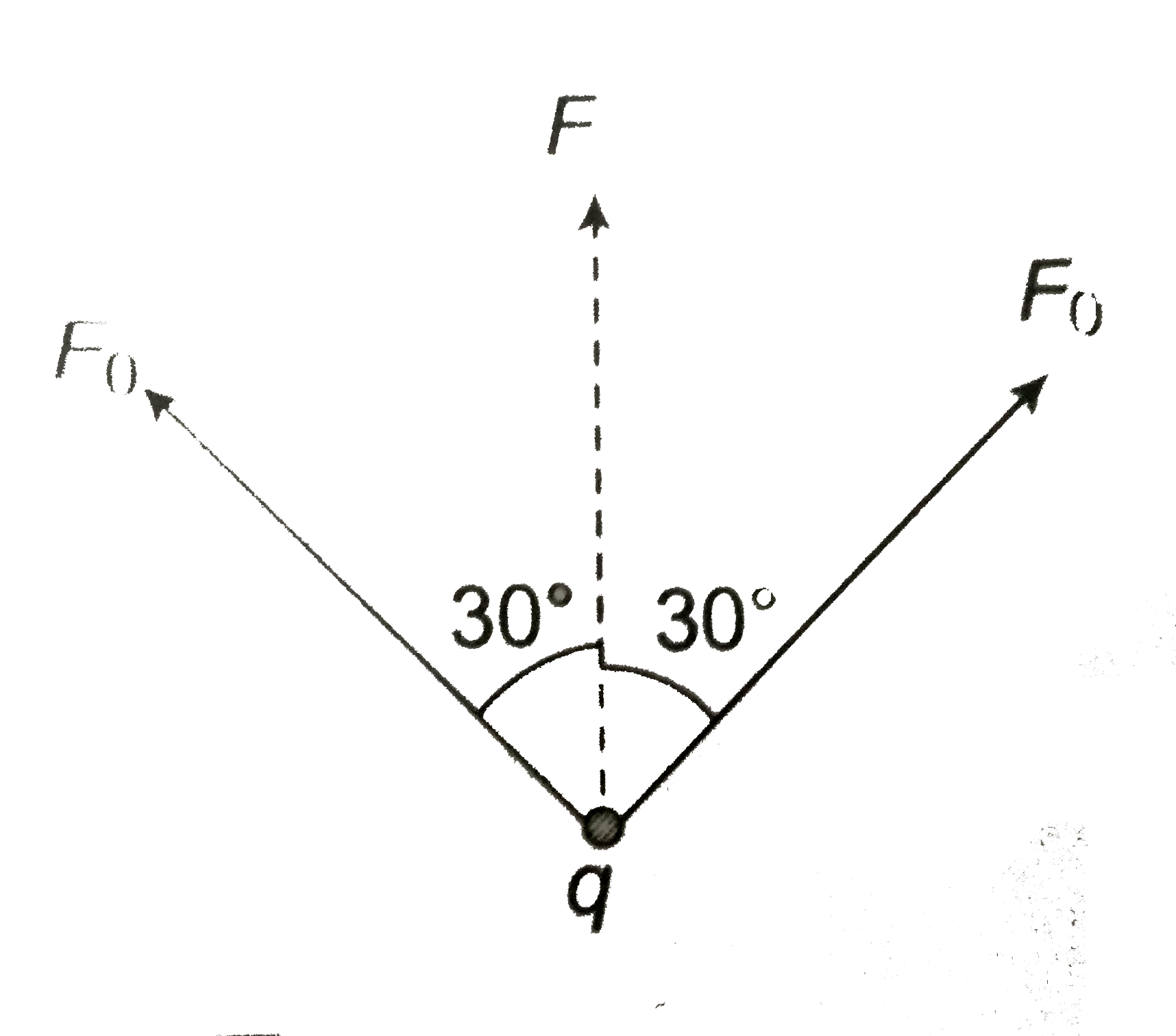
Due to `Q at B , F_(1) = (1)/(4 pi in_(0)) (Qq)/(d^(2)) = F_(0) , along BA`
Due to `Q at C , F_(2) = (1)/(4 pi in_(0)) (Qq)/(d^(2)) = F_(0) , along CA`
Resultant force on `q`:
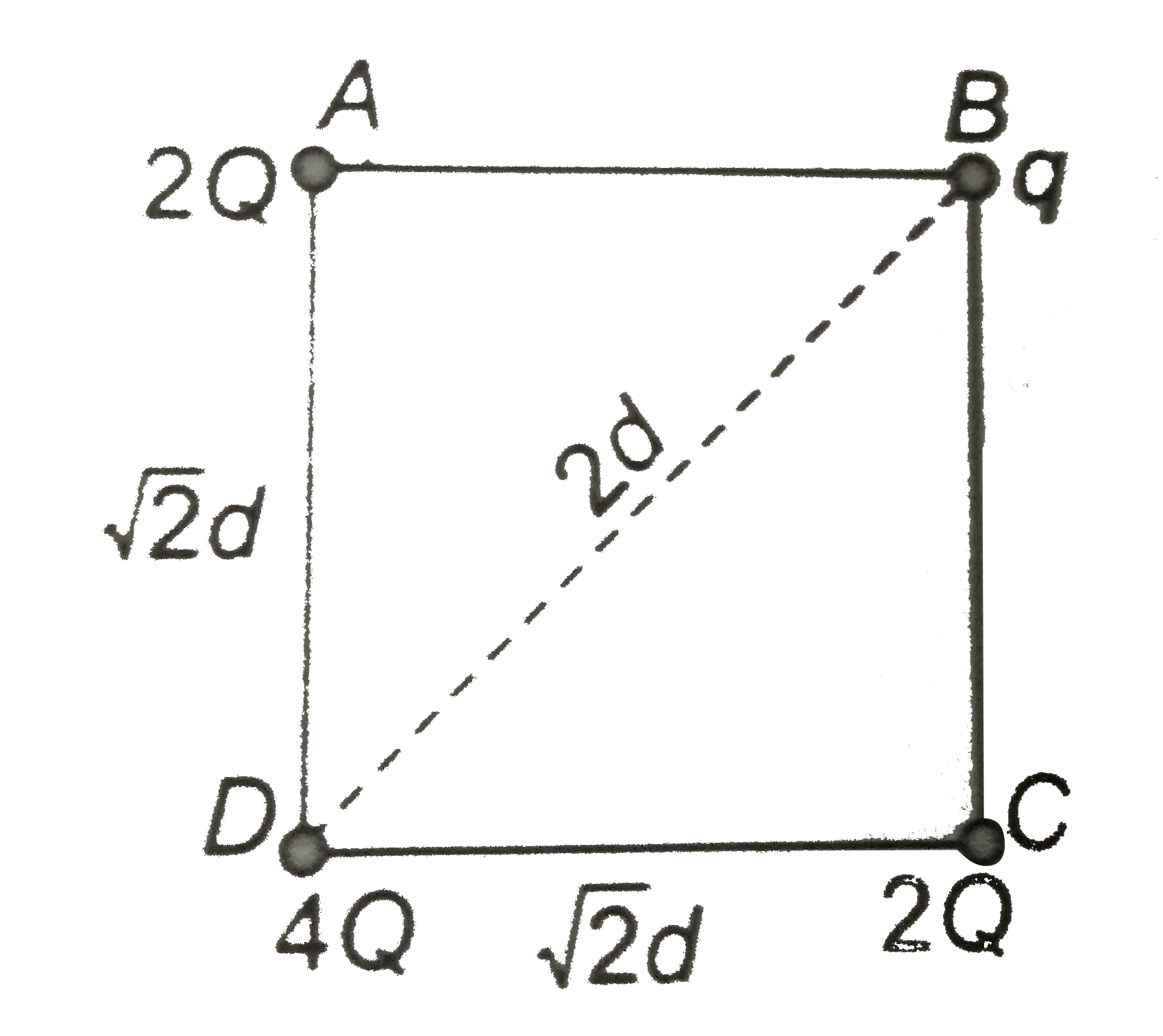
(d) Electric force on `q` :
Due to `2Q "at A" , F_(1) = (1)/(4 pi in_(0)) (2Qq)/((sqrt(2)d)^(2)) = F_(0)`, along AB
Due to `2Q at C,F_(2) = (1)/(4 pi in_(0)) (2Qq)/((sqrt(2)d)^(2)) = F_(0)` , along `CB`
Due to `4 Q` at D , `F_(3) = (1)/(4 pi in_(0)) (4 Qq)/((2d)^(2)) = F_(0)` ,along `DB`
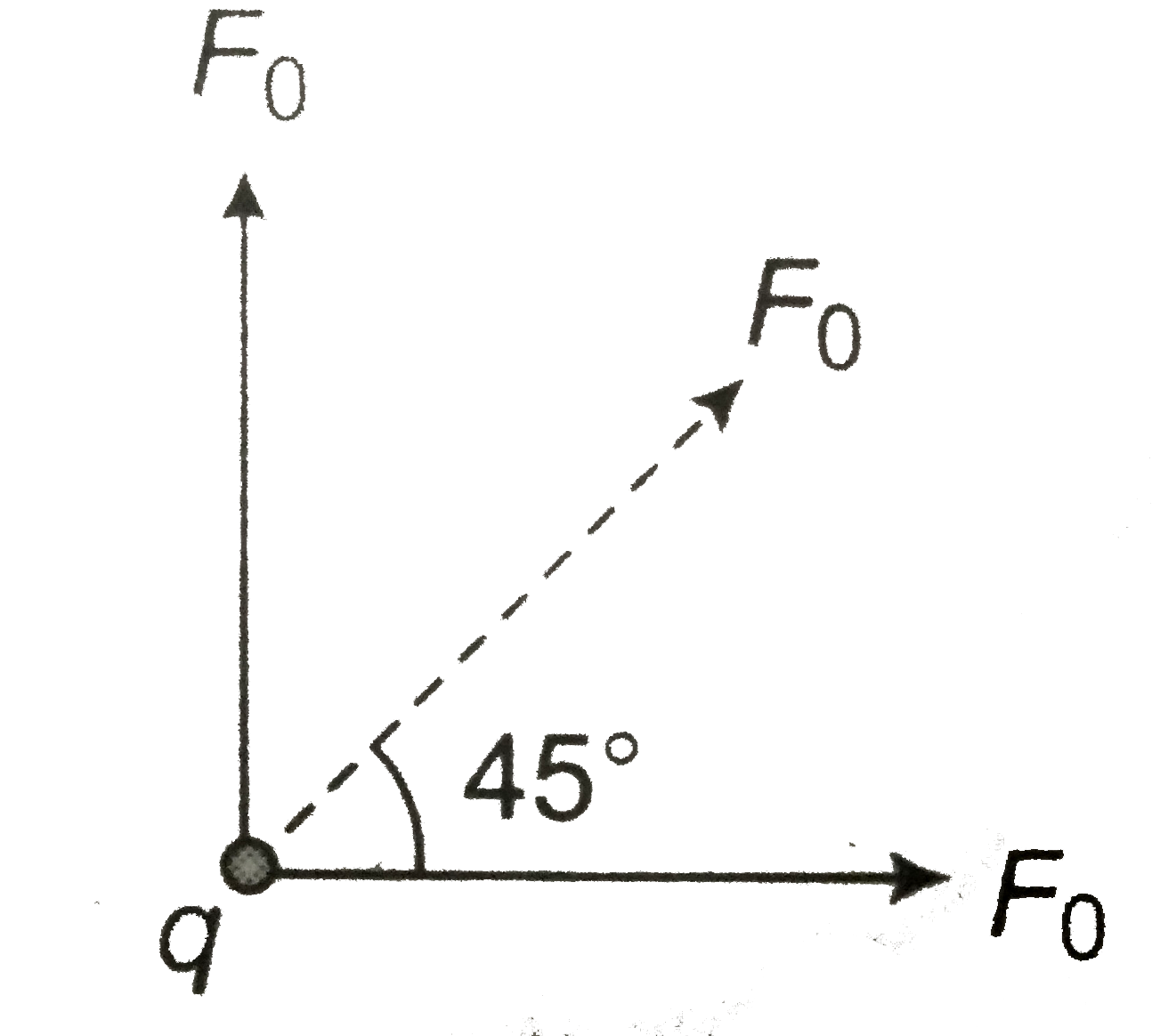
Resultant force on `q`:
Resolving forces along `x` and `y` axes
`F_(x) = F_(0) + F_(0) cos 45^(@) = F_(0) (1 + (1)/(sqrt(2)))`
`F_(y) = F_(0) + F_(0) sin 45^(@) = F_(0) (1 + (1)/(sqrt(2)))`
Resultant force is given as
`F = sqrt(F_(x)^(2) + F_(y)^(2)) = sqrt(2) F_(0) (1 + (1)/(sqrt(2)))`
`= F_(0) (sqrt(2) + 1)`
OR
The resultant of two perpendicular forces `F_(0)` will be `sqrt(2) F_(0)` along the third force `F_(0)`. Hence , resultant of three forces is `(sqrt(2) + 1)F_(0)`.
(e ) The electric force on `q` due to charges `Q , 8 Q , 27 Q , .... 1000 Q` will be towards left.
Force on `q`:
Due to `Q , F_(1) = (1)/(4 pi in_(0)) (Qq)/(d^(2)) = F_(0)`
Due to `8Q , F_(2) = (1)/(4 pi in_(0)) (8 Qq)/((2d)^(2)) = 2F_(0)`
Due to `27 Q , F_(3) = (1)/(4 pi in_(0)) (27 Qq)/((3 d)^(2)) = 3 F_(0)`
Due to `1000 Q , F_(10) = (1)/(4 pi in_(0)) (1000 Qq)/((10 d))^(2) = 10 F_(0)`
Net force on `q`:
`F = F_(1) + F_(2) + F_(3) + ... + F_(10)`
`= F_(0) ( 1 + 2 + 3 + ...+ 10)`
`= 55 F_(0)`


Promotional Banner

Topper's Solved these Questions

  • ELECTROSTATICS

    CP SINGH|Exercise Exercises|226 Videos
  • ELECTROMAGNETIC WAVES

    CP SINGH|Exercise EXERCISES|21 Videos
  • MAGNETIC FIELD

    CP SINGH|Exercise EXERCISE|77 Videos

Similar Questions

Explore conceptually related problems

(a) Two point charges Q and 16 Q are fixed at separation d . Where should a third point charge be placed between them so that it experiences no force I.e. in equilibrium ? (b) In the previous problem , if we replace Q by - Q , where should the third charge be placed on the joining the charges so that it is equilibrium ? (c ) Three point charges Q , q and Q are placed at x = 0 , x = d//2 and x = d . Find q in terms of Q so that all charges are in equilibrium. (d) Two point charges 9 Q and 25 Q are placed at separation d . Where should a third charge q be placed between them so that all charges are in equilibrium ? Also find the value of q and its nature.

A positive point charge q_(1) is placed at (a,0) and another positive point charge q_(2) is placed at (0,a) . Find the force acting on q_(1) .

(a) The charges each Q are placed at x - d , 2d , 4d ,…oo . Find electric potential at origin O . (b) A charge +Q is placed at each of the points x = d , x = 3d ,x = 5d ,…..,oo on the x -axis , and a charge -Q is placed at each of the points x = 2d , x = 4d , x= 6d , ...,oo .Find the electric potential at the origin O .

n charges Q,4Q,9Q,16Q…. are placed at distance of 1,2,3….. metre form a point 0, on the same straight line .The electric intensity at 0 is

The electric field at point P due to a charged ball is given by E_(p)=(1)/( 4pi epsilon_(0))(q)/(r^(2)) To measure 'E' at point P, A test charge q_(0) is placed at point P and measure electric force F upon the test charge. Check whether (F)/(q_(0)) is equal to (1)/(4pi epsilon_(0))(q)/(r^(2)) or not .

Electric potential is a scalar quantity. Due to a point charge charge q at distance r, the potential is given by V=(q)/(4pi in_(0)r) . A point charge q is placed at (3a, 0) and another charge -2q is placed at (-3a, 0) . At how many points on the x-axis, (at finite distance) electric potential will be zero?

CP SINGH-ELECTROSTATICS-Exercises
  1. Find the net electric force on charge q in the following cases , take ...

    Text Solution

    |

  2. Which of the following is correct regarding electric charge ? (i) If...

    Text Solution

    |

  3. When 10^(14) electrons are removed from a neutral metal sphere , the c...

    Text Solution

    |

  4. The ratio of the electric force between two electrons to the gravitati...

    Text Solution

    |

  5. Find the ratio of the magnitude of the electric force to the grativati...

    Text Solution

    |

  6. Two insultating small spheres are rubbed against each other and placed...

    Text Solution

    |

  7. Two particles having charge Q(1) and Q(2) , when kept at a certain dis...

    Text Solution

    |

  8. Two point charge +2 C and +6 C repel each other with a force of 12 N ....

    Text Solution

    |

  9. Two identical metals balls with charges +2Q and -Q are separated by so...

    Text Solution

    |

  10. Two positive point charges are 3 m apart their combined charge is 20 m...

    Text Solution

    |

  11. Charge Q is divided into two parts which are then kept some distance a...

    Text Solution

    |

  12. Force of attraction between two point charges Q and -Q separated by d...

    Text Solution

    |

  13. Two charges are at a distance d apart. If a copper plate (conducting m...

    Text Solution

    |

  14. Five balls numbered 1,2,3,4,and 5 are suspended using separated thread...

    Text Solution

    |

  15. Equal charges q are placed at the four corners A,B,C,Dof a square of l...

    Text Solution

    |

  16. Two spherical conductors B and C having equal radii and cayying equal ...

    Text Solution

    |

  17. Two positive ions , each carrying a charge q , are separated by a dist...

    Text Solution

    |

  18. Two point charges +4q and +q are placed at a distance L apart. A thir...

    Text Solution

    |

  19. Two point charges q(1) = +2 C and q(2) = - 1C are separated by a dista...

    Text Solution

    |

  20. A charge q is placed at the centre of the line joining two equal charg...

    Text Solution

    |

  21. In the previous question , if e = electronic charge , the minimum mag...

    Text Solution

    |