

Home
Class 12
PHYSICS
Two identical balls , each having a char...

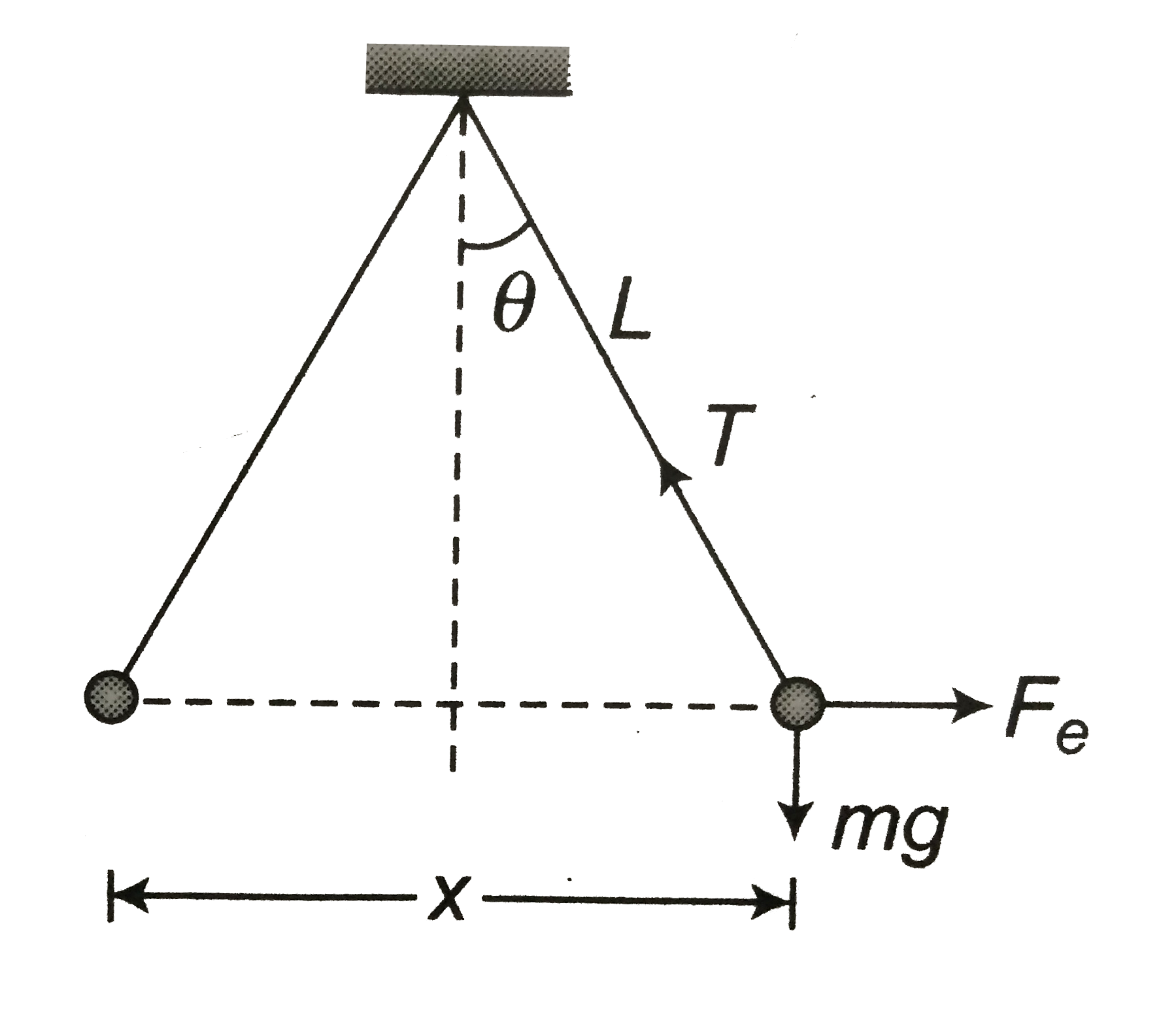
Two identical balls , each having a charge `q` and mass `m` , are suspended from a common point by two insultating strings each of length `L`. The balls are held at a separation `x` and then released. Find
(a) the electric force on each ball
(b) the component of the resultant force on a ball along and perpendicular to string
(c ) the tension in the string
(d) the acceleration of one of the balls. Consider the situation only for the instant just after the release.

Text Solution

Verified by Experts

(a) Electric force between balls , `F_(e ) = (1)/(4 pi in_(0)) (q^(2))/(x^(2))`
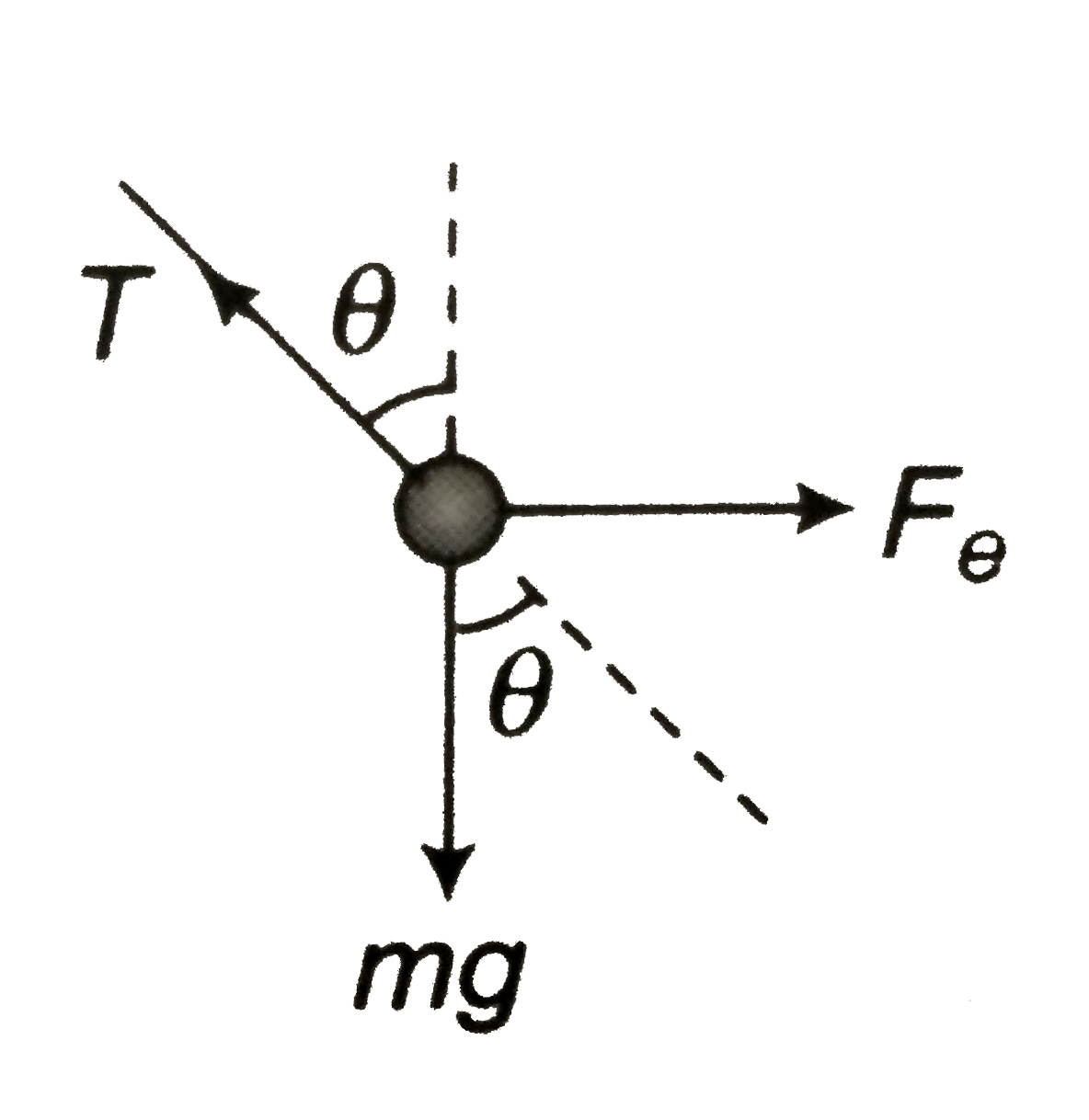
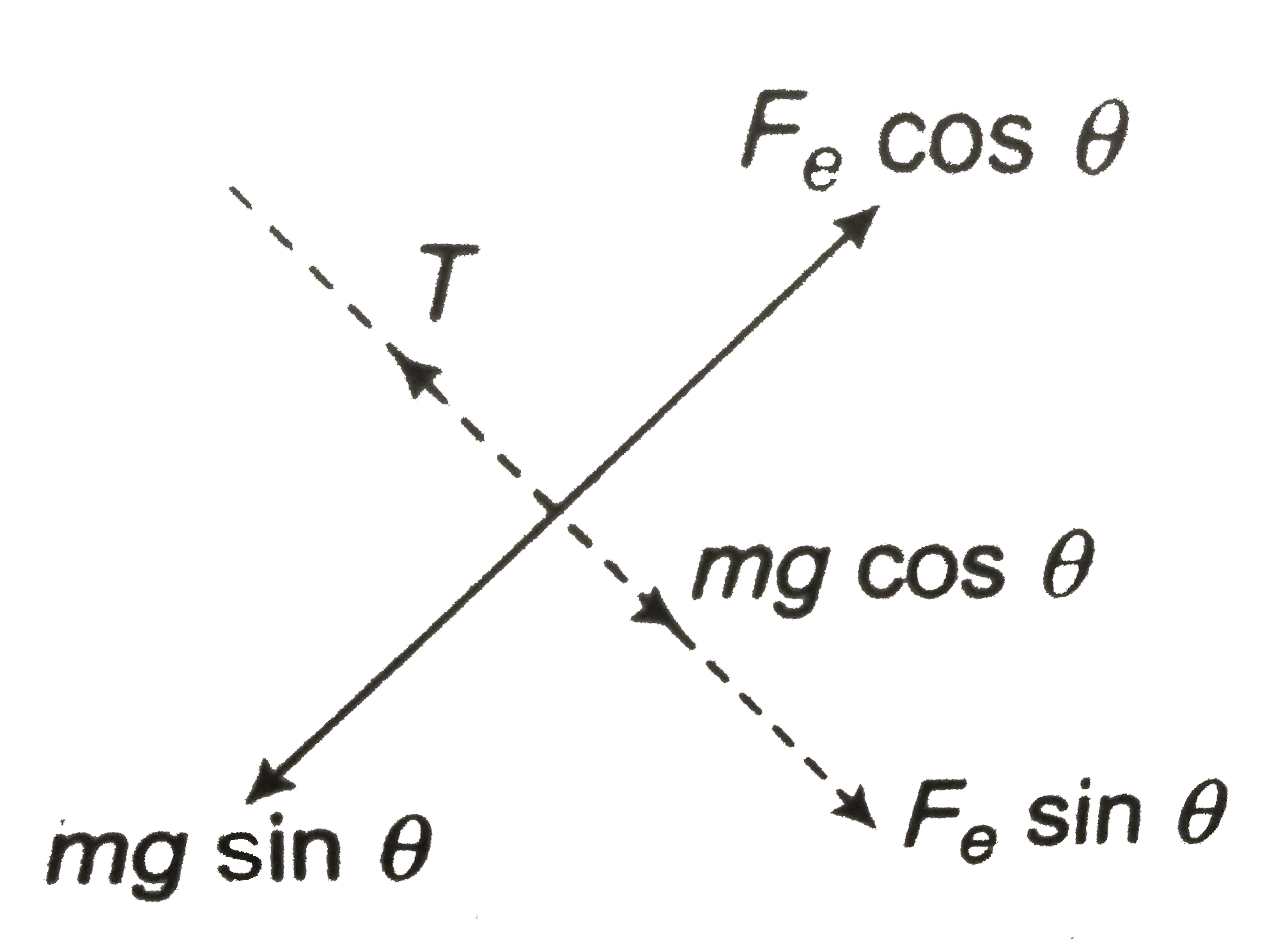
(b) Resolving forces along and `_|_^(ar)` to string.
Resultant force on ball along the string,
`T - (mg cos theta + F_(e ) sin theta ) = 0` { the string is unstrechable}
`_|_^(ar)` to string `= | F_(e ) cos theta - mg sin theta|`
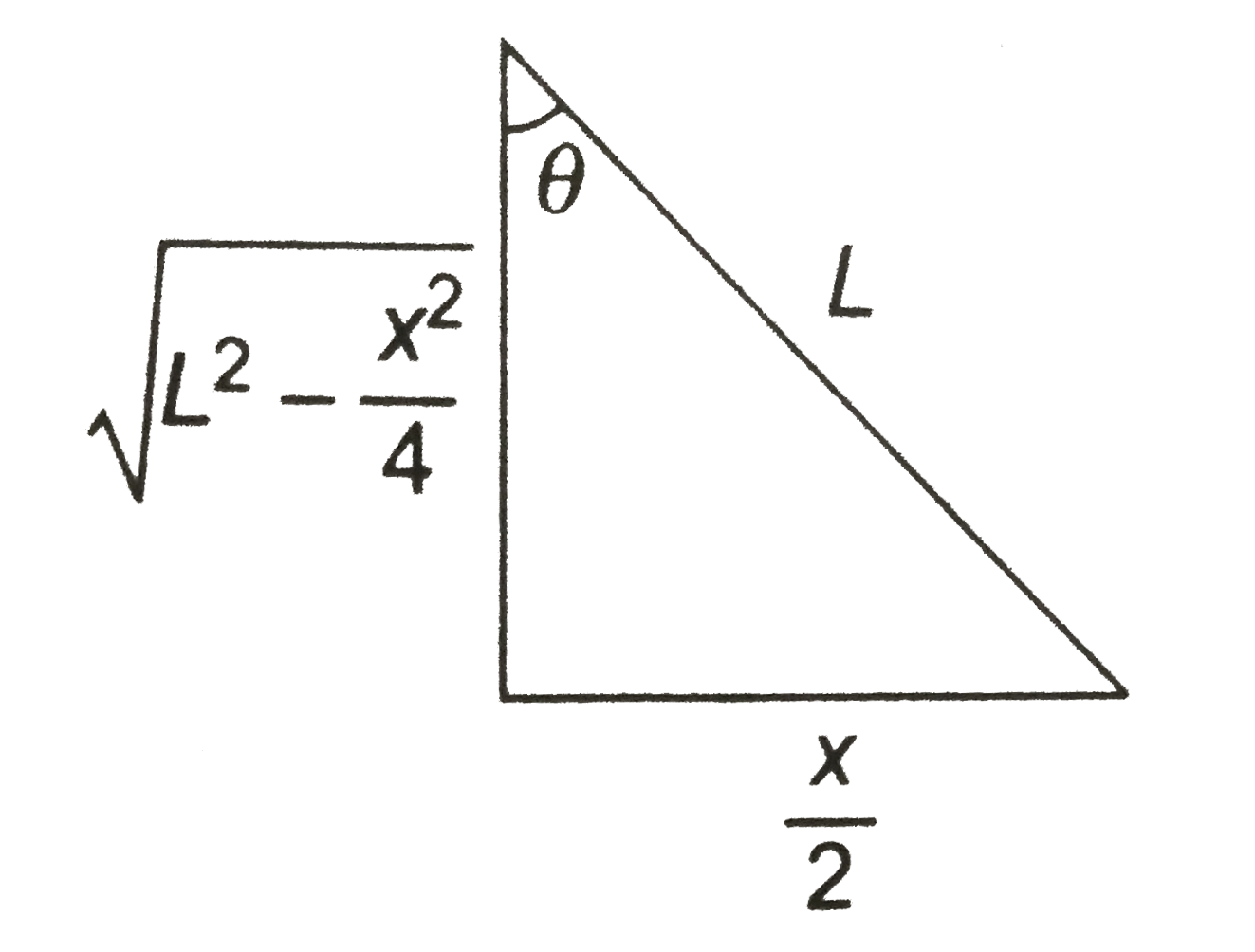
`theta` can be obtained from geometry.
( c) Since the net force on the ball along string is zero , hence
`T = mg cos theta + F_( e) sin theta`
(d) Acceleration of ball `a = (|F_(e ) cos theta - mg sin theta|)/(m)`


Promotional Banner

Topper's Solved these Questions

  • ELECTROSTATICS

    CP SINGH|Exercise Exercises|226 Videos
  • ELECTROMAGNETIC WAVES

    CP SINGH|Exercise EXERCISES|21 Videos
  • MAGNETIC FIELD

    CP SINGH|Exercise EXERCISE|77 Videos

Similar Questions

Explore conceptually related problems

Two indentical balls, each having a charge of 2.00xx10^(-7) C and a mass of 100g , are suspended from a common point by two insulating strings each 50 cm long. The balls are held at a separation 5.0cm apart and then released. Find (a) the electric force on one of the charged balls (b) the components of the resultant force on it alongand perpendicular to the string (c) the tension is the string (d) the components of the resultant force on it along and perpendicular to the string(c) the tension in the string (d) the acceleration of one of the balls. Answers are to be obtained just after the release.

Two indentical pith balls, each carrying charge q, are suspended from a common point by two strings of equal length l. Find the mass of each ball if the angle between the strings is 2theta in equilibrium.

Two small spheres, each having a mass of 20 g, are suspended form a common point by two insulating strings of length 40 cm each. The spheres are identically charged and the speration between the balls at equilibrium is found to be 4 cm . Find the charge on each sphere.

Two identical tennis balls each having mass 'm' and charge 'q' are suspended from a fixed point by threads of length 'l'. What is the equilibrium separation when each thread makes a small angle 'theta' with the vertical ?

Two identical balls each having a density rho are suspended from as common point by two insulating strings of equal length. Both the balls have equal mass and charge. In equilibrium each string makes an angle theta with vertical. Now, both the balls are immersed in a liquid. As a result the angle theta does not change. The density of the liquid is sigma . Find the dielectric constant of the liquid.

Two path balls carrying eqaul chareges are suspended froom a common point by strings of equal length, the strings are rightly clamped at half the height. The equilibrium separation between the balls, now becomes :

Two small balls, each having equal positive charge Q are suspended by two insulationg strings of equal length l from a hook fixed to a stand. It mass of each ball =m and total angle between the two strings is 60^(@) m, then find the charge on each ball.

Three small balls, each of mass 10 gm are suspended separately from common point. by silk threads, each one meter long. The balls are identically charged and hang at the corners of an equilateral triangle of side 0.1. metre. Find the charge on each ball?

CP SINGH-ELECTROSTATICS-Exercises
  1. Two identical balls , each having a charge q and mass m , are suspende...

    Text Solution

    |

  2. Which of the following is correct regarding electric charge ? (i) If...

    Text Solution

    |

  3. When 10^(14) electrons are removed from a neutral metal sphere , the c...

    Text Solution

    |

  4. The ratio of the electric force between two electrons to the gravitati...

    Text Solution

    |

  5. Find the ratio of the magnitude of the electric force to the grativati...

    Text Solution

    |

  6. Two insultating small spheres are rubbed against each other and placed...

    Text Solution

    |

  7. Two particles having charge Q(1) and Q(2) , when kept at a certain dis...

    Text Solution

    |

  8. Two point charge +2 C and +6 C repel each other with a force of 12 N ....

    Text Solution

    |

  9. Two identical metals balls with charges +2Q and -Q are separated by so...

    Text Solution

    |

  10. Two positive point charges are 3 m apart their combined charge is 20 m...

    Text Solution

    |

  11. Charge Q is divided into two parts which are then kept some distance a...

    Text Solution

    |

  12. Force of attraction between two point charges Q and -Q separated by d...

    Text Solution

    |

  13. Two charges are at a distance d apart. If a copper plate (conducting m...

    Text Solution

    |

  14. Five balls numbered 1,2,3,4,and 5 are suspended using separated thread...

    Text Solution

    |

  15. Equal charges q are placed at the four corners A,B,C,Dof a square of l...

    Text Solution

    |

  16. Two spherical conductors B and C having equal radii and cayying equal ...

    Text Solution

    |

  17. Two positive ions , each carrying a charge q , are separated by a dist...

    Text Solution

    |

  18. Two point charges +4q and +q are placed at a distance L apart. A thir...

    Text Solution

    |

  19. Two point charges q(1) = +2 C and q(2) = - 1C are separated by a dista...

    Text Solution

    |

  20. A charge q is placed at the centre of the line joining two equal charg...

    Text Solution

    |

  21. In the previous question , if e = electronic charge , the minimum mag...

    Text Solution

    |