Home
Class 12
PHYSICS
A particle A having a charge 10 mu C is ...

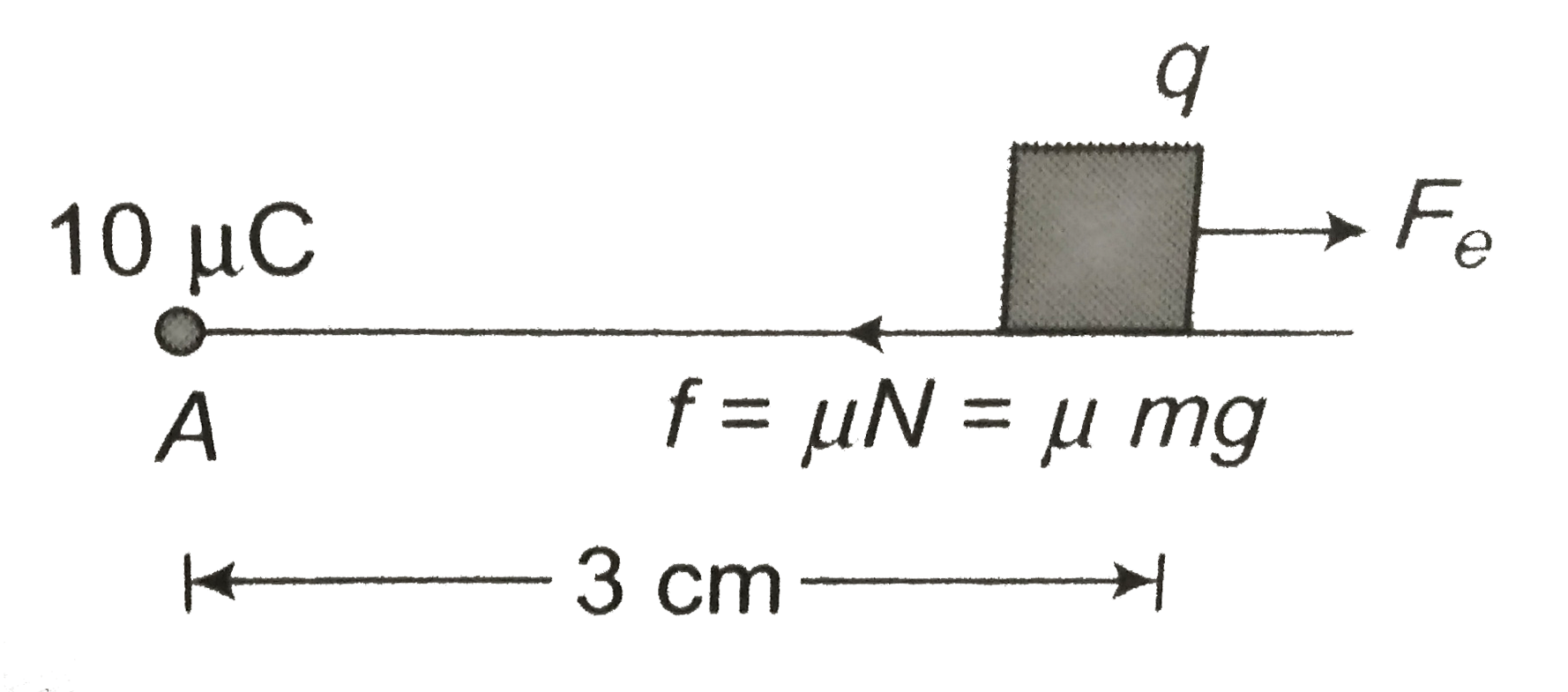
A particle `A` having a charge `10 mu C` is held fixed on a horizontal surface. A block of mass `80 g` and having charge stays in equilibrium on the surface at a distance `3 cm` from the first charge. The coefficient of friction between the surface and the block is `mu = 0.5`. Find the range within which the charge on the block may lie.

Text Solution

Verified by Experts
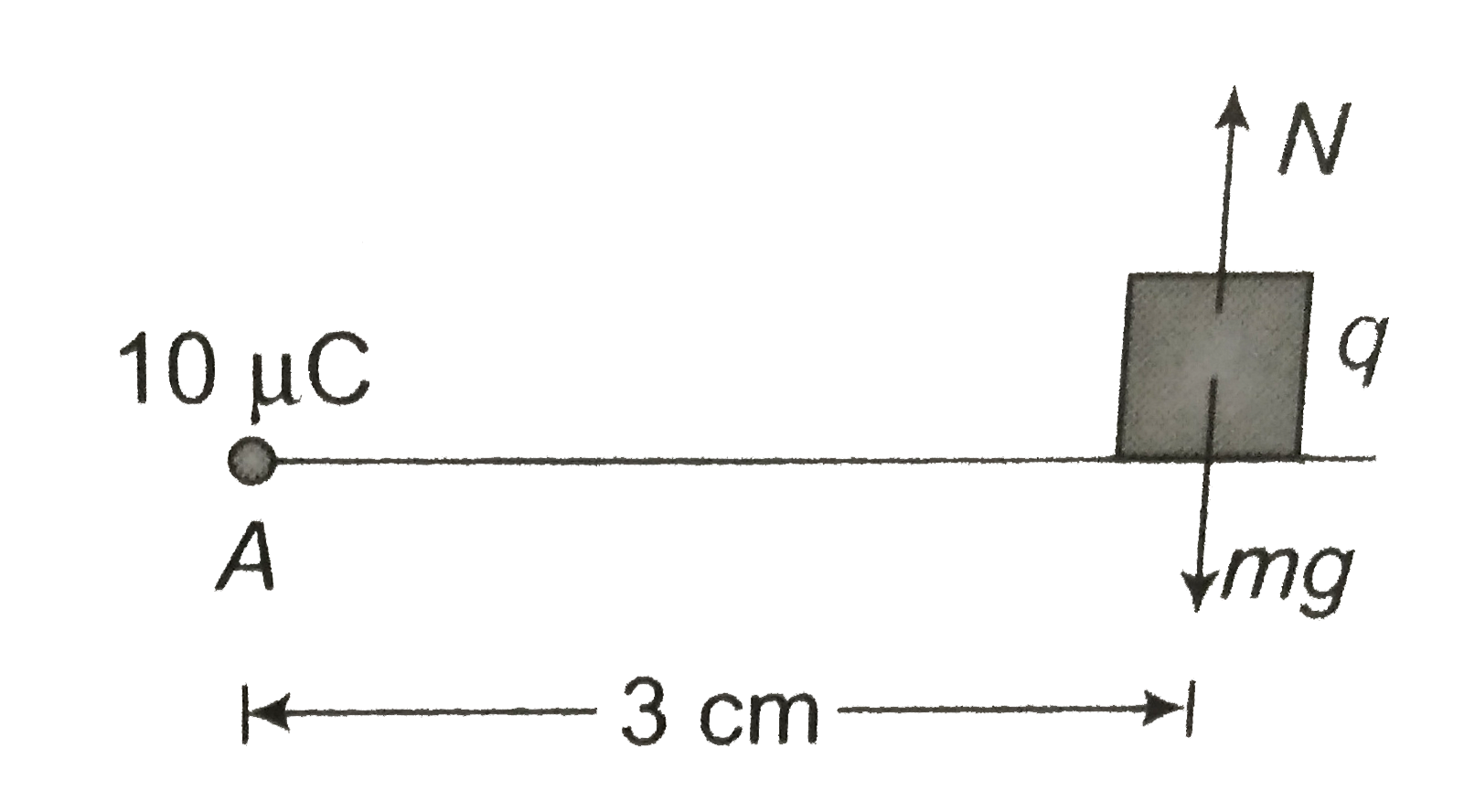
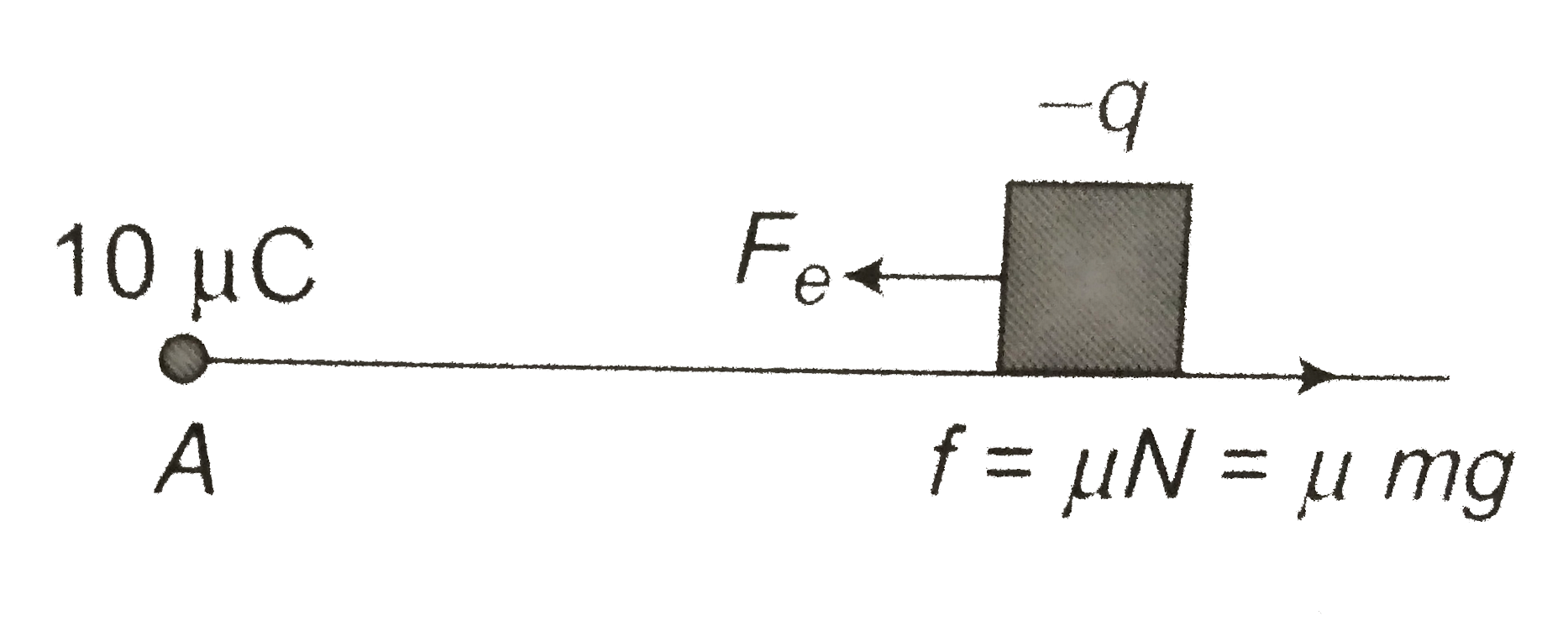
The block is in equilibrium because electric force is balanced by friction force. If `q is + ve` , friction will act towards left , if `q is - ve` , friction will act towards right. We know friction force develops according to need from `0` to `mu N`. To get maximum value of charge that can be given to the second particle , we should equate repulsive force by maximum friction force.
If `q is + ve`
`F_(e ) = mu mg`
`(1)/( 4 pi in_(0)) ((10 xx 10^(-6))q)/((3 xx 10^(-2))^(2)) = 0.5 xx 80 xx 10^(-3) xx 10`
`q = 4 xx 10^(-9) C =` maximum `+ ve` charge
If `q is -ve`
`F_(e ) = mu mg`
`q = 4 xx 10^(-9) C =` maximum `-ve` charge
Range of charge is from `-4 xx 10^(-9) C` to `4 xx 10^(-9) C`.
If charge smaller than `+- 4 xx 10^(-9) C` to `4 xx 10^(-9) C` is given , friction force develops up to that extent so that it balances electric e.g. if `q = 0`, friction is not developed.


Promotional Banner

Topper's Solved these Questions

  • ELECTROSTATICS

    CP SINGH|Exercise Exercises|226 Videos
  • ELECTROMAGNETIC WAVES

    CP SINGH|Exercise EXERCISES|21 Videos
  • MAGNETIC FIELD

    CP SINGH|Exercise EXERCISE|77 Videos

Similar Questions

Explore conceptually related problems

A particle A having a charge of 2.0xx10 ^(-6) C is held fixed on a horizontal table. A second charged jparticle of mass 80g stays in equilibrium on the table at a distance of 10 cm from the firsst charge. The coefficient of friction between the table and this second jparticle is mu = 0.2 . find the range within which the charge of this second particle may lie.

A block A of mass 2 kg rests on a horizontal surface. Another block B of mass 1 kg moving at a speed of m/s when at a distance of 16 cm from A. collides elastically with A. The coefficeint of friction between the horizontal surface and earth of the blocks is 0.2. Then (g = 10 m//s^(2))

A block of mass m is kept on horizontal turn table at x distance from the centre. If coefficient of friction between block and surface of turn table is mu , then maximum angular speed of the table so that block does not slip

A long block A is at rest on a smooth horizontal surface. A small block B whose mass is half of mass of A is placed on A at one end and is given an initial velocity u as shown in figure. The coefficient of friction between the blocks is mu .

A long block A is at rest on a smooth horizontal surface. A small block B, whose mass is half of A, is placed on A at one end and projected along A with some velocity u. The coefficient of friction between the blocks is mu :

A varying horizental force F = at act on a block of mass m kept on a smooth horizontal surface An identical block is kept on the first block.The coefficient of friction between the blocks is mu . The time after which the relative sliding between the blocks prevails is

Block B rests on a smooth surface .The coefficient of static friction between A and B is mu = 0.4 where F = 30 N then Acceleration of upper block is

Block B rests on a smooth surface .The coefficient of static friction between A and B is mu = 0.4 where F = 30 N then Acceleration of lower block is

A spring, placed horizontally on a rough surface is compressed by a block of mass m, placed on the same surface so as to store maximum energy in the spring. If the coefficient of friction between the block and the surface is mu , the potential energy stored in the spring is

CP SINGH-ELECTROSTATICS-Exercises
  1. A particle A having a charge 10 mu C is held fixed on a horizontal sur...

    Text Solution

    |

  2. Which of the following is correct regarding electric charge ? (i) If...

    Text Solution

    |

  3. When 10^(14) electrons are removed from a neutral metal sphere , the c...

    Text Solution

    |

  4. The ratio of the electric force between two electrons to the gravitati...

    Text Solution

    |

  5. Find the ratio of the magnitude of the electric force to the grativati...

    Text Solution

    |

  6. Two insultating small spheres are rubbed against each other and placed...

    Text Solution

    |

  7. Two particles having charge Q(1) and Q(2) , when kept at a certain dis...

    Text Solution

    |

  8. Two point charge +2 C and +6 C repel each other with a force of 12 N ....

    Text Solution

    |

  9. Two identical metals balls with charges +2Q and -Q are separated by so...

    Text Solution

    |

  10. Two positive point charges are 3 m apart their combined charge is 20 m...

    Text Solution

    |

  11. Charge Q is divided into two parts which are then kept some distance a...

    Text Solution

    |

  12. Force of attraction between two point charges Q and -Q separated by d...

    Text Solution

    |

  13. Two charges are at a distance d apart. If a copper plate (conducting m...

    Text Solution

    |

  14. Five balls numbered 1,2,3,4,and 5 are suspended using separated thread...

    Text Solution

    |

  15. Equal charges q are placed at the four corners A,B,C,Dof a square of l...

    Text Solution

    |

  16. Two spherical conductors B and C having equal radii and cayying equal ...

    Text Solution

    |

  17. Two positive ions , each carrying a charge q , are separated by a dist...

    Text Solution

    |

  18. Two point charges +4q and +q are placed at a distance L apart. A thir...

    Text Solution

    |

  19. Two point charges q(1) = +2 C and q(2) = - 1C are separated by a dista...

    Text Solution

    |

  20. A charge q is placed at the centre of the line joining two equal charg...

    Text Solution

    |

  21. In the previous question , if e = electronic charge , the minimum mag...

    Text Solution

    |