Home
Class 12
PHYSICS
Two particles , each having a charge Q, ...

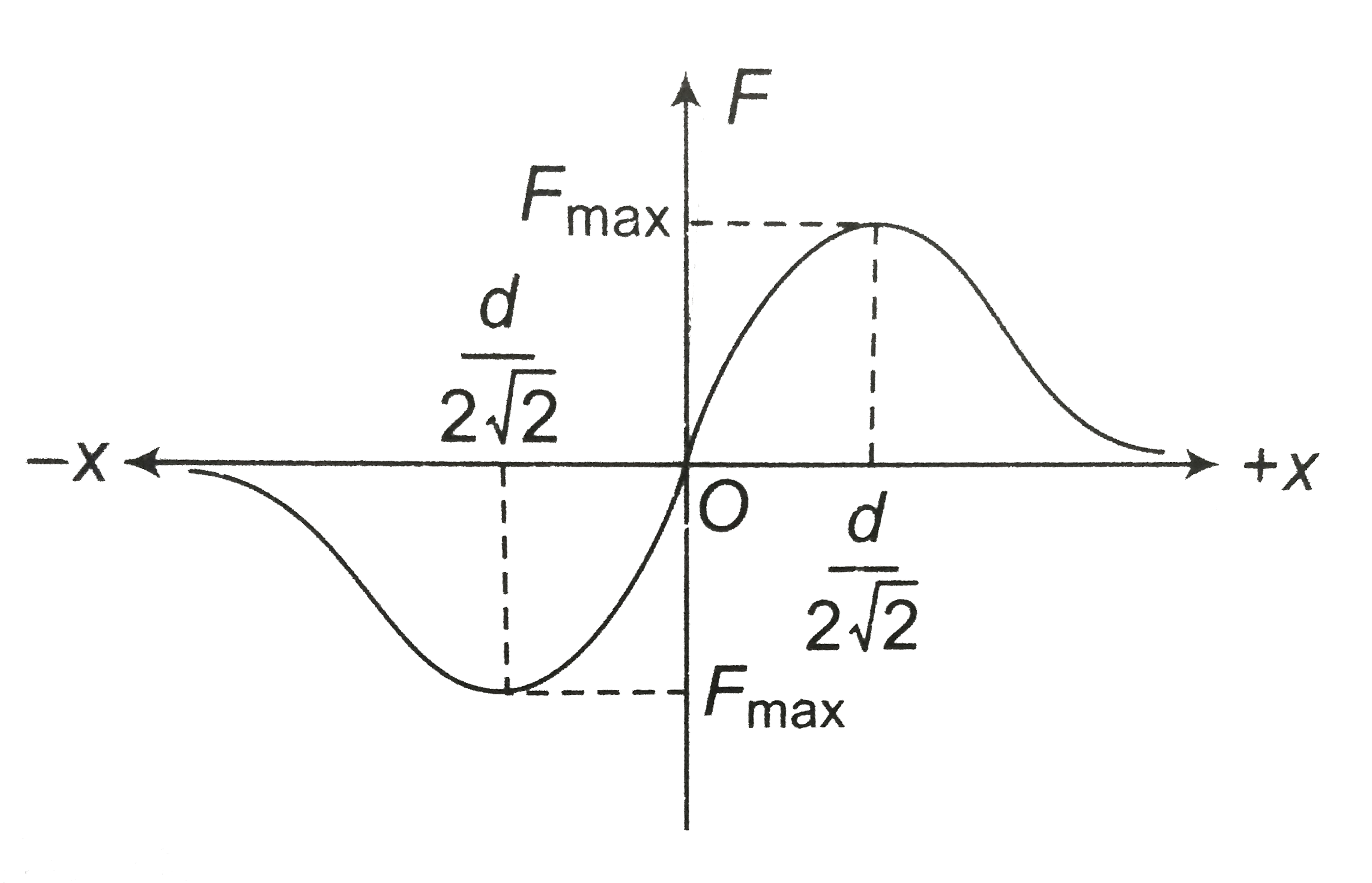
Two particles , each having a charge `Q`, are fixed at `y = d//2` and `y = -d//2`. Where should a particle of charge `q` be placed on `x`-axis from origin so that it experiences maximum force and what is it equal to ? Sketch variation of electric force experienced by `q v//s x`.

Text Solution

Verified by Experts
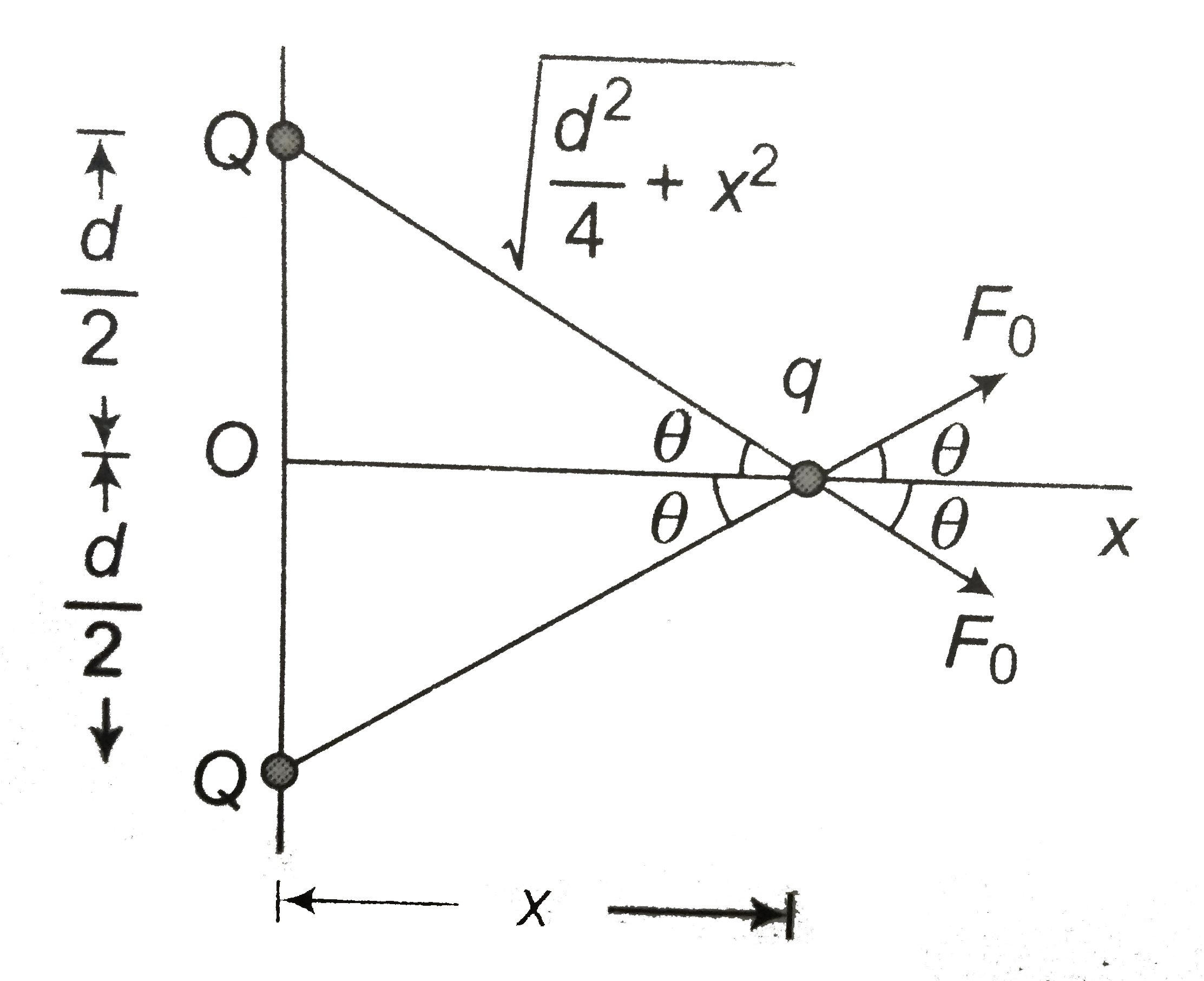
Force on `q` to each `Q` will be same in magnitude
`F_(0) = (1)/( 4 pi in_(0)) (Qq)/(((d^(2))/(4) + x^(2))`
Resultant force on `q`,
`F = 2 F_(0) cos theta`
`= 2. (1)/( 4 pi in_(0)) (Qq)/(((d^(2))/(4) + x^(2))) (x)/(((d^(2))/(4) + x^(2))^(1//2))`
`= (Qq)/(2 pi in_(0)) (x)/((d^(2))/(4) +x^(2))^(3//2)`
For `F` to be maximum,
`(dF)/(dx) = 0`
`(Qq)/(4 pi in_(0)) (((d^(2))/(4) + x^(2))^(3//2) . 1 - x.(3)/(2)((d^(2))/(4) + x^(2))^(1//2) . 2x)/(((d^(2))/(4) + x^(2)))`
`(d^(2))/(4) + x^(2) - 3x^(2) = 0`
`x^(2) = (d^(2))/(8)`
`x = +- (d)/( 2 sqrt(2))`
`F_(max) = (Qq)/( 2pi in_(0)) (d)/(2 sqrt(2)) (1)/((d^(2))/(4) + (d^(2))/(8))^(3//2)`
`= (Qq)/( 2 pi in_(0)) (d)/(2 sqrt(2)) (1)/((3d^(2))/(8) .(sqrt(3) d)/(2 sqrt(2)))`
` = (4 Qq)/( 3 sqrt(3) pi in_(0) d^(2))`
`F v//s x` graph : when `q` is at right of `O` , force on it will be along ` + x` axis (assuming `+ve`) , graph will above x-axis.
When `q` is the left of `O`, force will be along-x-axis (assuming `-ve`) , graph will be below x-axis.
`x = 0 , F = 0`
`x = +- (d)/(2 sqrt(2)) , F = F_(max)`
`x rarr prop , F rarr 0`

Promotional Banner

Topper's Solved these Questions

  • ELECTROSTATICS

    CP SINGH|Exercise Exercises|226 Videos
  • ELECTROMAGNETIC WAVES

    CP SINGH|Exercise EXERCISES|21 Videos
  • MAGNETIC FIELD

    CP SINGH|Exercise EXERCISE|77 Videos

Similar Questions

Explore conceptually related problems

Two particles A and B having equal charges are placed at distance d apart. A third charged particle placed on the perpendicular bisector at a distance x will experience the maximum Coulomb’s force when :

Two charge q and –3q are placed fixed on x–axis separated by distance d. Where should a third charge 2q be placed such that it will not experience any force ?

Two charges q and 3q are placed fixed on x-axis separated by distance 'd'. Where should a third charge 2q be placed such that it will not experience any force ?

Two particle of equal mass m and charge q are placed at a distance of 16 cm. They do not experience any force. The value of (q)/(m) is

A charge of +2muC is placed at x=0 and a charge of -32muc at x=60 .A third charge -Q be placed on the x axis such that it experiences no force .The distance of the point from +2muC is ( in cm)

(a) Two point charges Q and 16 Q are fixed at separation d . Where should a third point charge be placed between them so that it experiences no force I.e. in equilibrium ? (b) In the previous problem , if we replace Q by - Q , where should the third charge be placed on the joining the charges so that it is equilibrium ? (c ) Three point charges Q , q and Q are placed at x = 0 , x = d//2 and x = d . Find q in terms of Q so that all charges are in equilibrium. (d) Two point charges 9 Q and 25 Q are placed at separation d . Where should a third charge q be placed between them so that all charges are in equilibrium ? Also find the value of q and its nature.

A certain charge Q is divided into two parts q and (Q–q). How should the charges Q and q be divided so that q and (Q–q) placed at a certain distance apart experience maximum electrostatic repulsion ?

CP SINGH-ELECTROSTATICS-Exercises
  1. Two particles , each having a charge Q, are fixed at y = d//2 and y = ...

    Text Solution

    |

  2. Which of the following is correct regarding electric charge ? (i) If...

    Text Solution

    |

  3. When 10^(14) electrons are removed from a neutral metal sphere , the c...

    Text Solution

    |

  4. The ratio of the electric force between two electrons to the gravitati...

    Text Solution

    |

  5. Find the ratio of the magnitude of the electric force to the grativati...

    Text Solution

    |

  6. Two insultating small spheres are rubbed against each other and placed...

    Text Solution

    |

  7. Two particles having charge Q(1) and Q(2) , when kept at a certain dis...

    Text Solution

    |

  8. Two point charge +2 C and +6 C repel each other with a force of 12 N ....

    Text Solution

    |

  9. Two identical metals balls with charges +2Q and -Q are separated by so...

    Text Solution

    |

  10. Two positive point charges are 3 m apart their combined charge is 20 m...

    Text Solution

    |

  11. Charge Q is divided into two parts which are then kept some distance a...

    Text Solution

    |

  12. Force of attraction between two point charges Q and -Q separated by d...

    Text Solution

    |

  13. Two charges are at a distance d apart. If a copper plate (conducting m...

    Text Solution

    |

  14. Five balls numbered 1,2,3,4,and 5 are suspended using separated thread...

    Text Solution

    |

  15. Equal charges q are placed at the four corners A,B,C,Dof a square of l...

    Text Solution

    |

  16. Two spherical conductors B and C having equal radii and cayying equal ...

    Text Solution

    |

  17. Two positive ions , each carrying a charge q , are separated by a dist...

    Text Solution

    |

  18. Two point charges +4q and +q are placed at a distance L apart. A thir...

    Text Solution

    |

  19. Two point charges q(1) = +2 C and q(2) = - 1C are separated by a dista...

    Text Solution

    |

  20. A charge q is placed at the centre of the line joining two equal charg...

    Text Solution

    |

  21. In the previous question , if e = electronic charge , the minimum mag...

    Text Solution

    |