Home
Class 12
PHYSICS
A particle A of mass m and charge Q move...

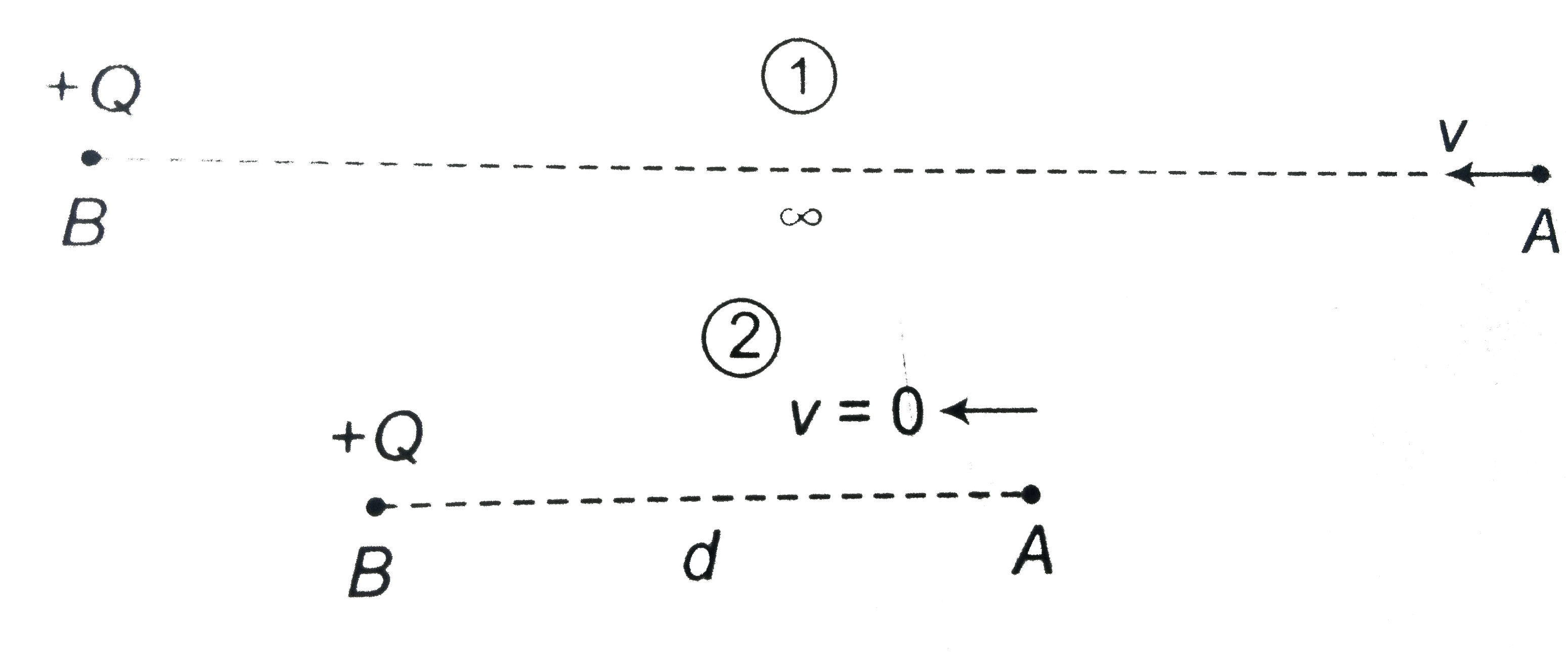
A particle `A` of mass `m` and charge `Q` moves directly towards a fixed particle `B`, which has charge `Q`. The speed of `A` is a `v` when it is far away from `B`. The minimum separtion between the particles is not proportional to

A

`Q^(2)`

B

`(1)/(v^(2))`

C

`(1)/(v)`

D

`(1)/(m)`

Text Solution

Verified by Experts

The correct Answer is:
3


Energy conservation between `①` and `②`
`(1)/(2) mv^(2) = (1)/( 4 pi in_(0)) .(Q^(2))/(d)`
`d = (Q^(2)) /(2 pi in_(0) mv^(2))`
Promotional Banner

Topper's Solved these Questions

  • ELECTROSTATICS

    CP SINGH|Exercise Exercises|226 Videos
  • ELECTROMAGNETIC WAVES

    CP SINGH|Exercise EXERCISES|21 Videos
  • MAGNETIC FIELD

    CP SINGH|Exercise EXERCISE|77 Videos

Similar Questions

Explore conceptually related problems

A particle of mass m and charge Q moving with a velocity v enters a region on uniform field of induction B Then its path in the region is s

A particle of mass m and charge q enters a magnetic field B perpendicularly with a velocity v , The radius of the circular path described by it will be

A particle of mass m and charge -q moves diametrically through a uniformily charged sphere of radius R with total charge Q. The angular frequency of the particle's simple harminic motion, if its amplitude lt R, is given by

A uniformly charged sphere has radius R and charge Q on it. A negatively charged particle having mass m and charge – q shoots out of the surface of the sphere with speed V. The minimum speed (V_0) for which the particle escapes the attraction of the sphere may be called as escape speed. Will the value of V_0 depend on magnitude of q? [Recall that escape speed of a body from the surface of the earth does not depend on its mass].

A particle of mass m and charge q is located midway between two fixed charged particles each having a charge q and a distance 2l apart. Prove that the motion of the particle will be SHM if it is displaced slightly along the line connecting them and released. Also find its time period.

A particle of charges Q and mass m travels through a potential difference V from rest. The final momentum of the particle is

There is a fixed sphere of radius R having positive charge Q uniformly spread in its volume. A small particle having mass m and negative charge (– q) moves with speed V when it is far away from the sphere. The impact parameter (i.e., distance between the centre of the sphere and line of initial velocity of the particle) is b. As the particle passes by the sphere, its path gets deflected due to electrostatics interaction with the sphere. (a) Assuming that the charge on the particle does not cause any effect on distribution of charge on the sphere, calculate the minimum impact parameter b0 that allows the particle to miss the sphere. Write the value of b_(0) in term of R for the case 1/2mV^(2)=100.((kQq)/(R)) (b) Now assume that the positively charged sphere moves with speed V through a space which is filled with small particles of mass m and charge – q. The small particles are at rest and their number density is n [i.e., number of particles per unit volume of space is n]. The particles hit the sphere and stick to it. Calculate the rate at which the sphere starts losing its positive charge (dQ)/(dt). Express your answer in terms of b_(0)

A particle of mass 2 g and charge 1 muC is held at rest on a frictionless surface at a distance of 1m from a fixed charge of 1 mC. If the particle is released it will be repelled. The speed of the particle when it is at distance of 10 m from fixed charge is :

CP SINGH-ELECTROSTATICS-Exercises
  1. Poistive and negative point charges of equal magnitude are kept at (0,...

    Text Solution

    |

  2. A proton and alpha-particle are placed at separation d on a smooth sur...

    Text Solution

    |

  3. A particle A of mass m and charge Q moves directly towards a fixed par...

    Text Solution

    |

  4. Charges 2q and 8q are placed at the end points A and B repsectively of...

    Text Solution

    |

  5. When the separation between two charges is increased, the electric po...

    Text Solution

    |

  6. If a positive charge is shifted from a low - potential region to a hig...

    Text Solution

    |

  7. An infinite number of charges each equal to q, are placed along th...

    Text Solution

    |

  8. An infinite number of charges each equal to q, are placed along th...

    Text Solution

    |

  9. Three charges 2q, -q, and -q are located at the vertices of an equilat...

    Text Solution

    |

  10. A cube of side b has a charge q at each of its vertices. Determine the...

    Text Solution

    |

  11. Four identical charges are placed at the points (1,0,0), (0,1,0),(-1,0...

    Text Solution

    |

  12. Four charges , all of the same magnitude , are placed at the four corn...

    Text Solution

    |

  13. Six point charges are kept at the vertices of a regular hexagon of sid...

    Text Solution

    |

  14. Conisder a system of three charges q//3, q//3 and -2q//3 placed at poi...

    Text Solution

    |

  15. Which of the following is correct regarding electric lines of force ? ...

    Text Solution

    |

  16. The figure shows some of the electric field lines corresponding to an ...

    Text Solution

    |

  17. Three poistive charges of equal value q are placed at the vertices of ...

    Text Solution

    |

  18. The spatial distribution of the electric field due to charges (A,B) is...

    Text Solution

    |

  19. A few electric field lines for a system of two charges Q(1) and Q(2) f...

    Text Solution

    |

  20. Electric lines of force about negative point charge are

    Text Solution

    |

