Home
Class 12
PHYSICS
Two large , parallel conducting plates X...

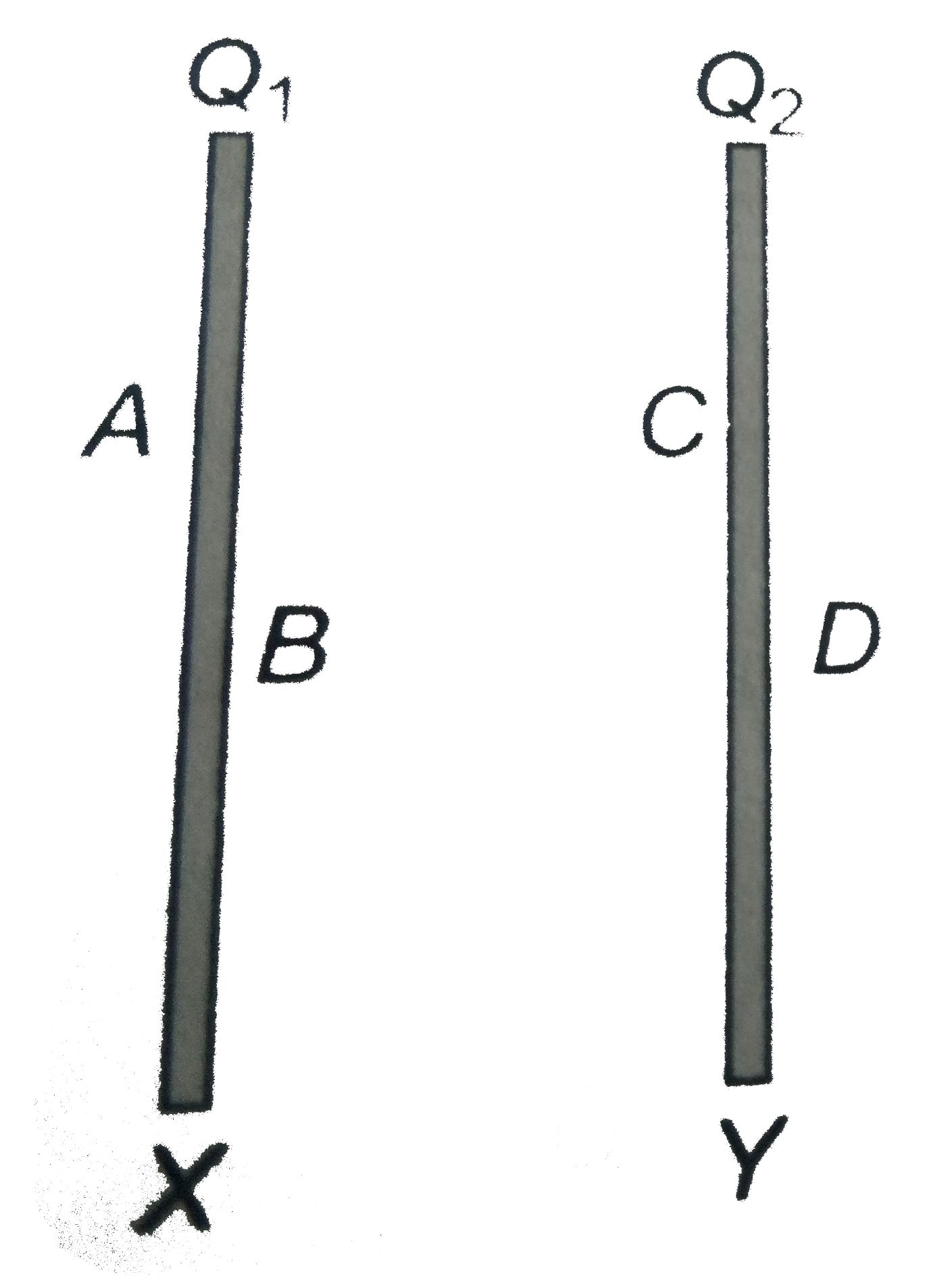
Two large , parallel conducting plates `X` and `Y` , kept close to each other , are given `Q_(1)` and `Q_(2) (Q_(1) gt Q_(2))`. The four surfaces of the plates are `A,B,C` and `D` , as shown

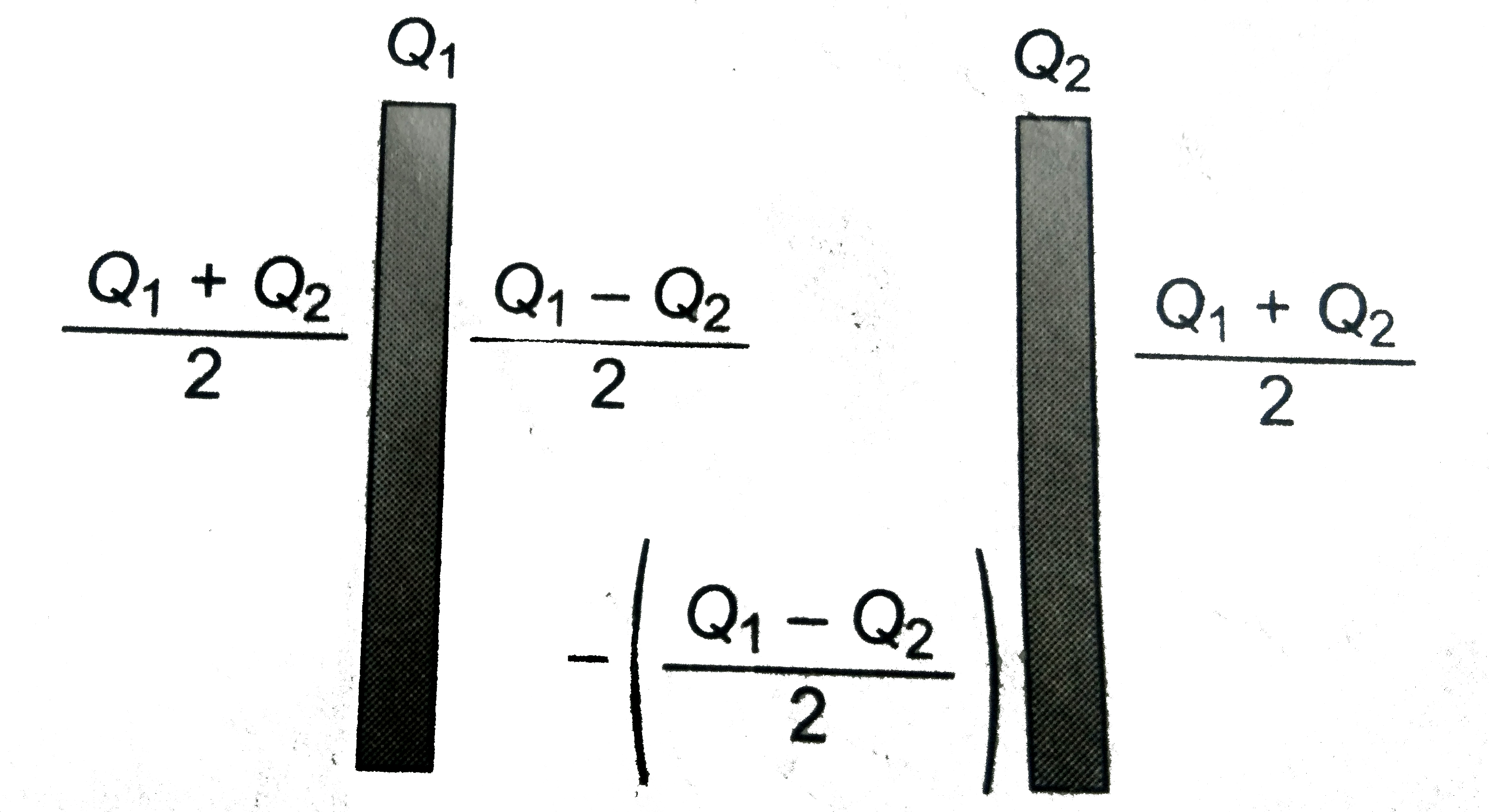
(i) The charge on `A` is `(1)/(2) (Q_(1) + Q_(2))`
(ii) The charge on `B` is `(1)/(2) (Q_(1) - Q_(2))`
(iii) The charge on `C` is `(1)/(2) (Q_(2) - Q_(1))`
(iv) The charge on `D` is `(1)/(2) (Q_(1) + Q_(2))`

A

`(i),(ii)`

B

`(ii),(iii)`

C

`(ii),(iv)`

D

All

Text Solution

Verified by Experts

The correct Answer is:
4

The outer surfaces of extreme plates have same charge (total `"charge"//2`), facing surfaces have equal and opposite charges.
Promotional Banner

Topper's Solved these Questions

  • ELECTROSTATICS

    CP SINGH|Exercise Exercises|226 Videos
  • ELECTROMAGNETIC WAVES

    CP SINGH|Exercise EXERCISES|21 Videos
  • MAGNETIC FIELD

    CP SINGH|Exercise EXERCISE|77 Videos

Similar Questions

Explore conceptually related problems

Two conducting plates A and B are placed parallel to each other. A is given a charge. Q_1 and B a charge Q_2 . Find the distribution of charges on the four surface.

Two conducting plates A and B are placed parallel to each other. A is given a charge Q_1 and B a charge Q_2 . Prove that the charges on the inner surfaces are of equal magnitude and opposite sign.

Charges Q_(1) and Q_(2) lie inside and outside respectively of an uncharged conducting shell. Their separation is r . (i) The force on Q_(1) is zero (ii) The force on Q_(1) is k((Q_(1) Q_(2))/(r^(2))) (iii) The force on Q_(2) is k((Q_(1) Q_(2))/(r^(2))) (iv) The force on Q_(2) is zero

The value of charge q_1 ,q_2 and q_3 as shown in the figure are

Identify the correct statement about the charges q_(1) and q_(2) .

In an isolated parallel plate capacitor of capacitance C , the plates have charge Q_(1) and Q_(2) . The potential difference between the plates is

Consider a parallel plate capaciter having plates of unequal area. When a battery supplies +Q_(1) and -Q_(2) charges to two plates.

Looking at the various electric lines of forces between charges Q_(1) and Q_(2) , find the value of (Q_(1))/(Q_(2))

In, the charges on C_(1),C_(2) , and C_(3) , are Q_(1), Q_(2) , and Q_(3) , respectively. .

In an isolated parallel plate capacitor of capacitancee C , the four surface have chrges Q_(1),Q_(2),Q-(3) and Q_(4) as shown. The potential difference between the plates is

CP SINGH-ELECTROSTATICS-Exercises
  1. Charge q on a small conducting sphere S(1) is placed inside a large ho...

    Text Solution

    |

  2. A spherical conductor A of radius r is placed concentrically inside a ...

    Text Solution

    |

  3. A,B and C are three concentric metallic shells . Shell A is the innerm...

    Text Solution

    |

  4. A conducting sphere A of radius a ,with charge Q , is placed concentri...

    Text Solution

    |

  5. Two large , parallel conducting plates X and Y , kept close to each ot...

    Text Solution

    |

  6. Three identical metal plates with large surface areas are kept paralle...

    Text Solution

    |

  7. The electric energy stored in a cube

    Text Solution

    |

  8. A positively charged oil droplet remins stationary in the electric fie...

    Text Solution

    |

  9. The electric field at the centre of a uniformly charged ring is zero. ...

    Text Solution

    |

  10. Two infinitely long parallel wires having linear charge densities lamb...

    Text Solution

    |

  11. An electric charge 2 xx 10^(-8) C is placed at the point (1,2,4). At t...

    Text Solution

    |

  12. A large solid sphere with uniformly distributed positive charge has a ...

    Text Solution

    |

  13. The electric field due to uniformly charged sphere of radius R as a fu...

    Text Solution

    |

  14. Two ideantical point charges are placed at a separation of d. P is a p...

    Text Solution

    |

  15. Conisder a thin spherical shell of radius R with centre at the origin,...

    Text Solution

    |

  16. Two concentric coducting thin spherical shells A and B having radii rA...

    Text Solution

    |

  17. A uniformly charged thin spherical shell of radius R carries uniform s...

    Text Solution

    |

  18. A soap bubble is given a negative charge, then its radius

    Text Solution

    |

  19. A conducting sphere of radius R is given a charge Q. The electric pote...

    Text Solution

    |

  20. In a region, the potential is respresented by V(x, y, z) = 6x - 8xy - ...

    Text Solution

    |

