

Home
Class 12
PHYSICS
(a) Find the value of i and potential di...

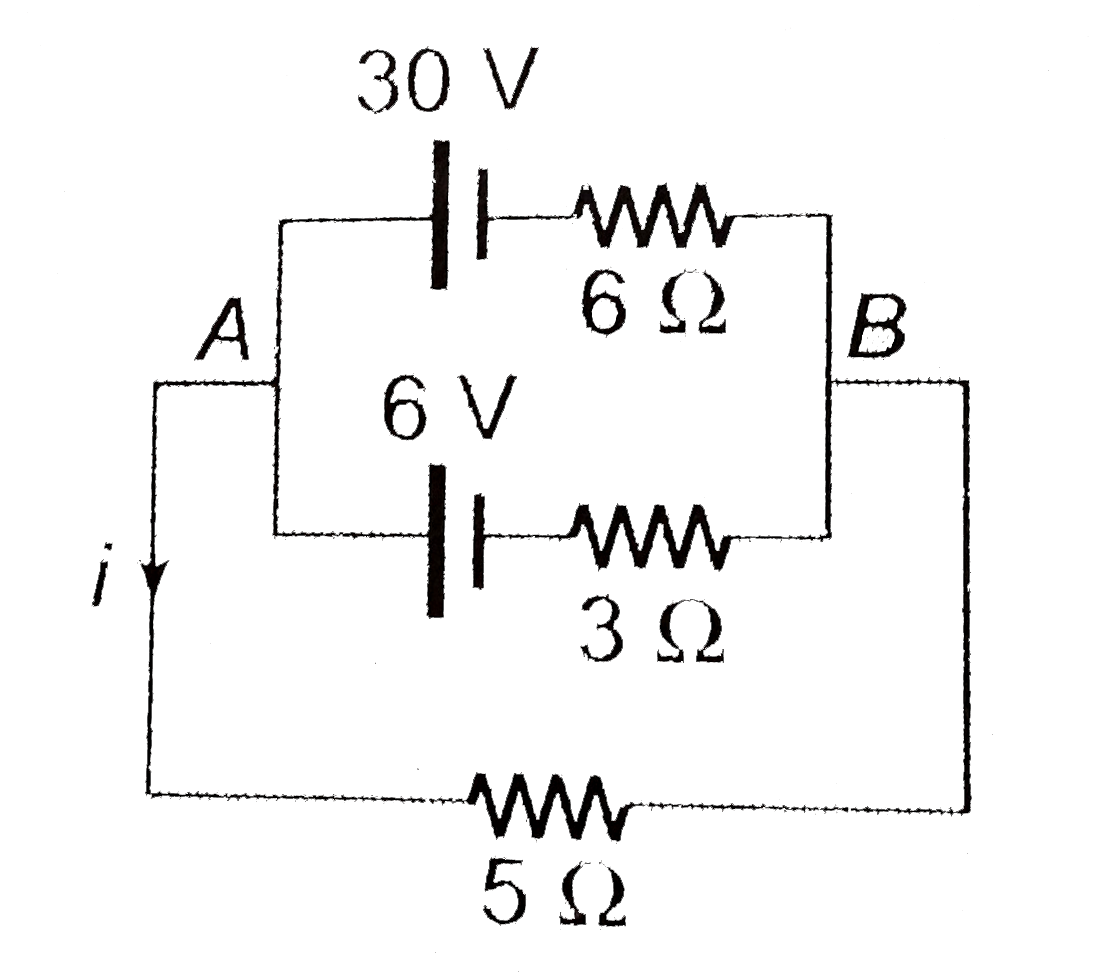
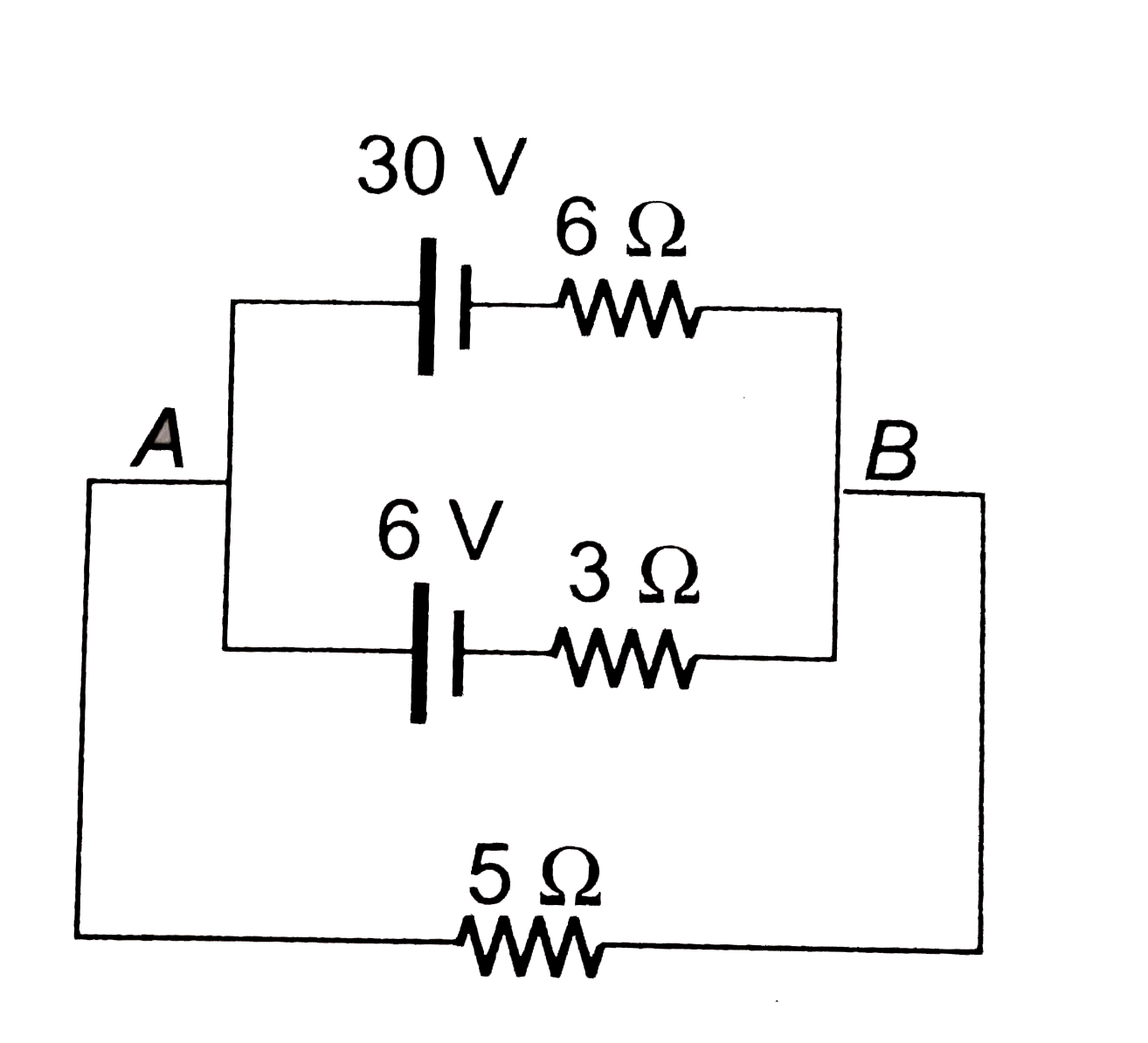
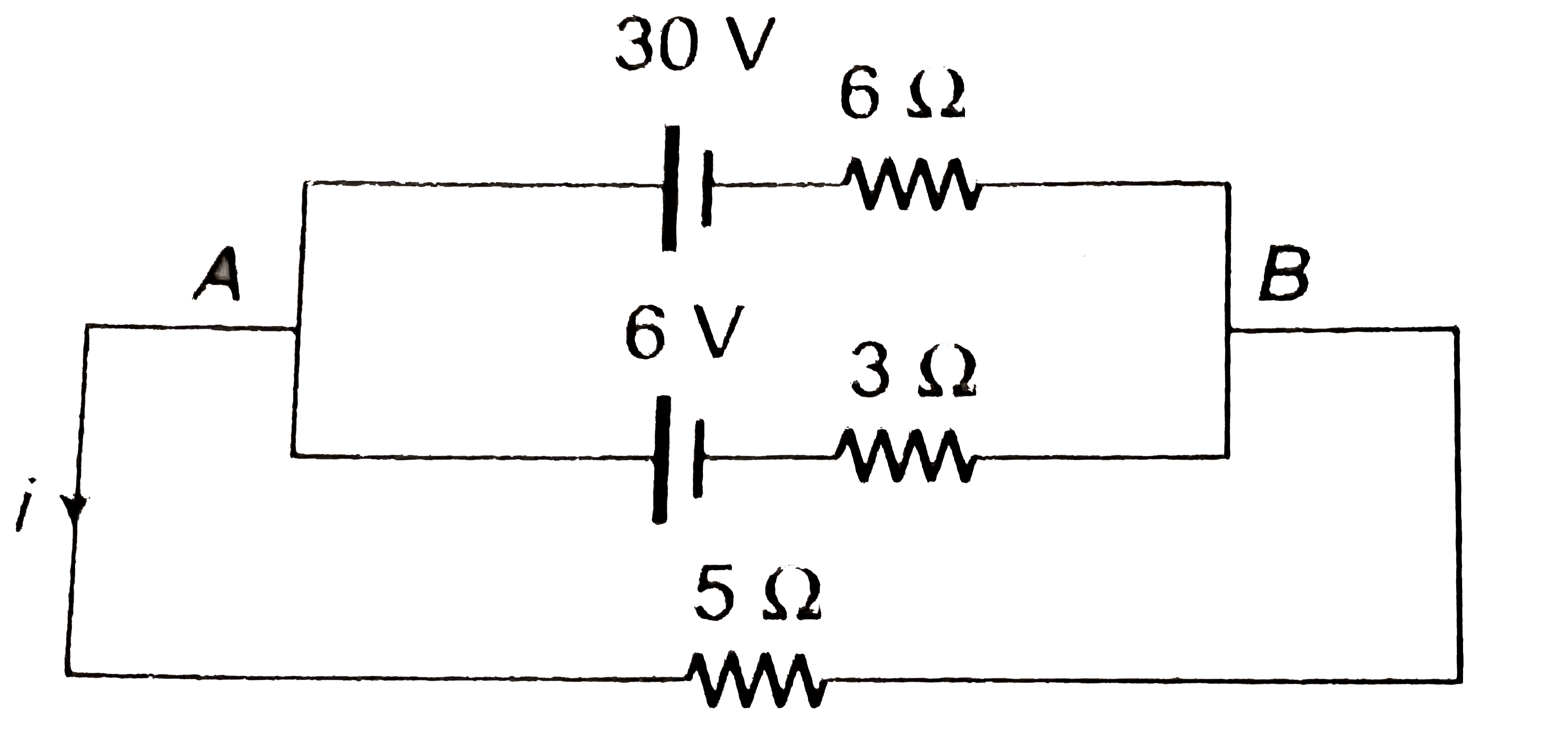
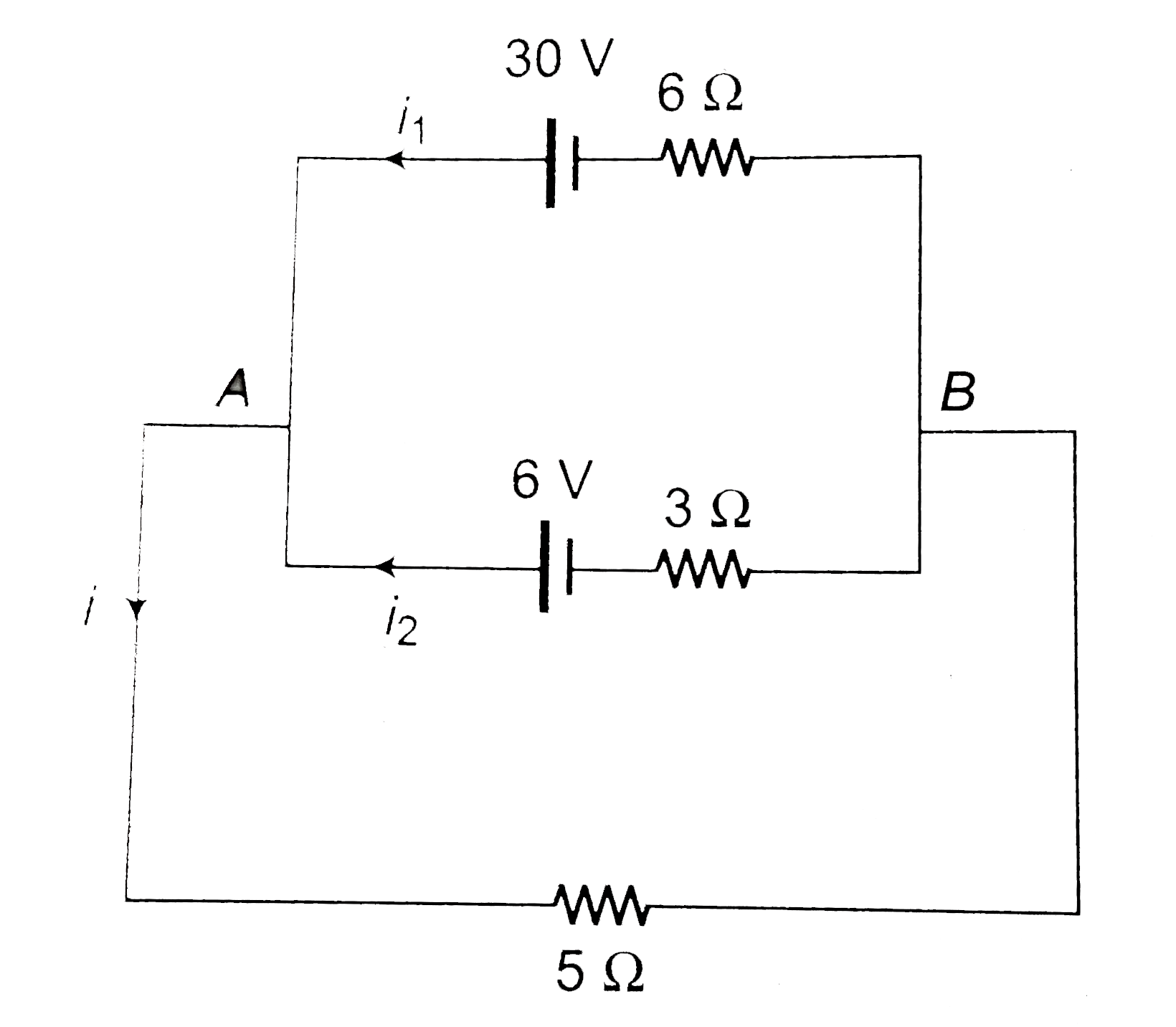
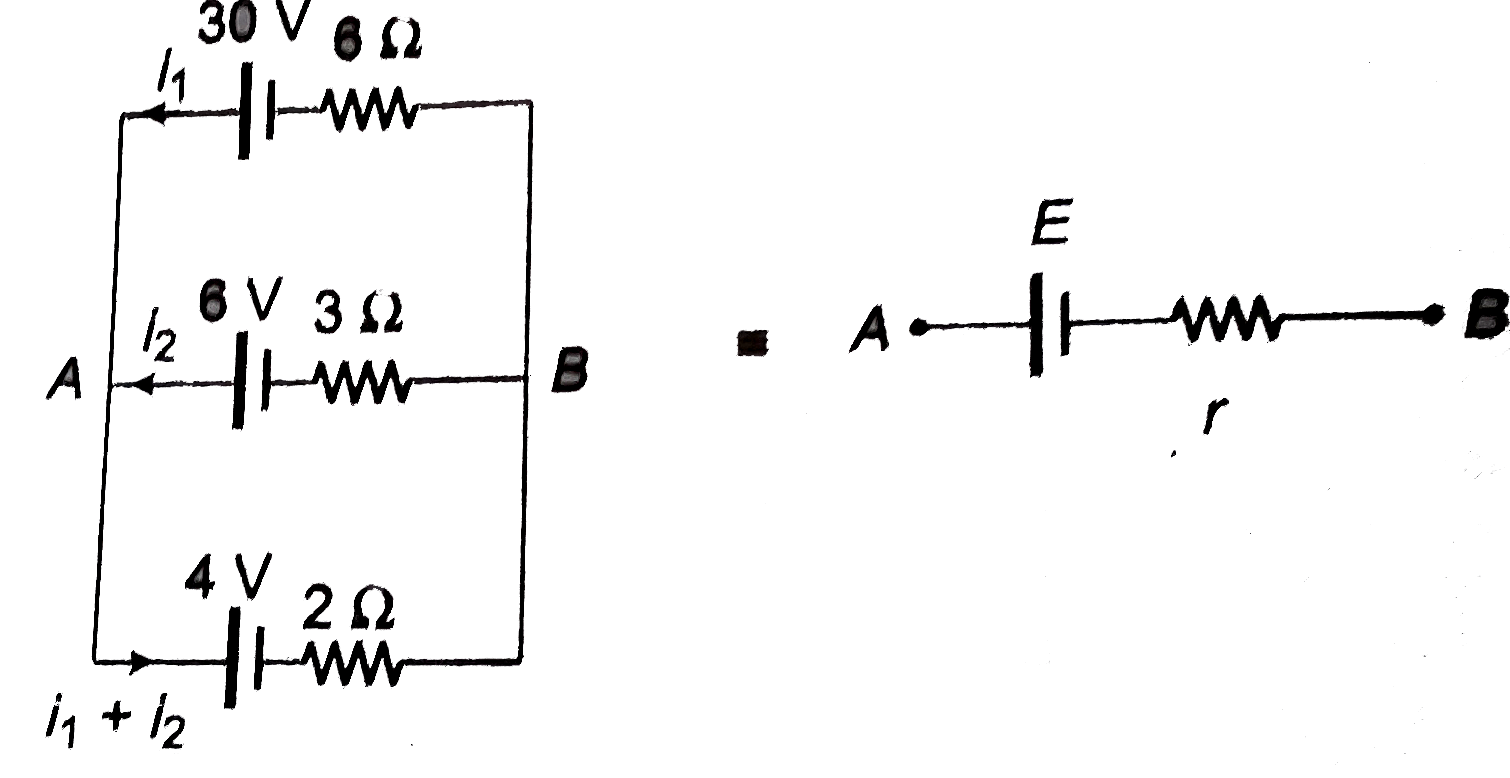
(a) Find the value of `i` and potential difference across each cell.

(b) Find potential difference between `A` and `B`.

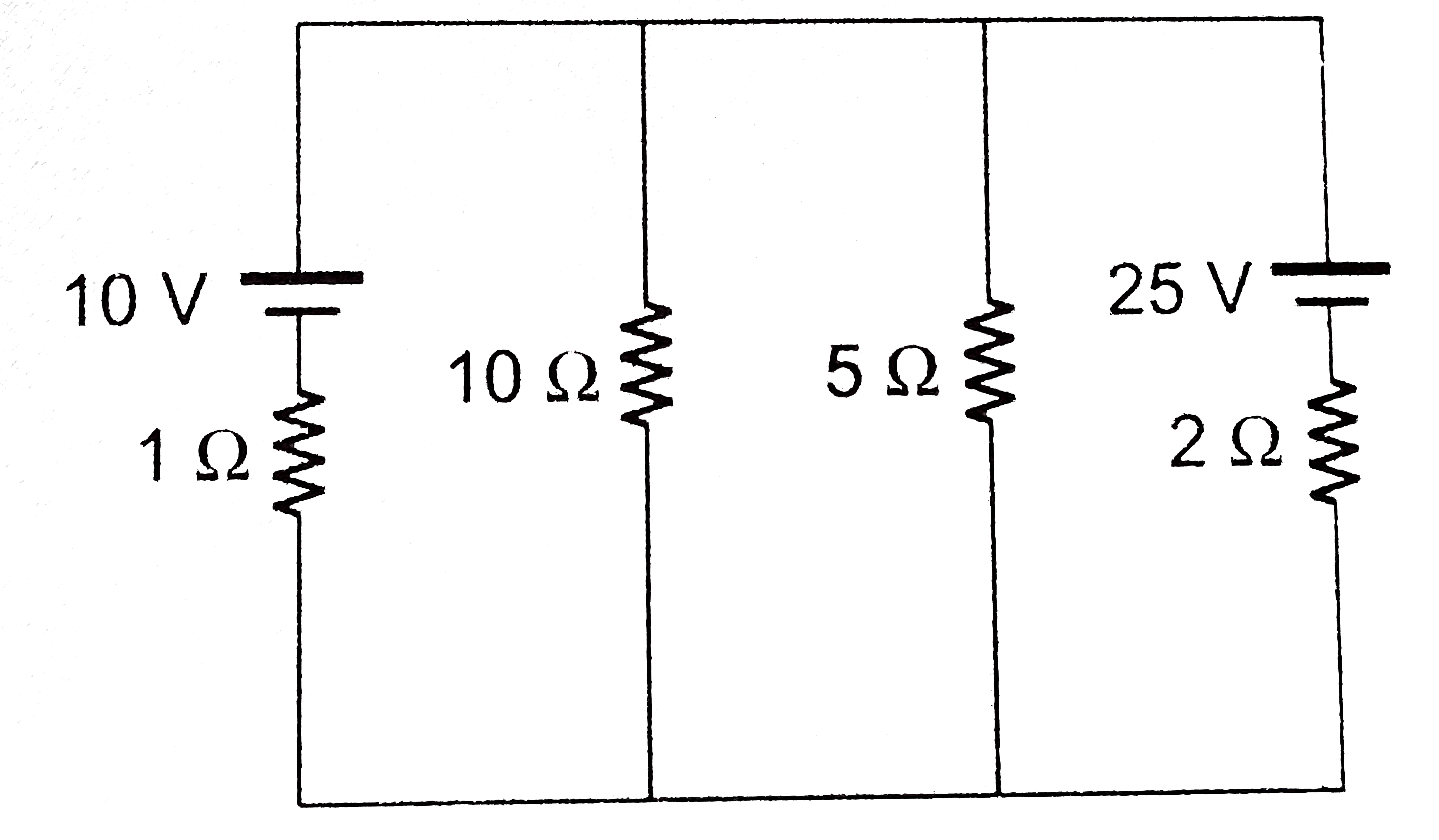
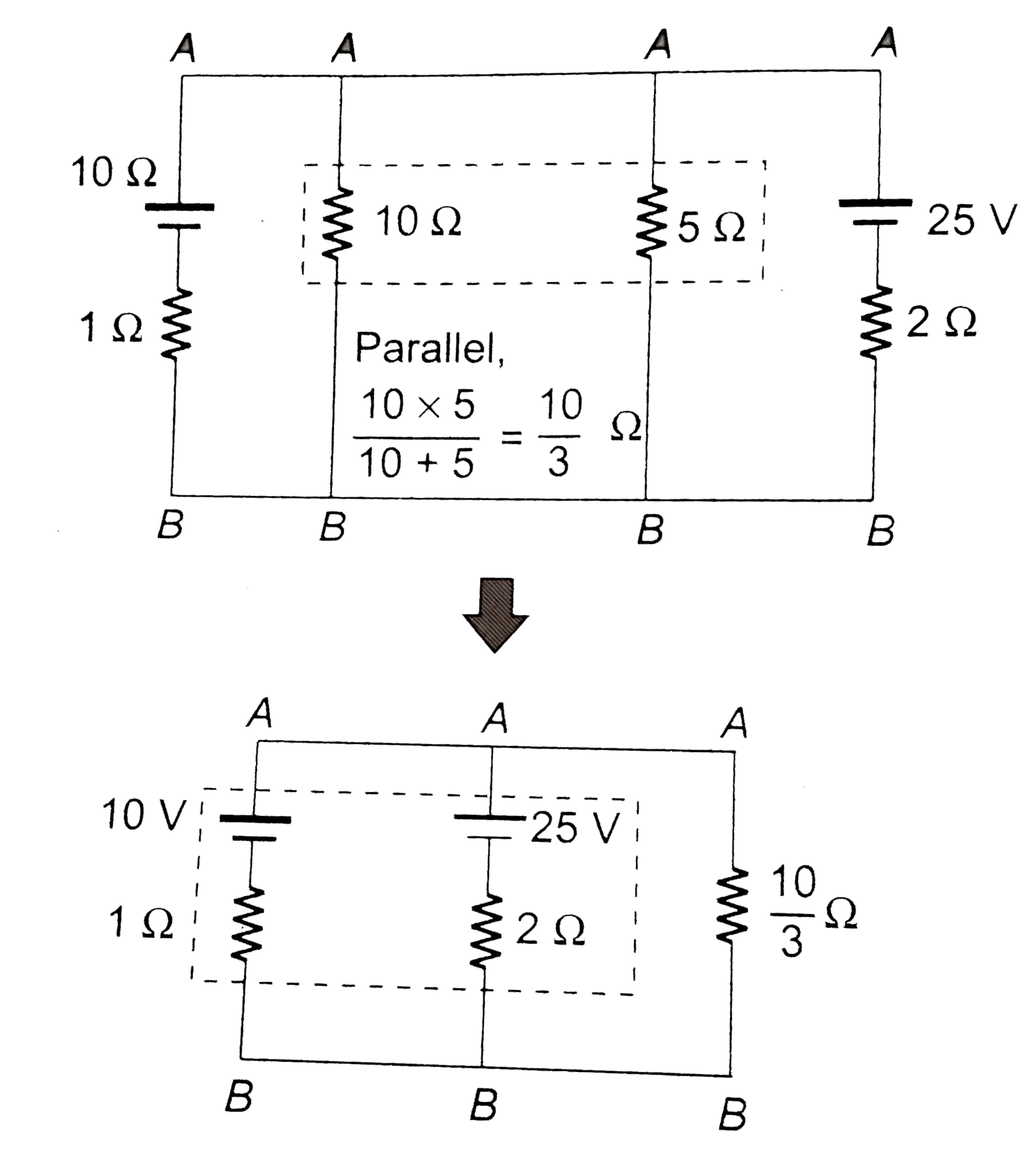
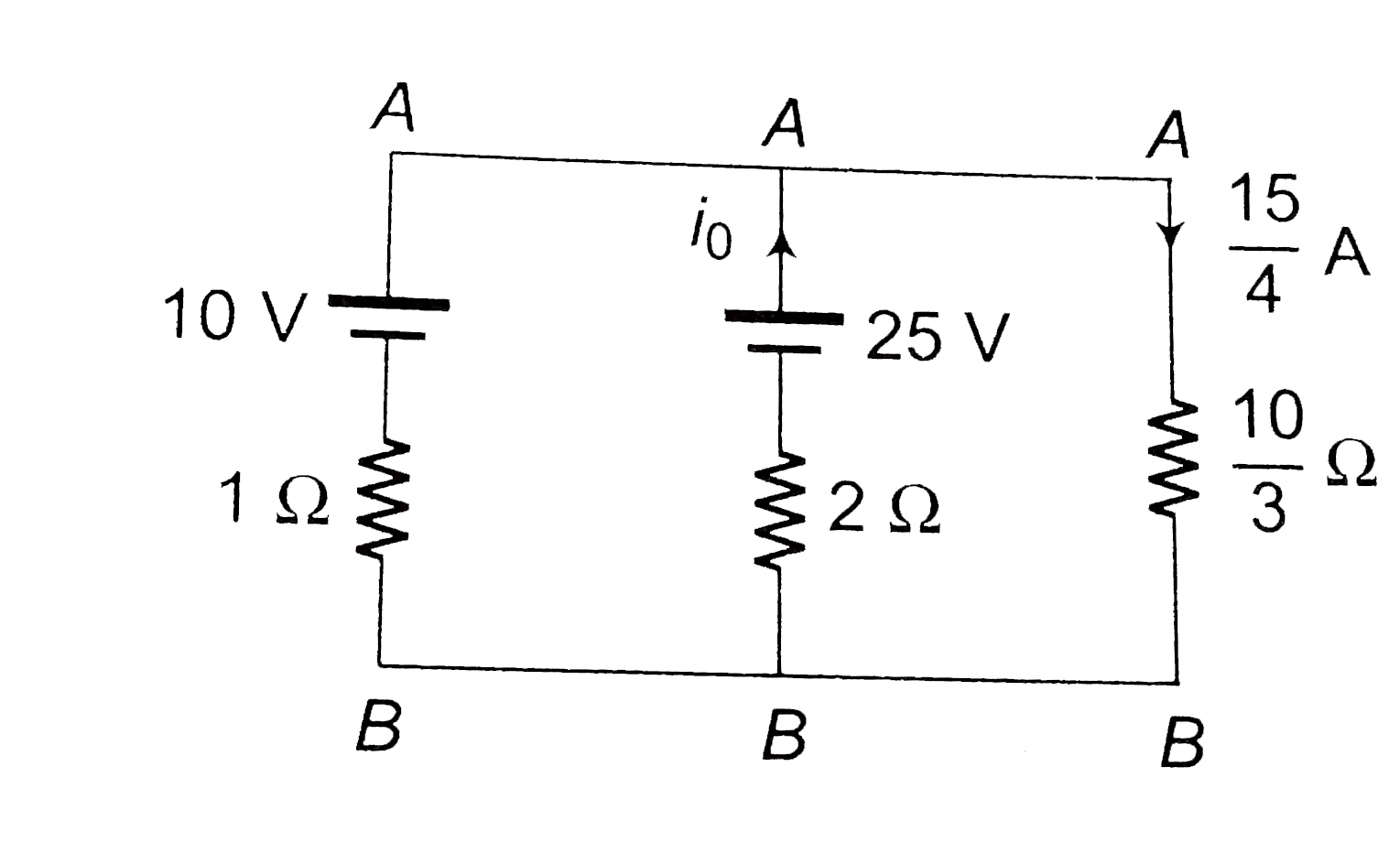
( c) In the given circuit,

find
(i) potential difference between terminals `10 V` cell
(ii) current through `25 V` cell
(iii) current through `5 Omega`
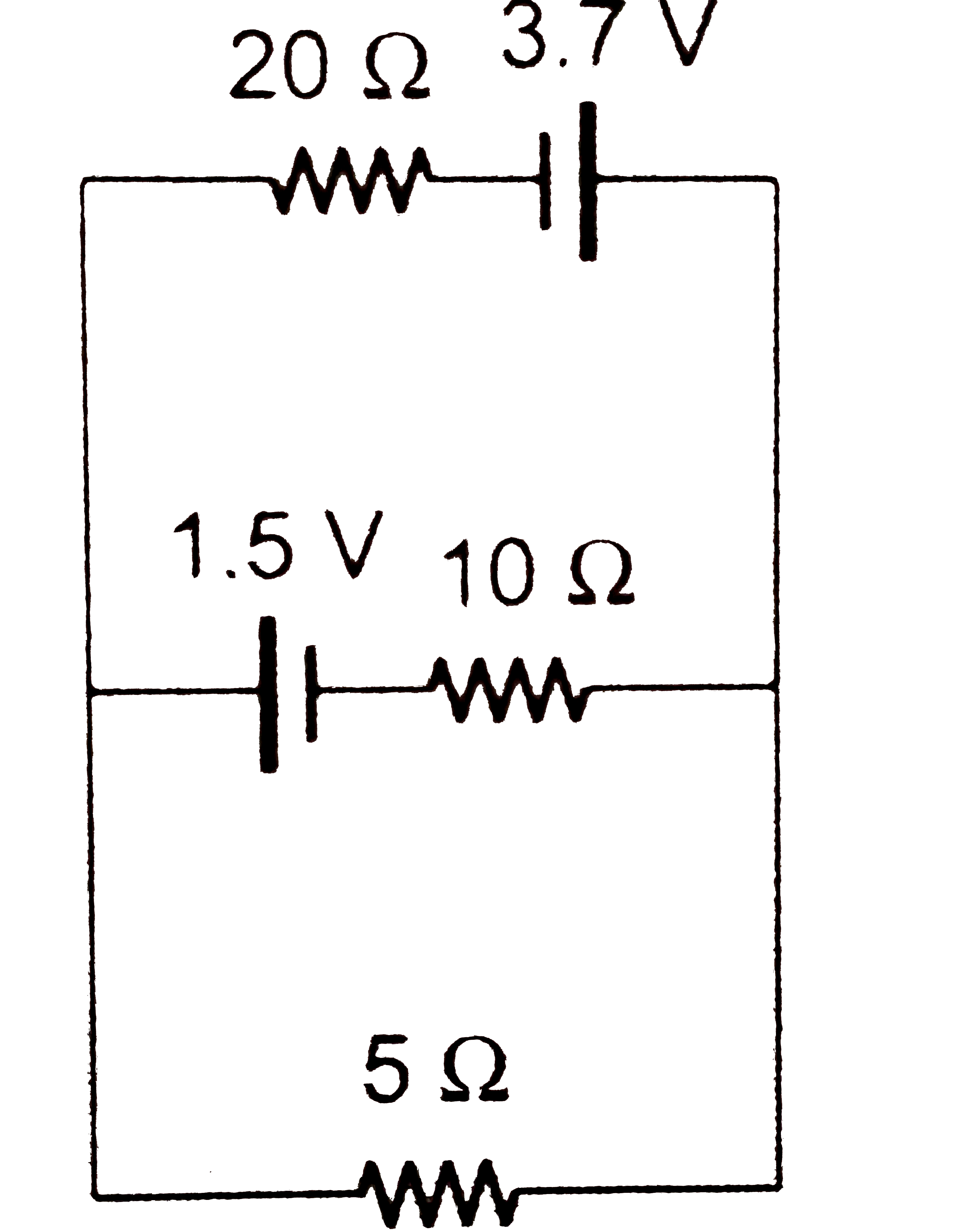
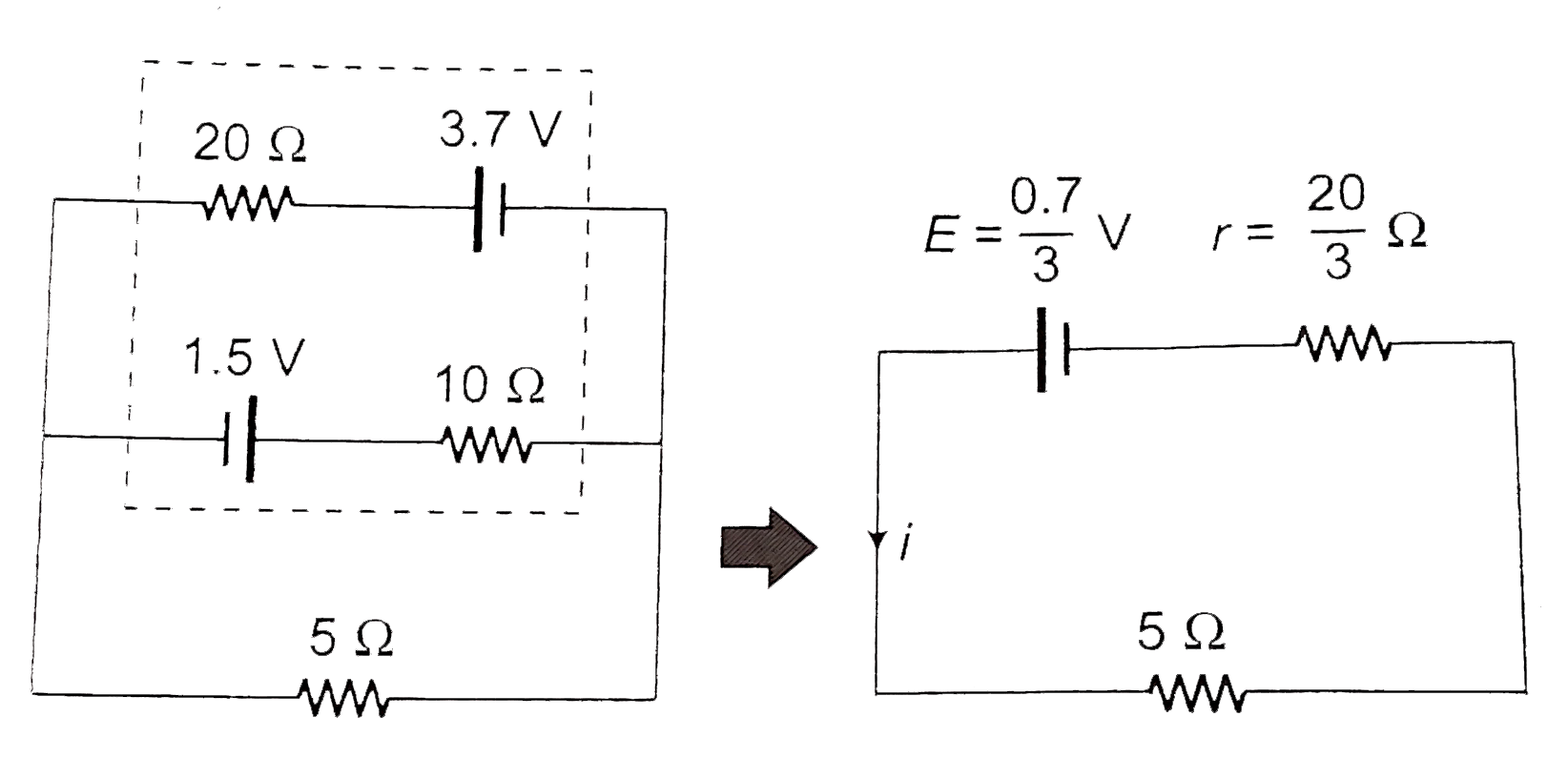
(d) Find the current through resistance `5 Omega`.
.

Text Solution

Verified by Experts

(a)
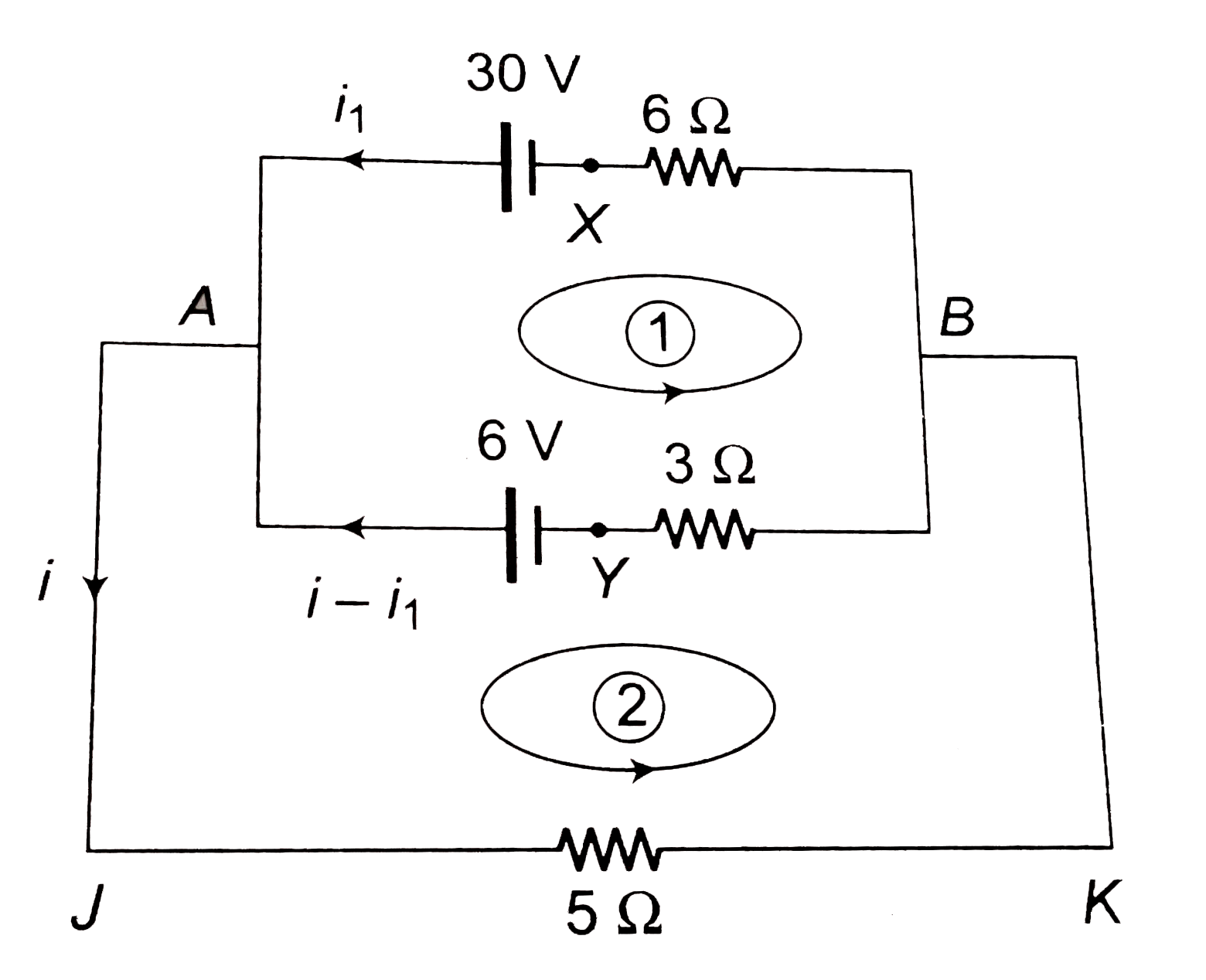
By Kirchhoff's rules :First assume direction of currents in different branches as you like but currents should be balanced at junctions. Here current in `5 Omega` is required and it is `i`. Let current in `30 V` cell is `i_1` towards left.
At junction `A : i = i_1 + x rArr x = i - i_1` i.e., current in `6 V` cell is `i - i_1` towards left.

Here two unknowns `i` and `i_1`, so we require two equations. For this move from one point to the same point on two different paths.
(a) `A to A , lo op ① , path AYBXA`
`V_A - 6 + 3(i - i_1) - 6 i_1 + 30 = V_A`
`3 i - 3 i - 6i_1 = - 24`
`i - 3 i_1 = -8` ...(i)
(ii) `A to A , lo op ② , "path AJKBYA"`
`V_A - i xx 5 - (i - i_1) xx 3 + 6 = V_A`
`-8 i + 3i_1 = - 6`
`8 i - 3 i_1 - 6` ...(ii)
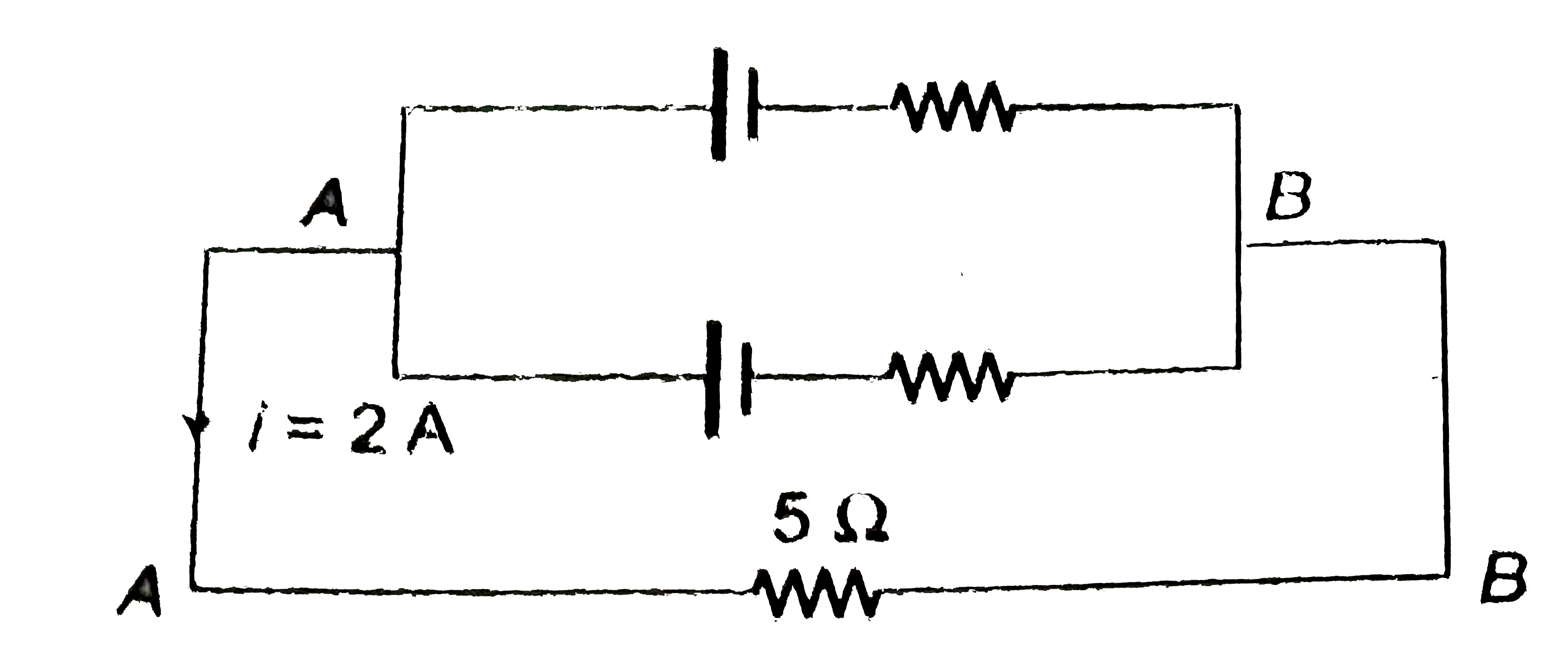
Solving (i) and (ii) rArr (i)-(ii) `rArr - 7 i = -14 rArr i = 2 A`

`V_A - V_B = 2 xx 5 = 10 V`
Alternative method :

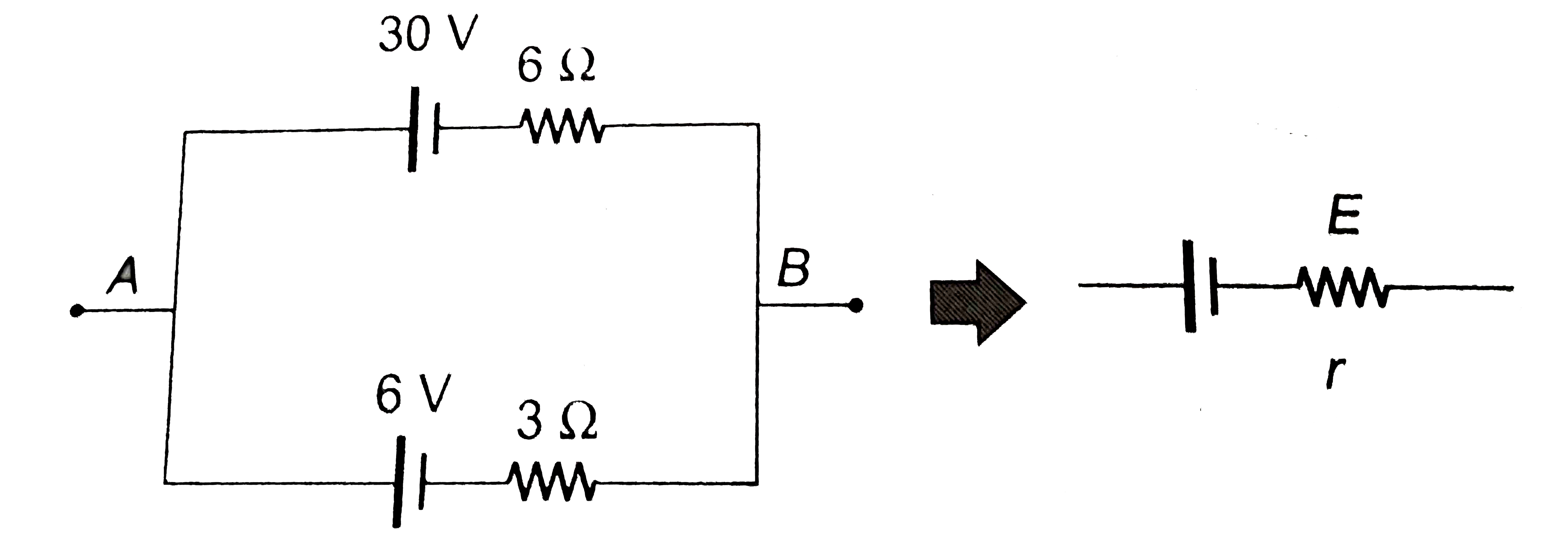
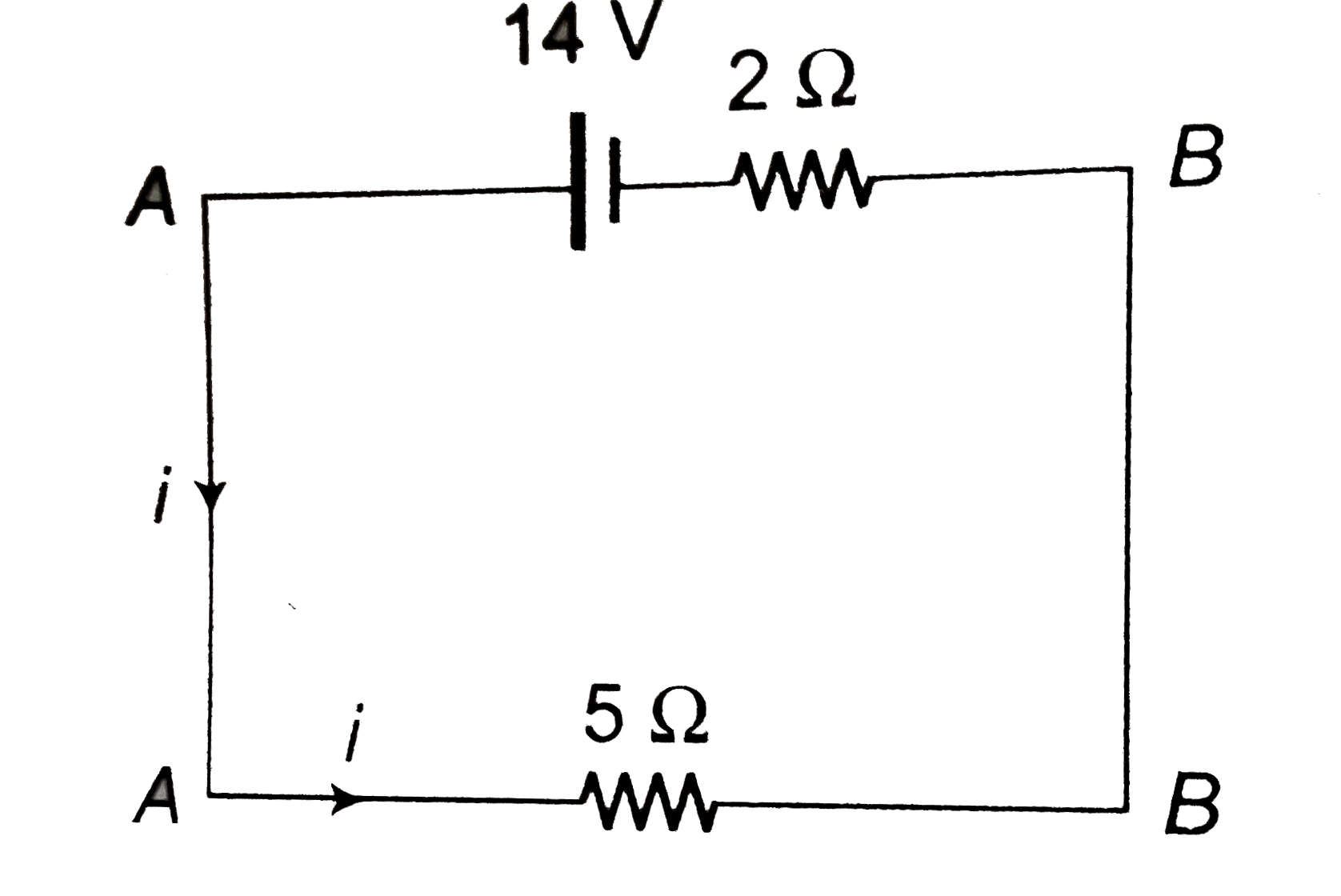
Here, one terminal of cells is connected to `A` and another terminal is connected to `B` (do not look at internal resistance of cells), hence these cells can be replaced by single cell.

`E = ((E_1)/(r_1) + (E_2)/(r_2))/((1)/(r_1) + (1)/(r_2)) = ((3)/(6) + (6)/(3))/((1)/(6) + (1)/(3)) = (5 + 2)/((1)/(2)) = 14 V`
`r = (r_1 r_2)/(r_1 + r_2) = (3 xx 6)/(3 + 6) = 2 Omega`.

`i = (14)/(2 + 5) = 2 A`
`V_A - V_B = i xx 5 = 2 xx 5 = 10 V`
OR
`V_A - V_B = 14 - 2 xx 2 = 10 V`
For calculating currents in other braches :

`V_A - V_B = 10 V`
Cell of emf `30 V` :
`V_A - V_B = 30 - i_1 xx 6`
`10 = 30 - 6 i_1 rArr i_1 = (10)/(3) A`
Cell of emf `6 V` :
`V_A - V_B = 6 - i_2 xx 3`
`10 = 6 - 3 i_2 rArr i_2 = -(4)/(3) A`
`-ve` sign indicates that current is flowing in opposite direction.
Check : `i_1 + i_2 = i`
`(10)/(3) - (4)/(3) = 2 = i` O.K.

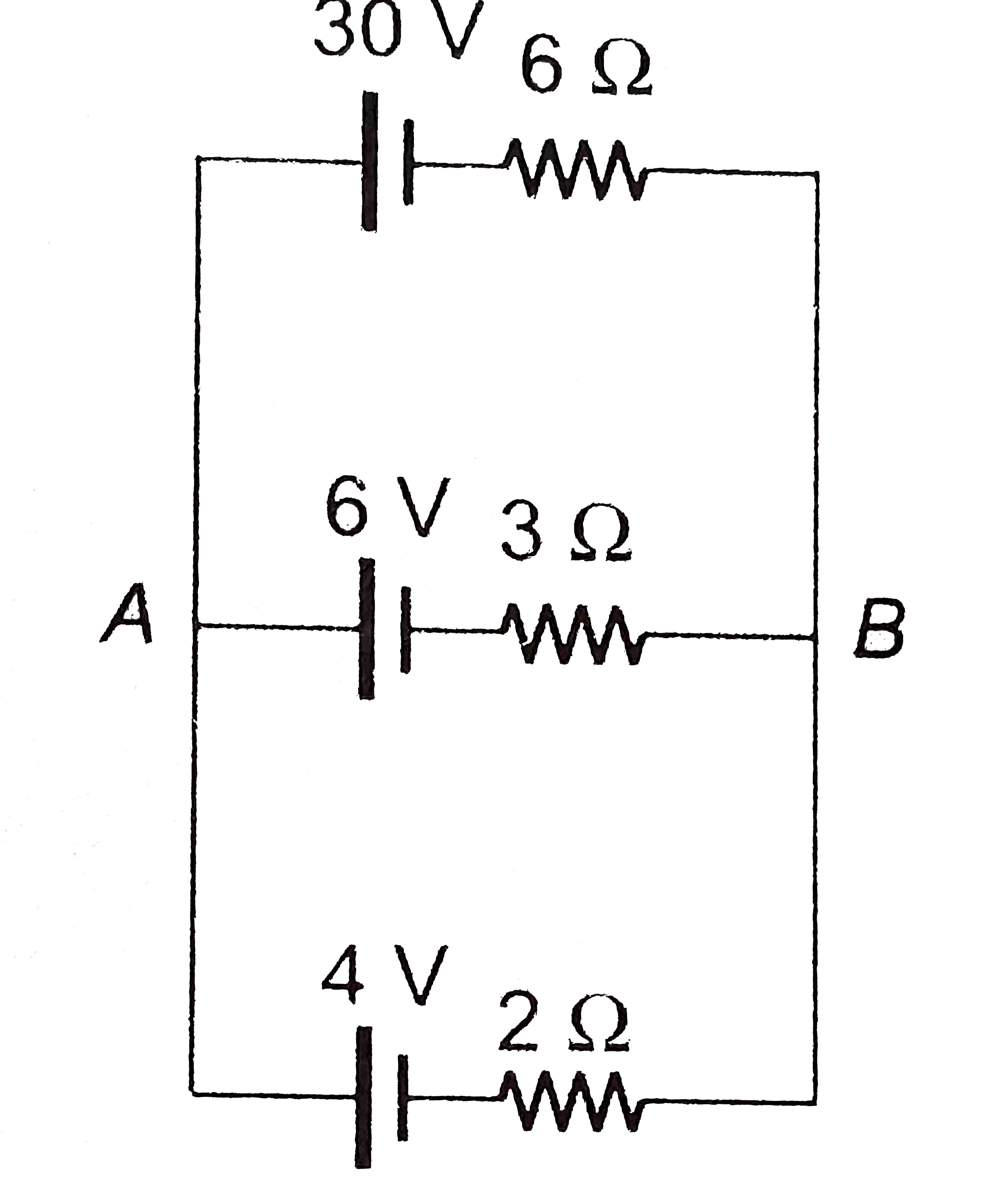
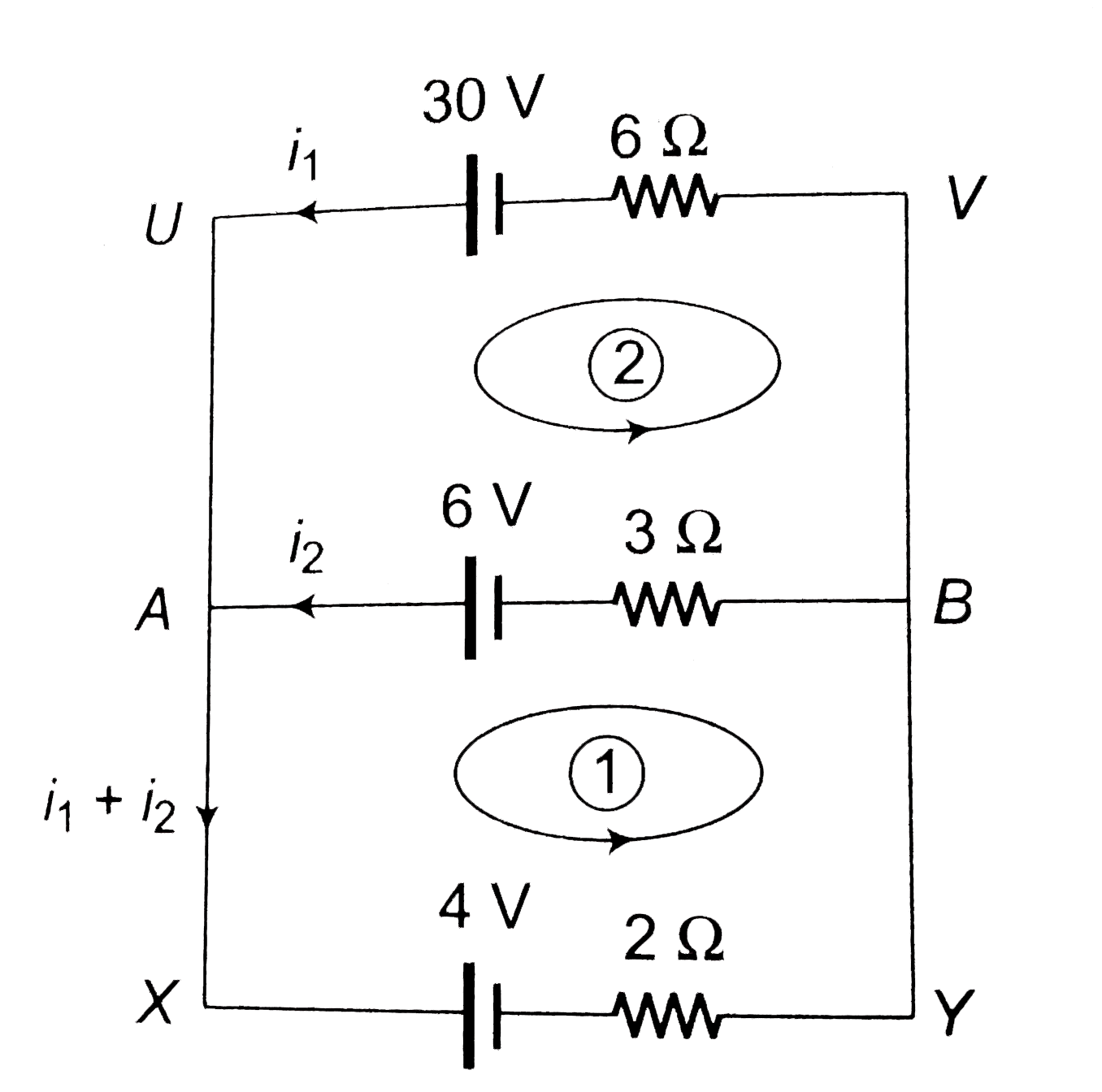
Let the current flowing in `30 V` cell is `i_1` and `6 V` cell is `i_2`. Current in `4 V` will be `i_1 + i_2` as shown
`Lo op ①, A to A, path AXYBA`
`V_A - 4 -(i_1 + i_2) xx 2 - 3 i_2 + 6 V_A`
`-2 i_1 - 5 i_2 + 2 = 0`
`2 i_1 + 5 i_2 = 2`
`Lo op ②, A to A, path AUVBA`
`V_A - 30 + 6 i_1 - 3 i_2 + 6 = V_A`
`6 i_1 - 3 i_2 = 24`
`2 i_1 - i_2 = 8`
Solving (i) and (ii), (i)-(ii), we get
`6 i_2 = -6 rArr i_2 = -1 A`
`2 i_1 - (-1) = 8 rArr i_1 = 7//2 = 3.5 A`
`A` to `B` :
`V_A - V_B = 6 - i_2 xx 3 = 6 -(-1) xx 3 = 8 V`.
Alternative method :
Here one terminal of all cells at point `A` and another terminal of all cells at point `B`, hence these cells can be replaced by single cell.

`E = (E_1//r_1 + E_2//r_2 + E_3//r_3)/((1)/(r_1) + (1)/(r_2) + (1)/(r_3)) = (30//6 + 6//3 + 4//2)/(1//6 + 1//3 + 1//2)`
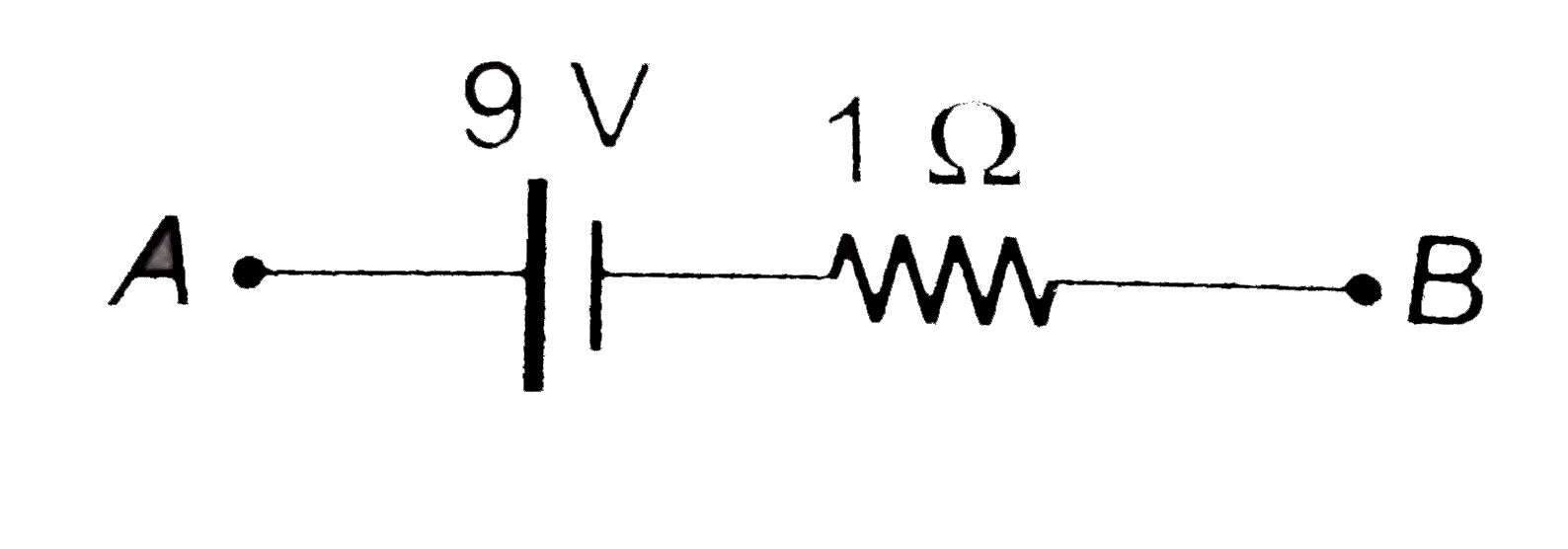
=`(5 + 2 + 2)/(1) = 9V`
`(1)/(r)=(1)/(r_1)+(1)/(r_2)+(1)/(r_3)=(1)/(6)+(1)/(3)+(1)/(2) = 1 rArr r = 1 Omega`

The equivalent cell is open circuit hence no current flows in it.
`V_A - V_B = 9 V`
Current on cells :
`30 V : V_A - V_B = 30 - i_1 xx 6 rArr 9 = 30 - 6 i_1`
`rArr i_1 = 3.5 A`
`6 V : V_A - V_B = 6 - i_1 xx 3 rArr 9 = 6 - 3 i_2 rArr i_2 = - 1 A`
`4 V: i_1 + i_2 = 3.5 - 1 = 2.5 A`.
( c)
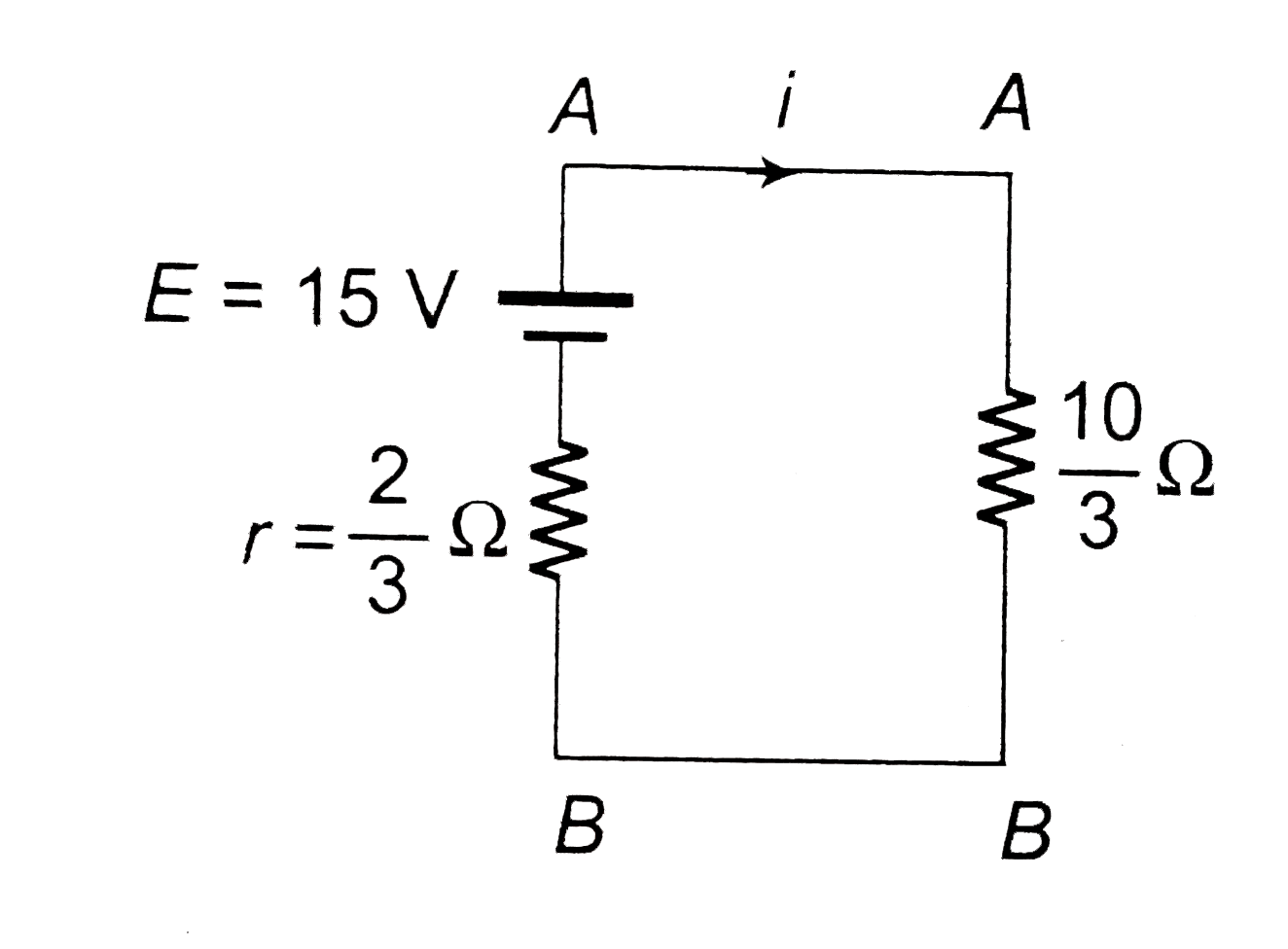
`E = ((10)/(1) + (25)/(2))/((1)/(1)+(1)/(2)) = 15 V`
`r = (1 xx 2)/(1+ 2) = (2)/(3) Omega`

`i = (15)/((2)/(3)+(10)/(3)) = (15)/(4) = 3.75 A`
`V_A - V_B = i xx (10)/(3)=(15)/(4) xx(10)/(3) = (50)/(4) V`

(i) `p.d.` between terminals of `10 V` cell : `V_A - V_B = (50)/(4) V`
(ii) Let current through `25 V` cell is `i_0`
`V_A - V_B = 25 - i_0 xx 2`
`(50)/(4) = 25 - 2 i_0`
`i_0 = (50)/(8) = 6.25 A`

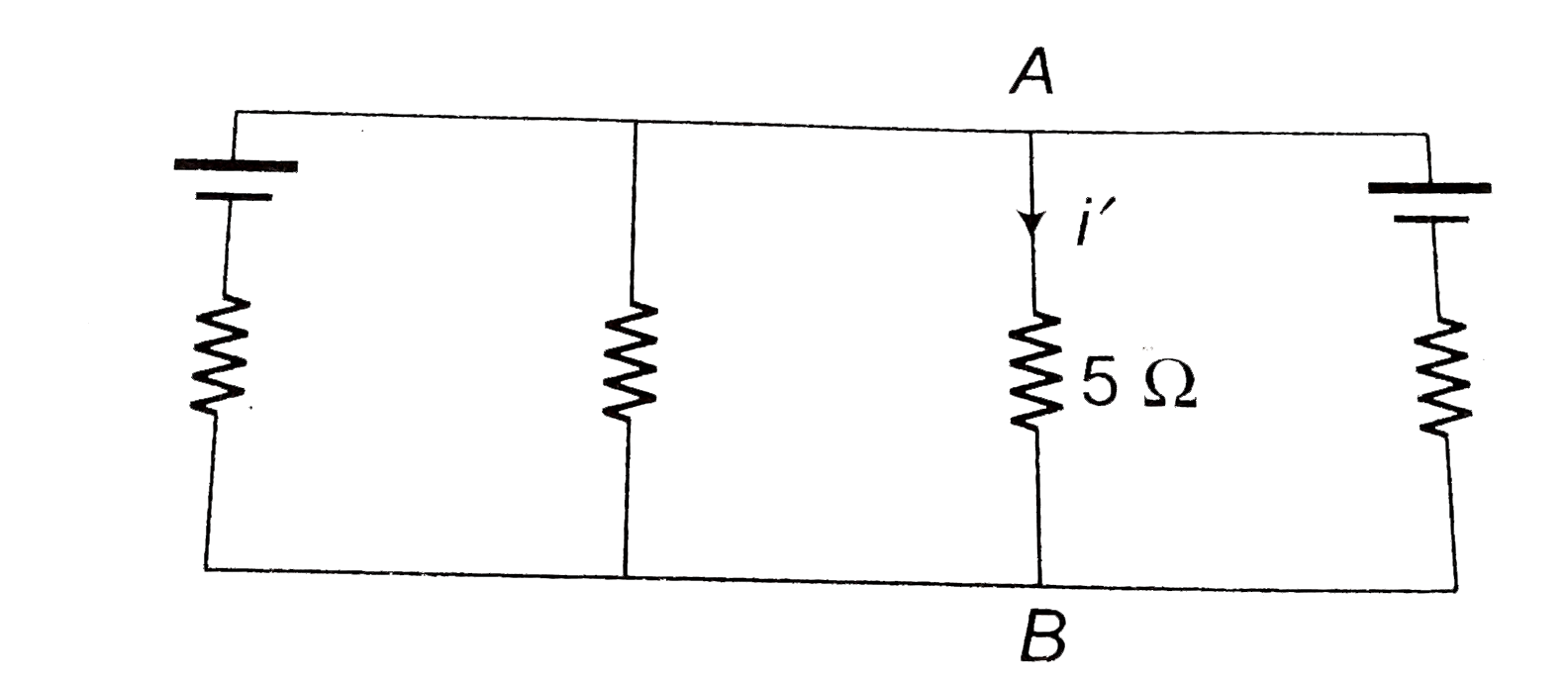
(iii) Current in `5 Omega`
`V_A - V_B = i' xx 5`
`(50)/(4) = 5 i' rArr i' = 2.5 A`
(d)
`E = ((3.7)/(20)-(1.5)/(10))/((1)/(20)+(1)/(10)) = (0.7)/(3) V`
`r = (20 xx 10)/(20 + 10) = (20)/(3) Omega`
`i = (0.7//3)/(20//3 + 5) =(0.7)/(35) = (1)/(20) A`.
Promotional Banner

Topper's Solved these Questions

  • CURRENT ELECTRICITY

    CP SINGH|Exercise Exercise|137 Videos
  • CAPACITANCE

    CP SINGH|Exercise Exercise|74 Videos
  • ELECTROMAGNETIC INDUCTION

    CP SINGH|Exercise EXERCISES|141 Videos

Similar Questions

Explore conceptually related problems

For the given circuit find current 'I' and phase difference between V & I

In the circuit shown in figure potential difference between point A and B is 16 V . Find the current passing through 2 Omega resistance.

Find potential difference across the resistance 300 Omega in A and B.

Find potential difference across the resistance 300 Omega in A and B.

Find the potential difference between the points a and b. If the points a and b are joined by a resistance of 5 Omega , calculate the current through this resistance.

For the given circuit find out:- (a) Total resistance of circuit across battery terminals. (b) Potential difference between A and B.

Find current in 6Omega resistance and potential difference across each cell in circuit shown in figure-3.173.

For the resistor network shown in the potential drop between a and b s 12V. a. Current through resistance of 6Omega is ……….. b. Current through resistance 2 Omega is ……….. c. Current through resistance of 8 Omega is ...........

CP SINGH-CURRENT ELECTRICITY-Exercise
  1. (a) Find the value of i and potential difference across each cell. ...

    Text Solution

    |

  2. In an atom, an electron moves in an orbit of radius r with a speed v, ...

    Text Solution

    |

  3. The current flowing through wire depends on time as, 1 = 3t^(2) + 2t +...

    Text Solution

    |

  4. We have two wire A and B of the same mass and the same material. The d...

    Text Solution

    |

  5. A wire of resistance R is elongated n-fold to make a new uniform wire....

    Text Solution

    |

  6. A wire of a certain material is stretched slowly by ten percent. Its n...

    Text Solution

    |

  7. If a copper wire is stretched to make it 0.1% longer wha is the percen...

    Text Solution

    |

  8. A ring is made of a wire having a resistance R(0) = 12 Omega. Find the...

    Text Solution

    |

  9. The massses of the three wires of copper are in the ratio 1 : 3 : 5. A...

    Text Solution

    |

  10. Dimensions of a block are 1 cm xx 1 cm xx 100 cm. If specific resistan...

    Text Solution

    |

  11. In the above question, the resistance between the square faces is.

    Text Solution

    |

  12. The resistance between ends will be .

    Text Solution

    |

  13. A material of resistivity rho is formed in the shape of a truncated co...

    Text Solution

    |

  14. Which of the following is correct regarding drift velocity.

    Text Solution

    |

  15. A steady current flows in a metallic conductor of non-uniform cross-se...

    Text Solution

    |

  16. A current of 5 A is passing through a metallic wire of cross-section a...

    Text Solution

    |

  17. A Steady current flows in a metalic conductor of non uniform cross sec...

    Text Solution

    |

  18. A straight conductor of uniform cross section carries a time varying c...

    Text Solution

    |

  19. Two resistors A and B have resistances R(A) and R(B)respectively with ...

    Text Solution

    |

  20. The resistance of a metallic conductor increases with temperature due ...

    Text Solution

    |

  21. A metallic resistor is connected across a battery.If the number of col...

    Text Solution

    |