Home
Class 12
PHYSICS
A milliammeter of range 10 mA and resist...

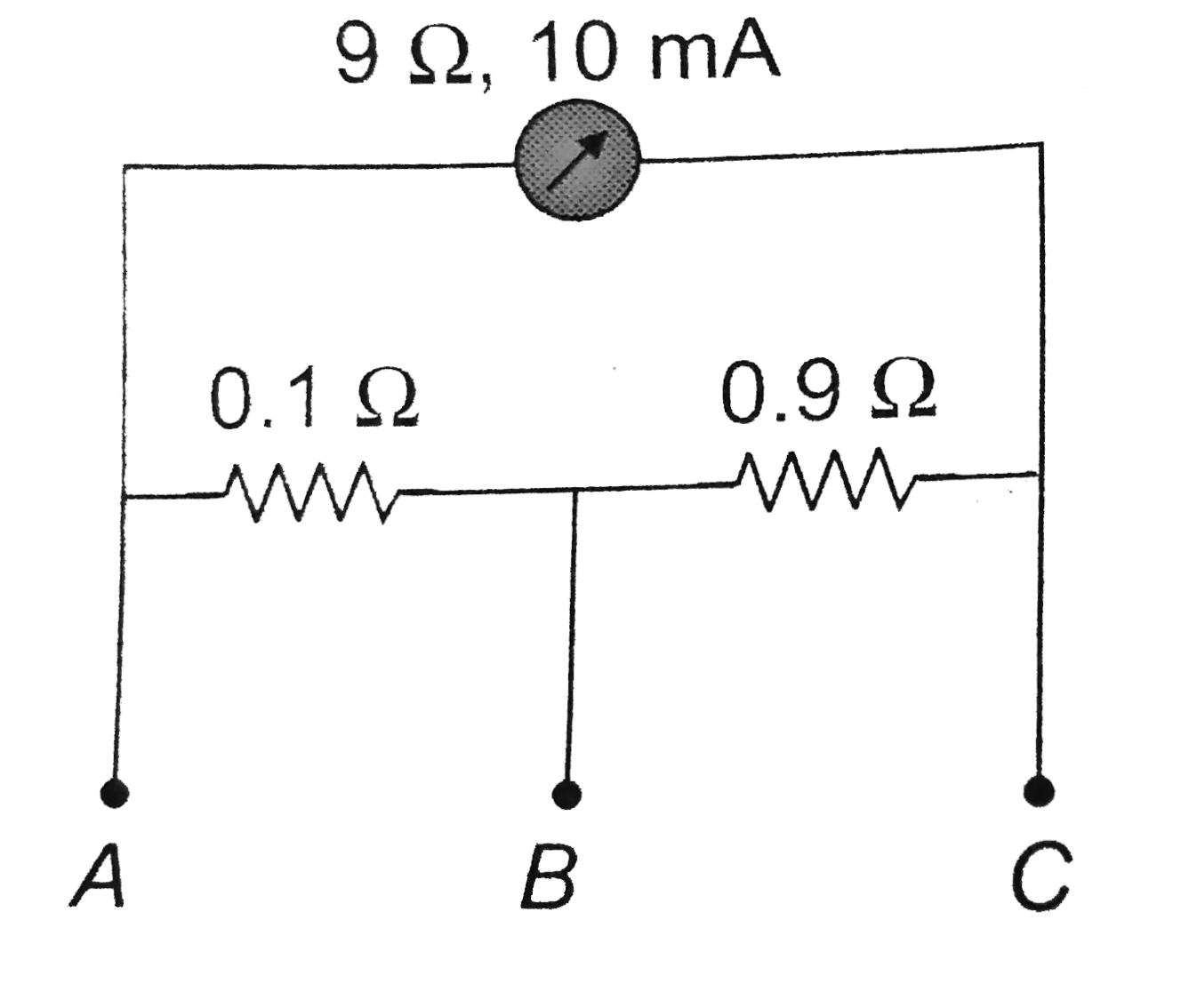
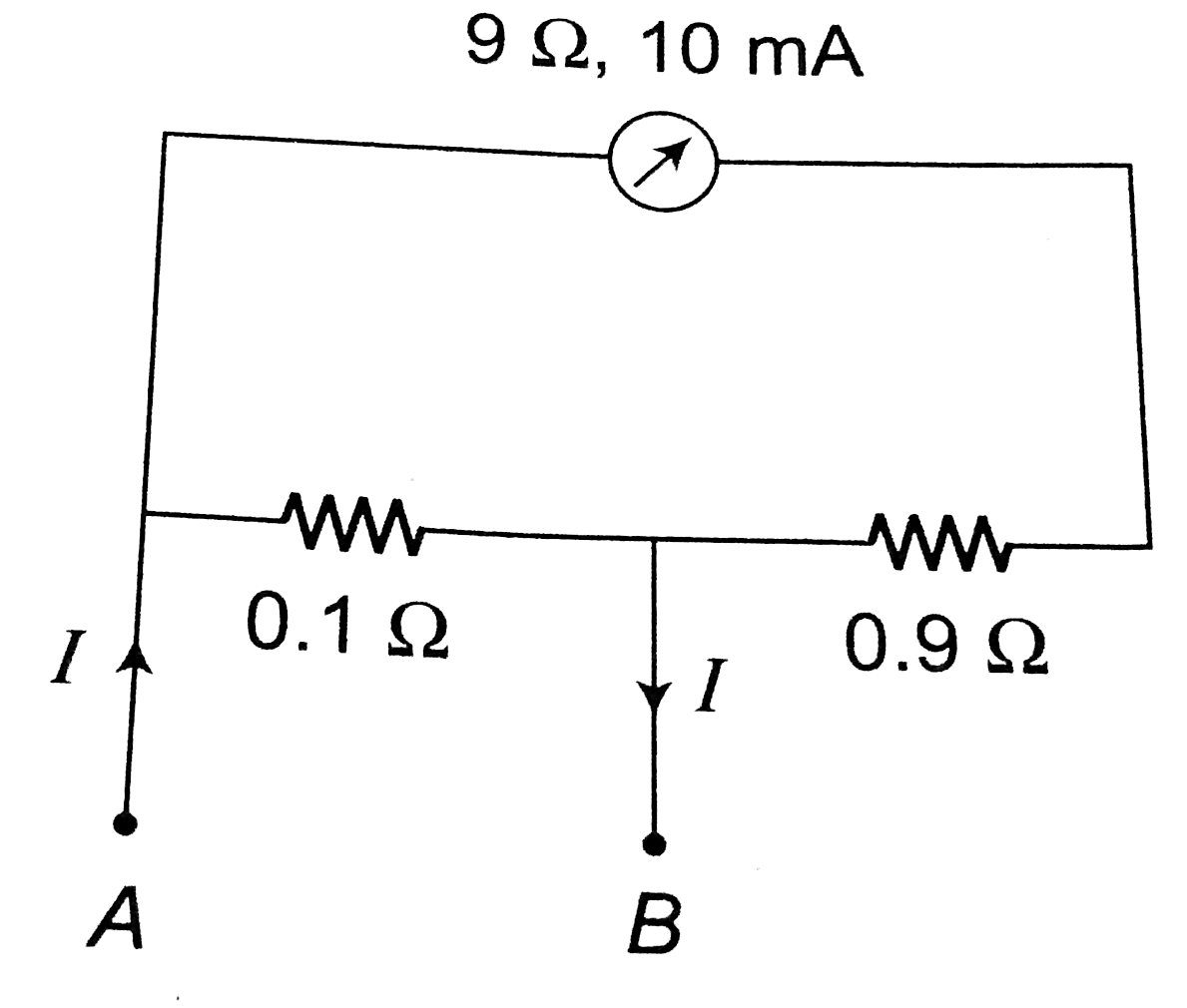
A milliammeter of range `10 mA` and resistance `9 Omega` is joined in a circuit as shown. The metre gives full-scale deflection for curretn `I` when `A` and `B` are used as its terminals, i.e., current enters at `A` and leaves at `B` (`C` is left isolated). The value if `I` is

A

100 mA

B

900 mA

C

`1 A`

D

`1.1 A`

Text Solution

Verified by Experts

The correct Answer is:
C


`(I - 10 xx 10^-3) xx 0.1 = (9 + 0.9) xx 10 xx 10^-3`
`I - 10 xx 10^-3 = 990 xx 10^-3`
`I = 1000 xx 10^-3 = 1 A`.
Promotional Banner

Topper's Solved these Questions

  • CURRENT ELECTRICITY

    CP SINGH|Exercise Exercise|137 Videos
  • CAPACITANCE

    CP SINGH|Exercise Exercise|74 Videos
  • ELECTROMAGNETIC INDUCTION

    CP SINGH|Exercise EXERCISES|141 Videos

Similar Questions

Explore conceptually related problems

A milli- ammeter of range 10 mA and resistance 9 Omega are joined in a circuit as shown in the fig. The meter gives full scale deflection, when current in the main circuit is I, and A and D are used as terminals. The value of I is

A milli-ammeter of range 10 mA and resistance 9Omega is joined in a circuit as shown in the figure. The meter gives full scale deflection, when circuit in the main circuit is 'I' and A and D are used as terminals. The value of I is

A galvanometer gives full scale deflection with current I_g . Can it be converted into an ammeter of range IltI_g ?

An ammeter has a resistance of 100 Omega A potential difference of 50 m V between its terminals gives full scale deflection. How will you convert it into an ammeter of range 5A ?

An ammeter gives full scale deflection when current of 1.0 A is passed in it. To convert it into 10 A range ammeter, the ratio of its resistance and the shunt resistance will be

A galvanometer coil has a resistance of 15 Omega and the metre shows full scale deflection for a current of 4 mA. To convert the meter into a voltmeter of range 0 to 18 V, the required resistance is

CP SINGH-CURRENT ELECTRICITY-Exercise
  1. Mark out the correct options (i) An ammeter should have small resist...

    Text Solution

    |

  2. A microammeter has as resistance of 100 Omega and full scale range of ...

    Text Solution

    |

  3. A milliammeter of range 10 mA and resistance 9 Omega is joined in a ci...

    Text Solution

    |

  4. In the previous question, if A and C are used as terminals, with B iso...

    Text Solution

    |

  5. A galvanometer of resistance G is shunted by a resistance S ohm. To...

    Text Solution

    |

  6. A voltmeter having a resistance of 998 ohms is connected to a cell of ...

    Text Solution

    |

  7. A voltmeter and an ammeter are connected in series to an ideal cell of...

    Text Solution

    |

  8. A, B and C are voltmeters of resistances R, 1.5R and 3R respectively. ...

    Text Solution

    |

  9. An ammeter and a voltmeter are joined in sereis to a cell. Their readi...

    Text Solution

    |

  10. Three voltmeters all having different resistance, are joined as shown....

    Text Solution

    |

  11. Three ammeters A,B, and C of resistances RA,Rb and RC respectively are...

    Text Solution

    |

  12. A voltmeter of resistance 200 Omega is used to measure p.d across resi...

    Text Solution

    |

  13. An ammeter and a voltmeter are connected in series to a battery of emf...

    Text Solution

    |

  14. The voltmeter reads 40 V across 60 Omega resistance. The resistance of...

    Text Solution

    |

  15. A p.d of 220 V is maintained across a 12000 Omega rheostat as shown. T...

    Text Solution

    |

  16. An elctrical circuit is shown in Fig. Calculate the potential differen...

    Text Solution

    |

  17. Two resistors of 500 Omega and 300 Omega are connected in series with ...

    Text Solution

    |

  18. In the circuit shown the cells A and B have negligible resistance. For...

    Text Solution

    |

  19. In the adjoining circuit, the e.m.f. of the cell is 2 volt and the int...

    Text Solution

    |

  20. In the circuit P != R, the reading of the galvanometer is same with s...

    Text Solution

    |

