Home
Class 12
PHYSICS
A narrow monochromatic beam of light of ...

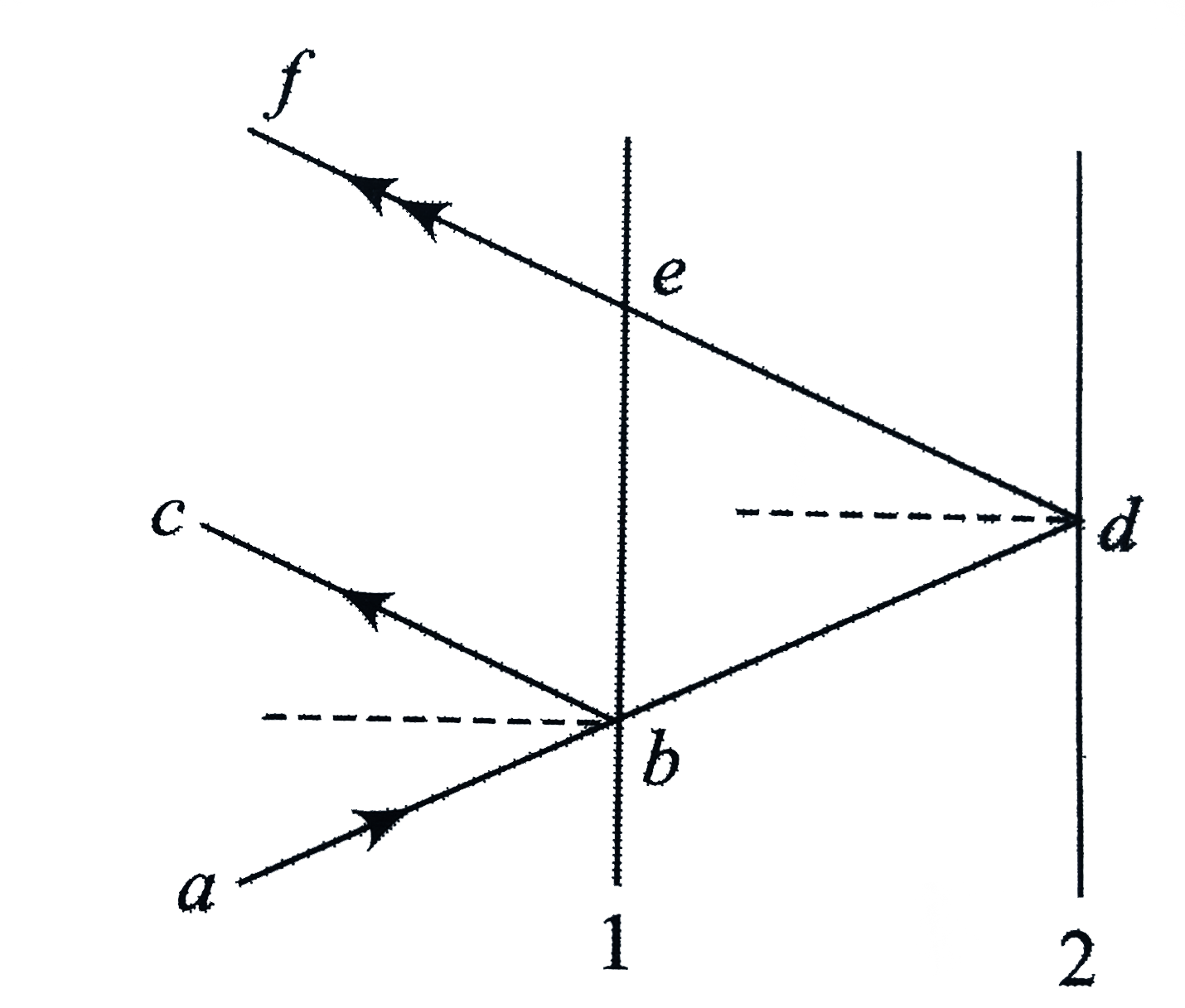
A narrow monochromatic beam of light of intensity 1 is incident on a glass plate as shown in figure Another identical glass plate is kept close to the first one and parallel to it. Each glass plate reflects `25%` of the light incident on it and transmits intensities in the interference pattern formed by two beams obtained after one reflection at each plate.

Text Solution

Verified by Experts
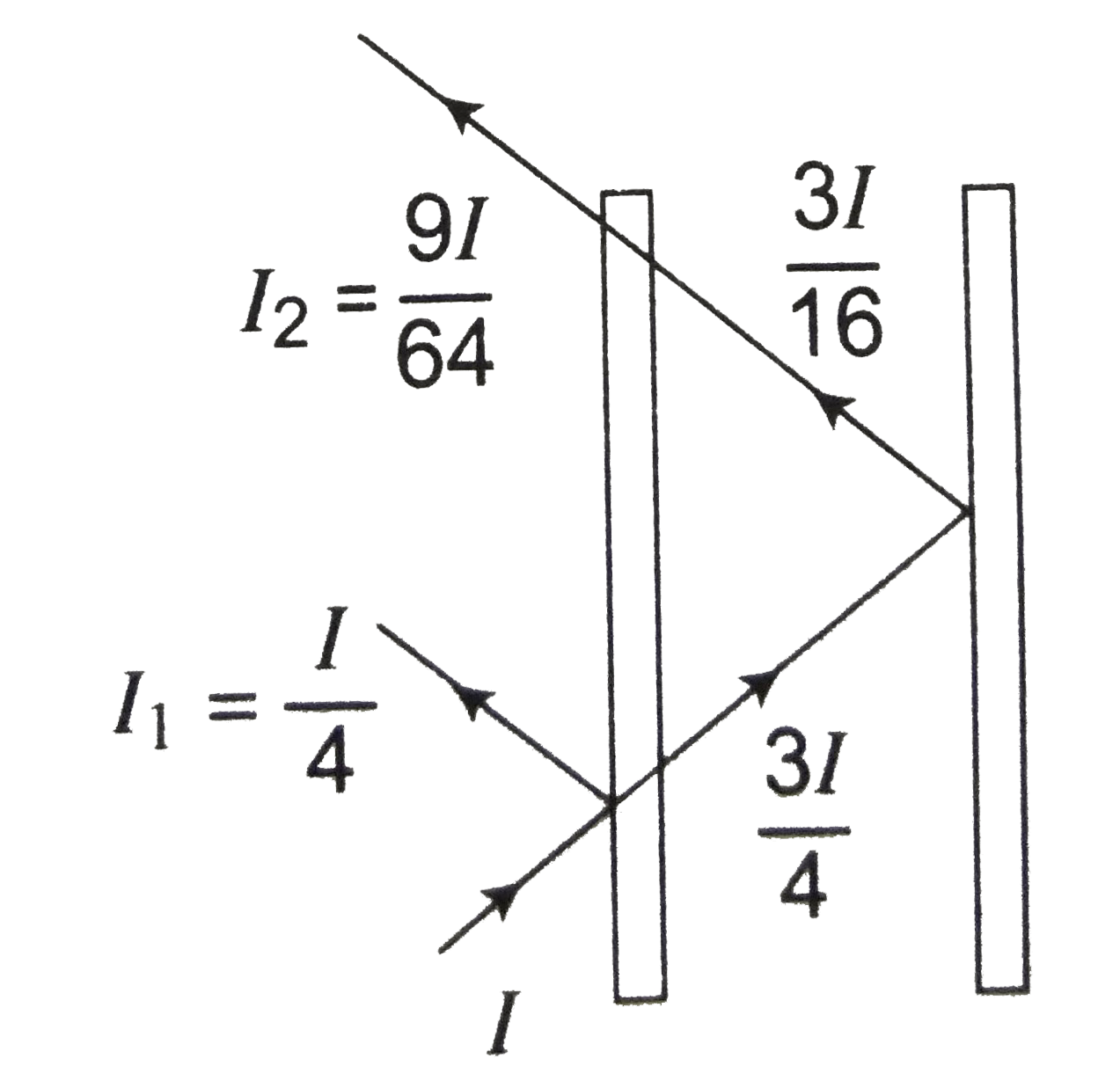

`I_(1)=I//4, I_(2)=(9I)/64`
`I_(min)/I_(max)=((sqrt(I_(1))-sqrt(I_(2)))/(sqrt(I_(1))+sqrt(I_(2))))^(2)=((sqrt(I//4)-sqrt((9I)/64))/(sqrt(I//4)+sqrt((9I)/64)))^(2)`
`=((1/2-3/8)/(1/2+3/8))^(2)=((1//8)/(7//8))^(2)=1/49`
Promotional Banner

Topper's Solved these Questions

  • WAVE NATURE OF LIGHT

    CP SINGH|Exercise EXERCISES|140 Videos
  • THERMAL AND ELECTRIC EFFECT oF CURRENT

    CP SINGH|Exercise Exercises|101 Videos
  • X-Rays

    CP SINGH|Exercise EXERCISES|34 Videos

Similar Questions

Explore conceptually related problems

A narrow monochromatic beam of light of intensity I is incident on a galss plate as shown in figure. Another identical glass plate is kept close to the first one & parallel to it. Each glass plate reflects 25% of the light incident on it % transmits the remaining find the ratio of the minimum & the maximum intensities in the interference pattern formed by the two beams obtained after one reflection at each plate.

A narrow monochromatic beam of light of intensity I is incident on a glass plate. Another identical glass plate is kept close to the first one and parallel to it. Each plate reflects 25% of the incident light and transmits the remaining. Calculate the ratio of minimum and maximum intensity in the interference pattern fromed by two beams obtained after reflection from each plate.

A ray light of intensity I is incident on a parallel glass-slab at a point A as shown in figure it undergoes partial reflection and refraction. At each reflection 20% of incident energy is refracted rays AB and A'B' undergo interference find the ratio I_(max)//I_(min)

A ray of light intensity I is incident on a parallel glass-slab at a point A as shown in figure. It undergoes partial reflection and refraction. At each reflection 25% of incident energy is reflected. The rays AB and A^(')B^(') undergo interference. The ratio I_(max)//I_(min) is

Two thin glass plates are placed parallel to each other such that distance between them is very small. Each glass plate reflects 25% of incident energy and transmits remaining 75% Light beam is incident on this system. Consider the interference of two light beams obtained after one reflection from each glass plate. Calculate ratio of the maximum to minimum intensity.

A parallel beam of light of intensity I is incident on a glass plate. 25% of light is reflected in any reflection by upper surface and 50% of light is reflected by any reflection from lower surface. Rest is refracted The ratio of maximum to minimum intensity in interference region of reflected rays is

A ray of light of intensity I is incident on a parallel glass slab at a point A as show. It undergoes partial reflection and refraction. At each reflaction 25% of incident energy is reflected. The rays AB and A'B' undergo interference. The ratio I_(max)//I_(min) is

A ray of unpolarised light is incident on a glass plate of refractive index 1.54 at polarising angle, then angle of refraction is :

A ray of light in incident on a glass plate at an angle of 60^@ . What is the refractive index of glass if the reflected and refracted rays are perpendicular to each other?

CP SINGH-WAVE NATURE OF LIGHT-EXERCISES
  1. A narrow monochromatic beam of light of intensity 1 is incident on a g...

    Text Solution

    |

  2. Lifgt is

    Text Solution

    |

  3. The speed of light depends

    Text Solution

    |

  4. The equation of a light wave i written as y=Asin(kx-omegat). Here y r...

    Text Solution

    |

  5. When light is refracted into a medium

    Text Solution

    |

  6. Wave nature of light follows because

    Text Solution

    |

  7. Ray optics is valid when characteristic dimensions are

    Text Solution

    |

  8. Light appears to travel in straight lines since

    Text Solution

    |

  9. The velocity of light in diamond, glass and water decreases in the fol...

    Text Solution

    |

  10. Choose the correct option:

    Text Solution

    |

  11. Choose the correct option: (i) A surface on which the wave disturban...

    Text Solution

    |

  12. A wavefront and a ray of light are

    Text Solution

    |

  13. Huygen's principle of secondary waves

    Text Solution

    |

  14. Huygen's priciple of secondary wavelets may be used to

    Text Solution

    |

  15. Which one of the following phenomena is not explained by Huygens const...

    Text Solution

    |

  16. By Huygen's wave theroy of light, we cannot explain the phenomenon of

    Text Solution

    |

  17. In the adjoining figure, a wavefront AB moving in air is incident on a...

    Text Solution

    |

  18. In the adjacent diagram, CP represents a wavefront and AO & BP, the co...

    Text Solution

    |

  19. Which of the following sources gives best mionochromatic light?

    Text Solution

    |

  20. A laser beam is used for carrying our surgery because it

    Text Solution

    |

  21. Two sources of light are said to be coherent if the waves produced by ...

    Text Solution

    |

