Home
Class 12
PHYSICS
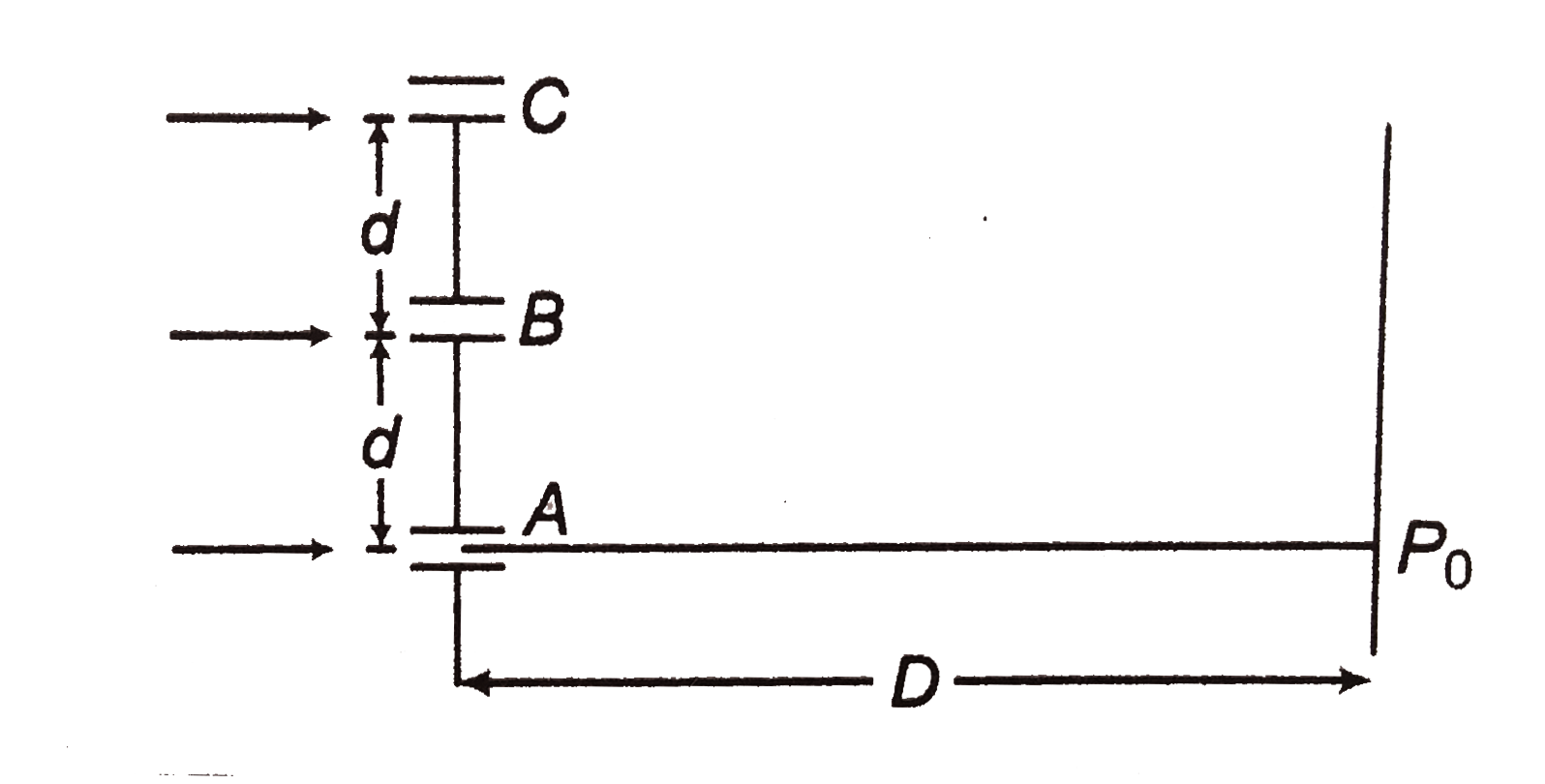
figure shows three equidistant slits ill...

figure shows three equidistant slits illuminated by a monochromatic parallel beam of light. Let `BP_0 -AP_0 = lambda/3` and `Dgtgtlambda`.

(a) Show that d = `sqrt ((2lambdaD)//3)`
(b) Show that the intensity at `P_0` is three times the intensity due to any of the three slits
individually.

Text Solution

Verified by Experts
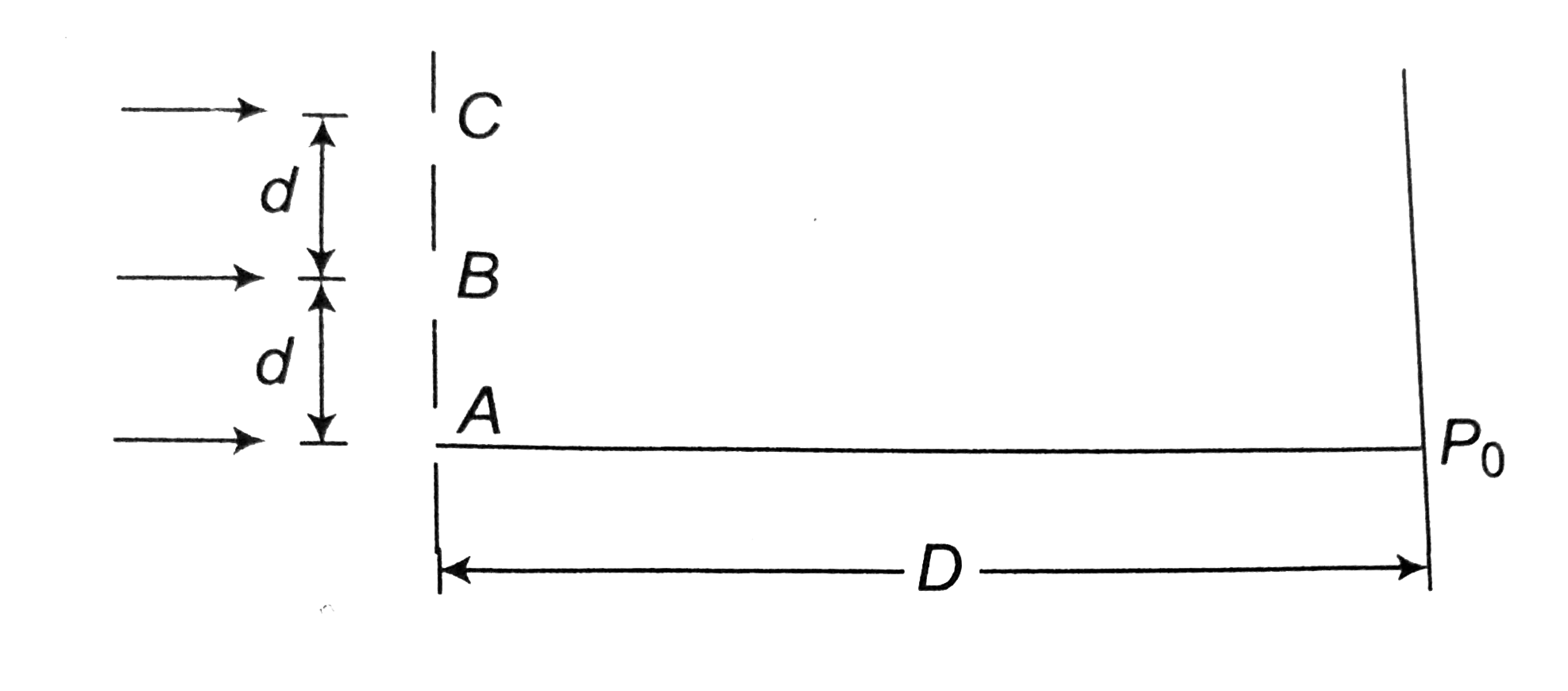

(a) `BP_(0)-AP_(0)=lambda/3`
`(D^(2)+d^(2))^(1/2)-D=D(1+d^(2)/D^(2))^(1//2)-D`
`=D(1+d^(2)/D^(2))-D=d^(2)/(2D)=lambda/3`
`d=sqrt((2Dlambda)/3)`
(b) `CP_(0)-AP_(0)=[D^(2)+(2d)^(2)]^(1//2)-D=D(1+(4d^(2))/D^(2))^(1/2-D`
`=D(1+(4d^(2))/(2D^(2)))-D`
`=(2d^(2))/D=2/D.(2Dlambda)/3=(4lambda)/3`
Phase difference between waves from `B` and `A` reaching at `P`
`=(2pi)/lambda(BP_(0)-AP_(0))=(2pi)/lambda.lambda/3=(2pi)/3`
Phase difference between waves from `C` and `A` reaching at `P`
`=(2pi)/lambda(CP_(0)-AP_(0))=(2pi)/lambda.(4lambda)/3=(8pi)/3=2pi+(2pi)/3`
`A: y_(1)=a sin omegat`
`B: y_(2)=a sin (omegat+2pi//3)`
`C: y_(3)=a sin (omegat+8pi//3)=a sin (2pi+omegat+2pi//3)`
`=a sin (omegat+2pi//3)`
Resultant wave:
`y=y_(1)+y_(2)+y_(3)`
`=a sin omegat+2a sin (omegat+(2pi)/3)`
`=a sin omegat+2a[sin omegai cos((2pi)/3)+ cos omegat sin ((2pi)/3)]`
`=2a sin (2pi//3) cos omegat`
`=2a.sqrt(3)/2 cos omegat`
`y=sqrt(3) a cos omegat`
`I prop a^(2), I_(R) prop (sqrt(3)a)^(2)`
`I_(R)/I=3`
`I_(R)=3I`
Promotional Banner

Topper's Solved these Questions

  • WAVE NATURE OF LIGHT

    CP SINGH|Exercise EXERCISES|140 Videos
  • THERMAL AND ELECTRIC EFFECT oF CURRENT

    CP SINGH|Exercise Exercises|101 Videos
  • X-Rays

    CP SINGH|Exercise EXERCISES|34 Videos

Similar Questions

Explore conceptually related problems

Three narrow slits A, B and C are illuminated by a parallel beam of light of wavelength lambda , P is a point on the screen exactly in front of point A. Slit plane is at a distance D from the screen (D gtgt lambda) . It is know that "BP – AP ="(1)/(3) (a) Find d in terms of D and lambda (b) Write the phase difference between waves reaching at P from C and A. (c) If intensity of P due to any of the three slits individu- ally is I_(0) , find the resultant intensity at P.

Figure shows a narrow slit S illuminated b a monochromatic light of wavelength lambda in a double-slit experiment. In the path of the rays reaching the upper slit S_(1) , a tube to length L is interposed in which the index of reflection of the medium varies linearly as shown in figure . The position of the central maximum in the interference pattern on the screen was displaceed by N fringes. Find the value of N in terms of mu_(0) , L and lambda .

A monochromatic light source of wavelength lamda is placed at S. three slits S_(1),S_(2) and S_(3) are equidistant from the source S and the point P on the screen S_(1)P-S_(2)P=lamda//6 and S_(1)P-S_(3)P=2lamda//3 . if I be the intensity at P when only one slit is open the intensity at P when all the three slits are open is-

Consider the situation shown in figure-6.35. The two slits S_(1) and S_(2) placed symmetrically around the central line are illuminated by a monochromatic light of wavelength lambda . The separation between the slits is d. The light transmitted by the slits falls on a screen E_(1) placed at a distance D from the slits. The slit S_(3) is at the central line and the slit S_(4) is at a distance z from S_(3) . Another screen E_(2) is placed a further distance D away from E_(1) . Find the ratio of the maximum to minimum intensity observed on E_(2) if z is equal is : (a) (lambdaD)/(2d) " "(b) (lambdaD)/(d)" " (c )(lambdaD)/(4d)

A Young's double slit experiment uses a monochromatic light of wavelength lambda . The intensity of each slit is same and is equal to I_(0) . What will be the resultant intensity at a point where waves interfere at a path difference of (lambda)/2 ?

In a Young's double slit set up using monochromatic light of wavelength lambda the intensity of light at a point, where path difference is 2lambda is found to be I_(0) What will be the intensity at a point when path different is lambda//3 ?

There are three forces F_(1) , F_(2) and F_(3) acting on a body , all acting on a point P on the body . The body is found to move with uniform speed. (a) Show that the forces are coplanar. (b) Show that the torque acting on the body about any point due to these three forces is zero.

CP SINGH-WAVE NATURE OF LIGHT-EXERCISES
  1. figure shows three equidistant slits illuminated by a monochromatic pa...

    Text Solution

    |

  2. Lifgt is

    Text Solution

    |

  3. The speed of light depends

    Text Solution

    |

  4. The equation of a light wave i written as y=Asin(kx-omegat). Here y r...

    Text Solution

    |

  5. When light is refracted into a medium

    Text Solution

    |

  6. Wave nature of light follows because

    Text Solution

    |

  7. Ray optics is valid when characteristic dimensions are

    Text Solution

    |

  8. Light appears to travel in straight lines since

    Text Solution

    |

  9. The velocity of light in diamond, glass and water decreases in the fol...

    Text Solution

    |

  10. Choose the correct option:

    Text Solution

    |

  11. Choose the correct option: (i) A surface on which the wave disturban...

    Text Solution

    |

  12. A wavefront and a ray of light are

    Text Solution

    |

  13. Huygen's principle of secondary waves

    Text Solution

    |

  14. Huygen's priciple of secondary wavelets may be used to

    Text Solution

    |

  15. Which one of the following phenomena is not explained by Huygens const...

    Text Solution

    |

  16. By Huygen's wave theroy of light, we cannot explain the phenomenon of

    Text Solution

    |

  17. In the adjoining figure, a wavefront AB moving in air is incident on a...

    Text Solution

    |

  18. In the adjacent diagram, CP represents a wavefront and AO & BP, the co...

    Text Solution

    |

  19. Which of the following sources gives best mionochromatic light?

    Text Solution

    |

  20. A laser beam is used for carrying our surgery because it

    Text Solution

    |

  21. Two sources of light are said to be coherent if the waves produced by ...

    Text Solution

    |

