Home
Class 12
PHYSICS
In a modified Young's double-slit experi...

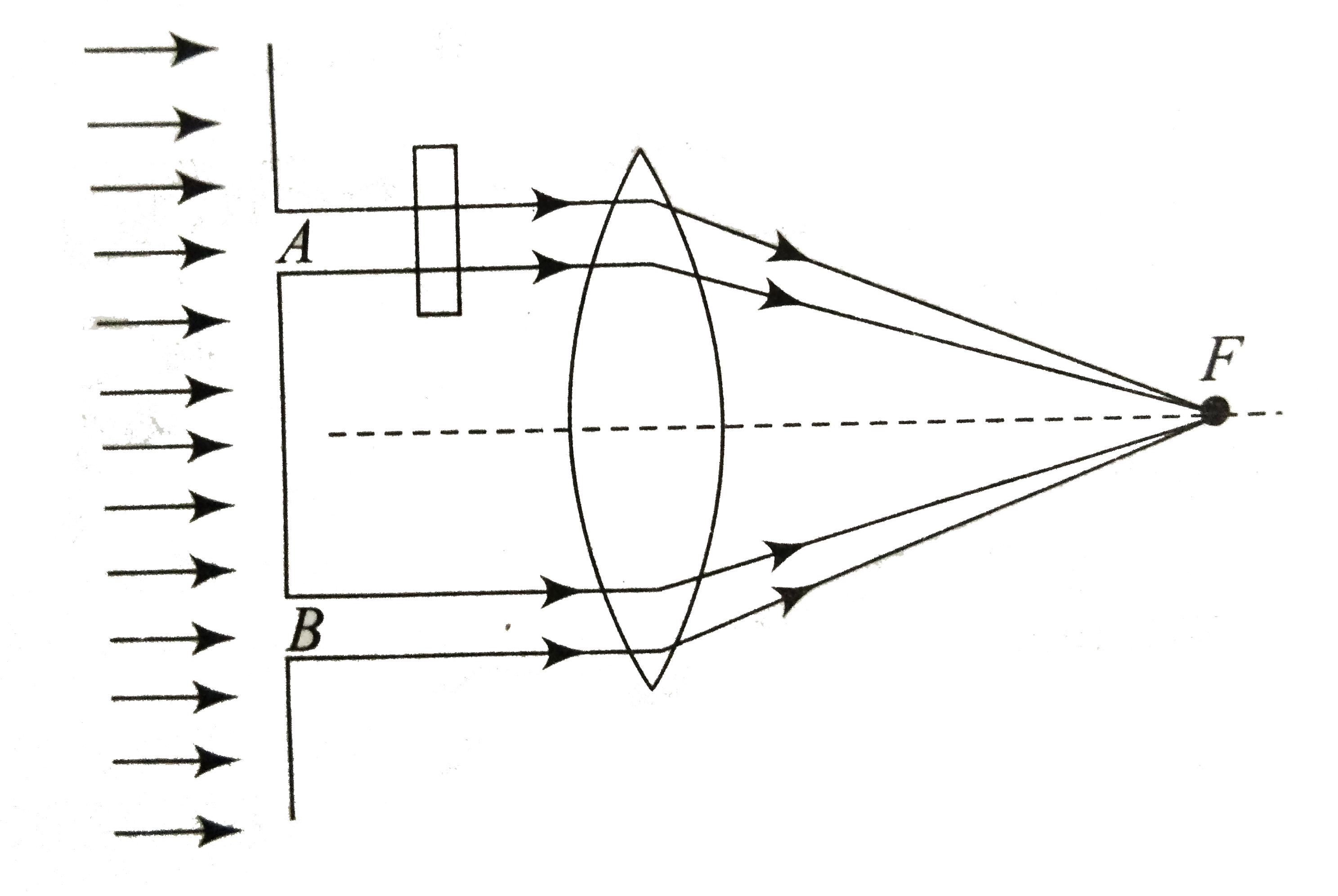
In a modified Young's double-slit experiment, a monochromatic uniform and parallel beam of light of wavelength `6000 Å` and intensity `(10//pi)` W `m^(-2)` is incident normally on two circular apertures A and B of radii 0.001 m and 0.002 m, respectively. A perfectly transparent film of thickness `2000 Å` and refractive index 1.5 for the wavelength of `6000 Å` is placed in front of aperture A (see the figure). Calculate the power (in mW) received at the focal spot F of the lens. Then lens is symmetrically placed with respect to the aperture. Assume that 10% of the power received by each aperture goes in the original direction and is brought to the focal spot.

Text Solution

Verified by Experts

`I=10/pi W//m^(2)`
`P_(A)=IA_(A)=10/pixxpi(0.001)^(2)=10^(-5) W`
`P_(B)=IA_(B)=10/pixxpi(0.002)^(2)=4xx10^(-5) W`
The aperture allows only `10%` of power, hence
`P_(A)^(')=0.1xx10^(-5)=10^(-6)W`
`P_(B)^(')=0.1xx4xx10^(-5)=4xx10^(-6)W`
Film: `t=200 nm, mu=3//2, lambda=600 nm`
Path difference due ti film,
`Deltax=(mu-1)t=(3//2-1)xx200=100 nm`
Phase difference `phi=(2pi)/lambdaDeltax=(2pi)/600xx100=pi/3`
Power received at `F`
`P=P_(A)^(')+P_(B)^(')+2sqrt(P_(A)^(')-P_(B)^(')) cos phi`
`=10^(-6)+4xx10^(-6)+2sqrt(10^(-6)xx4xx10^(-6)) cos(pi//3)`
`=10^(-6)+4xx10^(-6)+2xx10^(-6)`
`=7xx10^(-6) W`
Promotional Banner

Topper's Solved these Questions

  • WAVE NATURE OF LIGHT

    CP SINGH|Exercise EXERCISES|140 Videos
  • THERMAL AND ELECTRIC EFFECT oF CURRENT

    CP SINGH|Exercise Exercises|101 Videos
  • X-Rays

    CP SINGH|Exercise EXERCISES|34 Videos

Similar Questions

Explore conceptually related problems

In a modified Young's double slit experiment a monochromatic uniform and parallel beam of light of wave length 6000Å and intensity (10/pi)Wm^(-2) is incident normally on two circular apertures A and B of radii 20009Å and refractive index 1.5 for the wavelength of 6000Å is placed in front of aperture. A. Calculate the power (in watt) received at the focal spot F of the lens. The lens is symmertrically placed with respect to the apertures. Assume that 10% of the power received by each aperture goes in the originally direction and is brought to the focal spot.

A light has a wavelength 6000Å. The energy of this light is

In young's double slit experiment, the two slits are 0.2 mm apart. The fringes for light of wavelength 6000Å are found on the screen 80 cm away. The distance of fifth dark fringe, from the central fringe, will be

A parallel beam of light of wavelength 6000Å gets diffracted by a single slit of width 0.3 mm. The angular position of the first minima of diffracted light is :

In Young's double slit experiment, the fringe width obtained by a monochromatic light of wavelength 6000Å is 2 mm. I fthe apparatus is dipped into water of R.I. 1:33, then change in fringe width will be

Young's double-slit experiment setup with ligth of wavelength lambda = 6000 Å , distance between two slit in 2 mm and distance between the plane of slits and the screen. Is 2 m. The slits are of equal intensity. When a sheet of glass of refractive index 1.5 (which permtis only a fraction eta of the incident light to pass through) and thickness 8000 Å is placed in front of the lower slit, it is observed that the intensity at a point P, 0.15 mm above the central maxima, does not change. The value of eta is

In Young's double slit experiment, we get 60 fringes in the field of view of monochromatic light of wavelength 4000Å . If we use monochromatic light of wavelength 6000Å , then the number of fringes obtained in the same field of view is

When a transparent film of refractive index 1.5 is kept over one of the openings of a double slit experiment apparatus, the interference pattern is shifted through six successive maxima, towards the side, where the film was placed. What is the thickness of the film if the wavelength of light used in 6000 Å?

CP SINGH-WAVE NATURE OF LIGHT-EXERCISES
  1. In a modified Young's double-slit experiment, a monochromatic uniform ...

    Text Solution

    |

  2. Lifgt is

    Text Solution

    |

  3. The speed of light depends

    Text Solution

    |

  4. The equation of a light wave i written as y=Asin(kx-omegat). Here y r...

    Text Solution

    |

  5. When light is refracted into a medium

    Text Solution

    |

  6. Wave nature of light follows because

    Text Solution

    |

  7. Ray optics is valid when characteristic dimensions are

    Text Solution

    |

  8. Light appears to travel in straight lines since

    Text Solution

    |

  9. The velocity of light in diamond, glass and water decreases in the fol...

    Text Solution

    |

  10. Choose the correct option:

    Text Solution

    |

  11. Choose the correct option: (i) A surface on which the wave disturban...

    Text Solution

    |

  12. A wavefront and a ray of light are

    Text Solution

    |

  13. Huygen's principle of secondary waves

    Text Solution

    |

  14. Huygen's priciple of secondary wavelets may be used to

    Text Solution

    |

  15. Which one of the following phenomena is not explained by Huygens const...

    Text Solution

    |

  16. By Huygen's wave theroy of light, we cannot explain the phenomenon of

    Text Solution

    |

  17. In the adjoining figure, a wavefront AB moving in air is incident on a...

    Text Solution

    |

  18. In the adjacent diagram, CP represents a wavefront and AO & BP, the co...

    Text Solution

    |

  19. Which of the following sources gives best mionochromatic light?

    Text Solution

    |

  20. A laser beam is used for carrying our surgery because it

    Text Solution

    |

  21. Two sources of light are said to be coherent if the waves produced by ...

    Text Solution

    |
