Home
Class 12
PHYSICS
Three waves of equal frequency having am...

Three waves of equal frequency having amplitudes `10mum`, `4mum`, `7mum` arrive at a given point with successive phase difference of `pi//2`, the amplitude of the resulting wave in `mum` is given by

A

4

B

5

C

6

D

7

Text Solution

Verified by Experts

The correct Answer is:
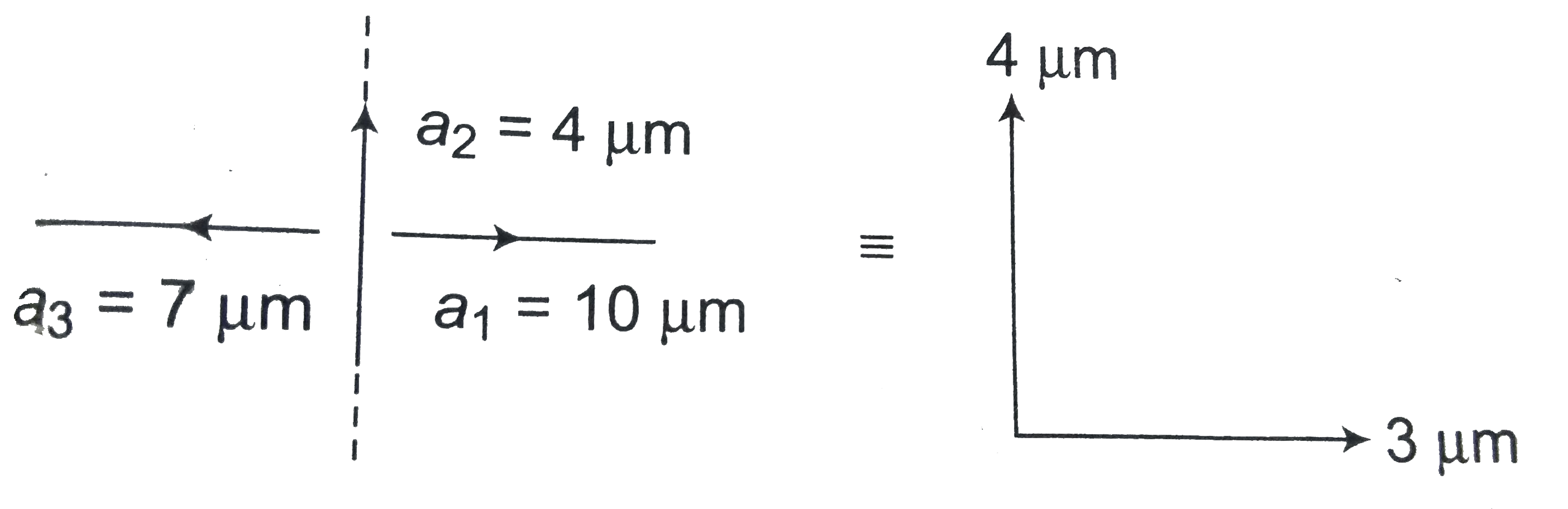
B


Resultant amplitude `A=sqrt((3)^(2)+(4)^(2))=5 mum`
Promotional Banner

Topper's Solved these Questions

  • WAVE NATURE OF LIGHT

    CP SINGH|Exercise EXERCISES|140 Videos
  • THERMAL AND ELECTRIC EFFECT oF CURRENT

    CP SINGH|Exercise Exercises|101 Videos
  • X-Rays

    CP SINGH|Exercise EXERCISES|34 Videos

Similar Questions

Explore conceptually related problems

Three waves of equal frequencies having amplitudes 10 mu m, 4mu m and 7 mum arrive at a given point with successive phase difference of pi//2 . The amplitude of the resulting wave in mu m is given by

Three waves of equal frequency having amplitudes 10 mm, 4 mm and 7 mm superpose at a given point with successive phase difference of pi /2 . The amplitude of the resulting wave in mm is given by

Three coherent waves having amplitudes 12mm, 6mm and 4mm arrive at a given point with successive phase difference of pi/2 . Then, the amplitude of the resultant wave is

Three waves producing displacement in the same direction of same frequency and of amplitudes 10etam, 4etam" and "7eta m arrive at a point with successive phase difference of pi//2 . The amplitude of the resultant wave is :--

Three waves of amplitudes 7 mm, 3 mm and 11 mm with a successive phase difference of (pi)/(2) are super - imposed. The amplitude of the resulting wave will be

Three waves of amplitudes 12mu m , 4mu m & 9 mu m but of same frequency arrive at a point in a medium with a successive phase difference of ((pi)/(2)) . Then the resultant amplitude in mu m is

Two waves of the same frequency have amplitudes 2 and 4. They interfare at a point where their phase difference is 60^(@) . Find their resultant amplitude.

Two waves of the same frequency and same amplitude 'a' are reaching a point simultaneously. What should be the phase difference between the waves so that the amplitude of the resultant wave be : (i) 2a (ii) sqrt2a (iii) a (iv) zero.

Two sinusoidal waves have the same angular frequeny the same amplitude y_m , and travel in the same direction in the same medium. If they differ in phase by 50^@ the amplitude the resultant wave is given by

Two waves of the same frequency have amplitudes 1.60 and 2.20. They interfere at a point where their phase difference is 60.0^(@) . What is the resultant amplitude?

CP SINGH-WAVE NATURE OF LIGHT-EXERCISES
  1. In Young's experiment with one source and two slits, one of the slits ...

    Text Solution

    |

  2. In Young's interference expriment with one source and two slits, one s...

    Text Solution

    |

  3. Three waves of equal frequency having amplitudes 10mum, 4mum, 7mum arr...

    Text Solution

    |

  4. Fig, here shows P and Q as two equally intense coherent sources emitti...

    Text Solution

    |

  5. In Young's experiment, monochromatic light is used to illuminate the t...

    Text Solution

    |

  6. In a Young's double-silt experiment the source slit S and the two slit...

    Text Solution

    |

  7. When a transparent parallel plate of uniform thickness t and refractiv...

    Text Solution

    |

  8. Light of wavelength 5000 Å is travelling in air. A thin glass plate (m...

    Text Solution

    |

  9. If a transparent medium of refractive index mu=1.5 and thickness t=2.5...

    Text Solution

    |

  10. A thin sheet of glass (refractive index 1.5) of thickness 6 microns, i...

    Text Solution

    |

  11. A thin mica sheet of thickness 2xx10^-6m and refractive index (mu=1.5)...

    Text Solution

    |

  12. Interference fringes were produced in Young's double-slit experiment u...

    Text Solution

    |

  13. When one of the slits of Young's experiment is covered with a transpar...

    Text Solution

    |

  14. In the ideal double-slit experiment, when a glass-plate (refractive in...

    Text Solution

    |

  15. A monochromatic beam of light fall on YDSE apparatus at some angle (sa...

    Text Solution

    |

  16. In double slit experiment fringes are obtained using light of waveleng...

    Text Solution

    |

  17. When exposed to sunlight, thin films of oil on water often exhibit bri...

    Text Solution

    |

  18. When viewed in white light, soap bubbles show colours because of

    Text Solution

    |

  19. A parallel beam of sodium light of wavelength 6000 Å is incident on a ...

    Text Solution

    |

  20. If wavelength 4500 Å and 6000 Å are found to be missing in the reflect...

    Text Solution

    |

