Home
Class 10
MATHS
Similar Triangles and their properties...

Similar Triangles and their properties

Text Solution

Verified by Experts
Similar Triangles and their Properties

In this chapter, we will focus on similar triangles and their properties.  We will also have a look at the similar triangles theorem along with solved examples that would help in getting the perfect knowledge about it. Well, when we say similar triangles, it refers to the triangles that possess the same shape, but there is the variation of size. Examples of similar objects are squares of any side lengths or all equilateral triangles. It can be understood that when two triangles are similar, then the corresponding sides are in equal proportion and their corresponding angles are also congruent. The symbol, ‘~’ is used in denoting the similarity of triangles. Here we can consider a hula hoop and wheel of a cycle. It should be noted that there are similarities in both the shapes of the objects.

similar triangles theorem

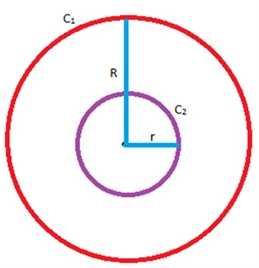
Consider the above circle C1 and C2 where the radiuses are R and r, respectively. Although the shapes are the same, it does not have the same size. So, in this case, it can be said that C1 ~ C2. So, two circles are always similar irrespective of their diameter. So, if we look at the condition for the similarity of triangles, then they are as follows:

...
Promotional Banner

Similar Questions

Explore conceptually related problems

Area of Similar Triangle and Questions

Mg and Li are similar in their properties due to

Mg and Li are similar in their properties due to

Mg and Li are similar in their properties due to

Sides of two similar triangles are in the ratio 4:9. Areas of these triangles are in the ratio

The sides of two similar triangles are in the ratio 2: 3 , then the areas of these triangles are in the ratio ________.

Sides of two similar triangles are in the ratio 3:5 , Areas of these triangles are in the ratio..

The sides of two similar triangles are in the ratio 3:7. The ratio of areas of these triangles will be :

