Home
Class 11
BIOLOGY
Read the given passage and answer the qu...

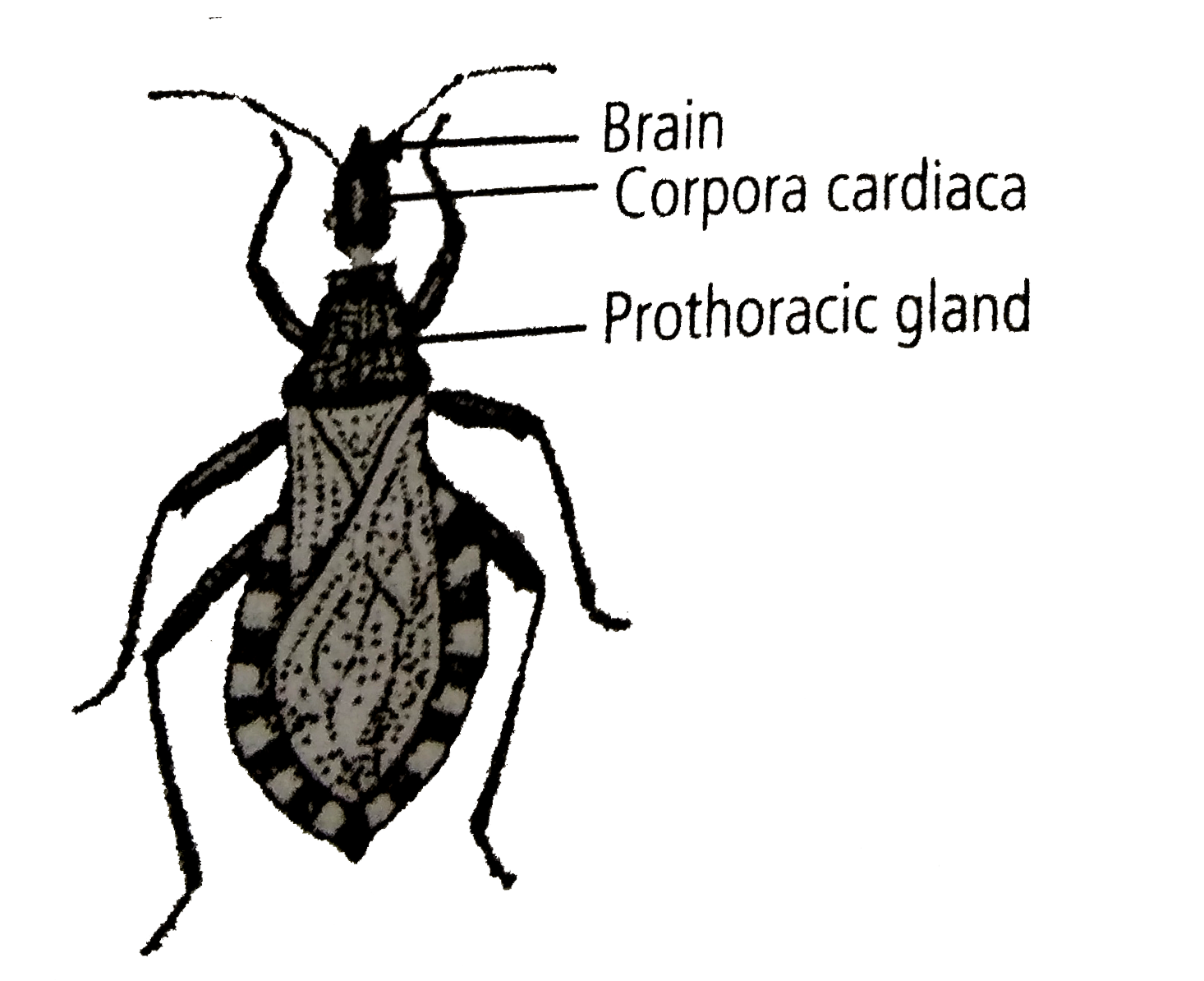
Read the given passage and answer the questions that follows: Rhodinus, a blood-sucking bug, shows five instars before it metamorphoses into an adult. It ahs a very long head with the brain located at tip and an organ called Corpora Cardiaca (C C) behind it. The hormone that ensures the continuum of the juvenile stages is called a juvenile hormone. Behind the head is a pro - thoracic gland, which gets triggered by the Pro - Thoracico - Tropic Hormone (PTTH) to release ecdysone required for molting into an adult.

The following observations were made when the juveniles of this insect were subjected to various conditions :
1. Starved juveniles (any instar) when decapitated `rarr` remained juveniles and did not molt into adults.
2. Well-fed juveniles (any instar) when decapitated `rarr` molted into adults.
3. Starved juveniles (any instar) when partially decapitated to remove the brain cells `rarr` remained juveniles and did not molt into adults.
4. Well - fed juveniles (any instar) when partially deitated to remove the brain cells `rarr` did not molt into adults.
Which of the following conclusions can be drawn from this data ?
(i) Ecdysone hormone is produced irrespective of the level of feeding.
(ii) C C is the site of production of juvenile hormone.
(iii) PTTH is produced irrespective of the level of feeding.
(iv) Increase in juvenile hormone is an important trigger for production of PTTH.
(v) Absence of C C alone is a trigger for molting into adult form.
(vi) Well-fed larvae in absence of juvenile hotmone can molt into adults.

A

(i), (iii) (iv) and (v)

B

(ii), (iv) and (v)

C

(ii) and (vi)

D

(i) and (iv)

Text Solution

Verified by Experts

The correct Answer is:

C
Promotional Banner

Topper's Solved these Questions

  • ANATOMY OF FLOWERING PLANTS

    NCERT FINGERTIPS|Exercise Anatomy Of Flowering Plants|143 Videos
  • BIOLOGICAL CLASSIFICATION

    NCERT FINGERTIPS|Exercise Biological Classification|132 Videos

Similar Questions

Explore conceptually related problems

Read the given passage and answer the questions that follows: Rhodinus, a blood-sucking bug, shows five instars before it metamorphoses into an adult. It ahs a very long head with the brain located at tip and an organ called Corpora Cardiaca (C C) behind it. The hormone that ensures the continuum of the juvenile stages is called a juvenile hormone. Behind the head is a pro - thoracic gland, which gets triggered by the Pro - Thoracico - Tropic Hormone (PTTH) to release ecdysone required for molting into an adult. The following observations were made when the juveniles of this insect were subjected to various conditions : 1. Starved juveniles (any instar) when decapitated rarr remained juveniles and did not molt into adults. 2. Well-fed juveniles (any instar) when decapitated rarr molted into adults. 3. Starved juveniles (any instar) when partially decapitated to remove the brain cells rarr remained juveniles and did not molt into adults. 4. Well - fed juveniles (any instar) when partially deitated to remove the brain cells rarr did not molt into adults. If an unfed, completely decapitated, fth (final) instar juvenile is connected to a well-fed, decapitated fourth instar juvenile by a glass tube so that fluids can be exchanged, what whill be the expected result ?

Juvenile state of moss is

Which of the following is called as phytogerontogical hormone

In insects, the effect of juvenile hormone is to

Infective juvenile of Wuchereria is

The juvenile stage of the gametophyte of moss is

Which one of the following is called as milk ejection hormone and birth hormone ?

Juvenile hormone causes

The skeleton of the head is called

Endocrine glands of insects which secrete juvenile hormone are

NCERT FINGERTIPS-ANIMAL KINGDOM-Animal Kingdom
  1. Refer to the given figures A-D and select the incorrect statement rega...

    Text Solution

    |

  2. Which of the following are correct ? (i) Sponges : Cellular level o...

    Text Solution

    |

  3. Read the given passage and answer the questions that follows: Rhodinus...

    Text Solution

    |

  4. Read the given passage and answer the questions that follows: Rhodinus...

    Text Solution

    |

  5. Observe the following diagrams of invertebrates embryos illustrating t...

    Text Solution

    |

  6. Animal classification is depicted below. Mark the correct option.

    Text Solution

    |

  7. Match animals give in column B with their respective mode of locomotio...

    Text Solution

    |

  8. In some animal groups, the body is found divided into compartments wit...

    Text Solution

    |

  9. Given below are types of cells present in some animals. Which of the f...

    Text Solution

    |

  10. Which one of the following sets of animals share a four chambered hear...

    Text Solution

    |

  11. Which of the following pairs of animals has non-glandular skin ?

    Text Solution

    |

  12. Birds and mammals share one of the following characteristics as a comm...

    Text Solution

    |

  13. Which one of the following sets of animals belong to a single taxonomi...

    Text Solution

    |

  14. Which one of the following statements is incorrect ?

    Text Solution

    |

  15. Which one of the following statements is incorrect ?

    Text Solution

    |

  16. Which one of the following is oviparous ?

    Text Solution

    |

  17. Which one of the following is not a poisonous snake ?

    Text Solution

    |

  18. Match the following list of animals with their level of organisation. ...

    Text Solution

    |

  19. Body cavity is the cavity present between body wall and gut wall. In s...

    Text Solution

    |

  20. Match of column A with column B and choose the correct option. {:("C...

    Text Solution

    |
