

Home
Class 12
PHYSICS
A particle is moving along a vertical ci...

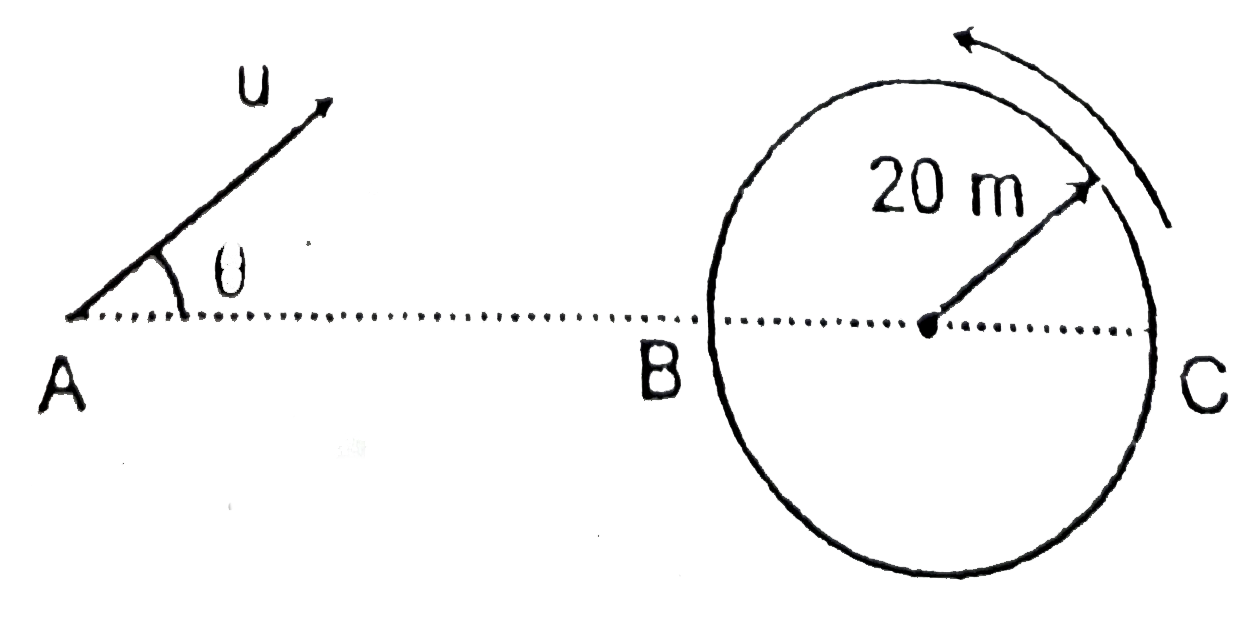
A particle is moving along a vertical circle of radius `R=20 m` with a constant speed `v=31.4 m//s` as shown in the figure. Straight line `ABC` is horizontal and passes through the centre of the circle. A shell is fired from point `A` at the instant when particle is at `C`. The distance `AB` is `20sqrt(3)m` and shell collides with the particle at `B`, if smallest possible value of the angle of projection is `k xx 10^(@)` then find the value of `k`.

Promotional Banner

Similar Questions

Explore conceptually related problems

A particle is moving along a vertical circle of radius r = 20 m with a constnat vertical circle of radius r = 20 m with a constnat speed v = 31.4m/s as shown is figure . Straight line ABC is horizontal and passes throught the centre of the circle . A shell if fired from point A at the instant when the particle is at C. If distance AB is 20sqrt(3) m and the shell collide with the particle at B , then prove tan theta = ((2 n -1)^(2))/(sqrt(3)) .where n is an interger. Further , show that smallest value of theta is 30^(@) .

If a particle is moving along a circle of radius 3 m with a constant speed 9 m//s , then it covers a quarter of the circle in time of

If a particle is moving along a circle of.radius 3m with a constant speed 9 m//s , then it covers a quarter of the circle in time of

A particle is moving along a circle of radius 20cm , with a linear velocity of 2m//s. Calculate the angular velocity of the particle.

A particle is moving along a circle of radius 20cm , with a linear velocity of 2m//s. Calculate the angular velocity of the particle.

A particle is moving along a circle of radius 20cm , with a linear velocity of 2m//s. Calculate the angular velocity of the particle.

A particle is moving in a circle of radius R = 1m with constant speed v = 4 m/s. The ratio of the displacement to acceleration of the foot of the perpendicular drawn from the particle onto the diameter of the circle is

A particle moves in a circle of radius 20 cm with linear speed of 10 m/s. Find the angular velocity