

Home
Class 11
PHYSICS
A spherical ball of mass 4m, density sig...


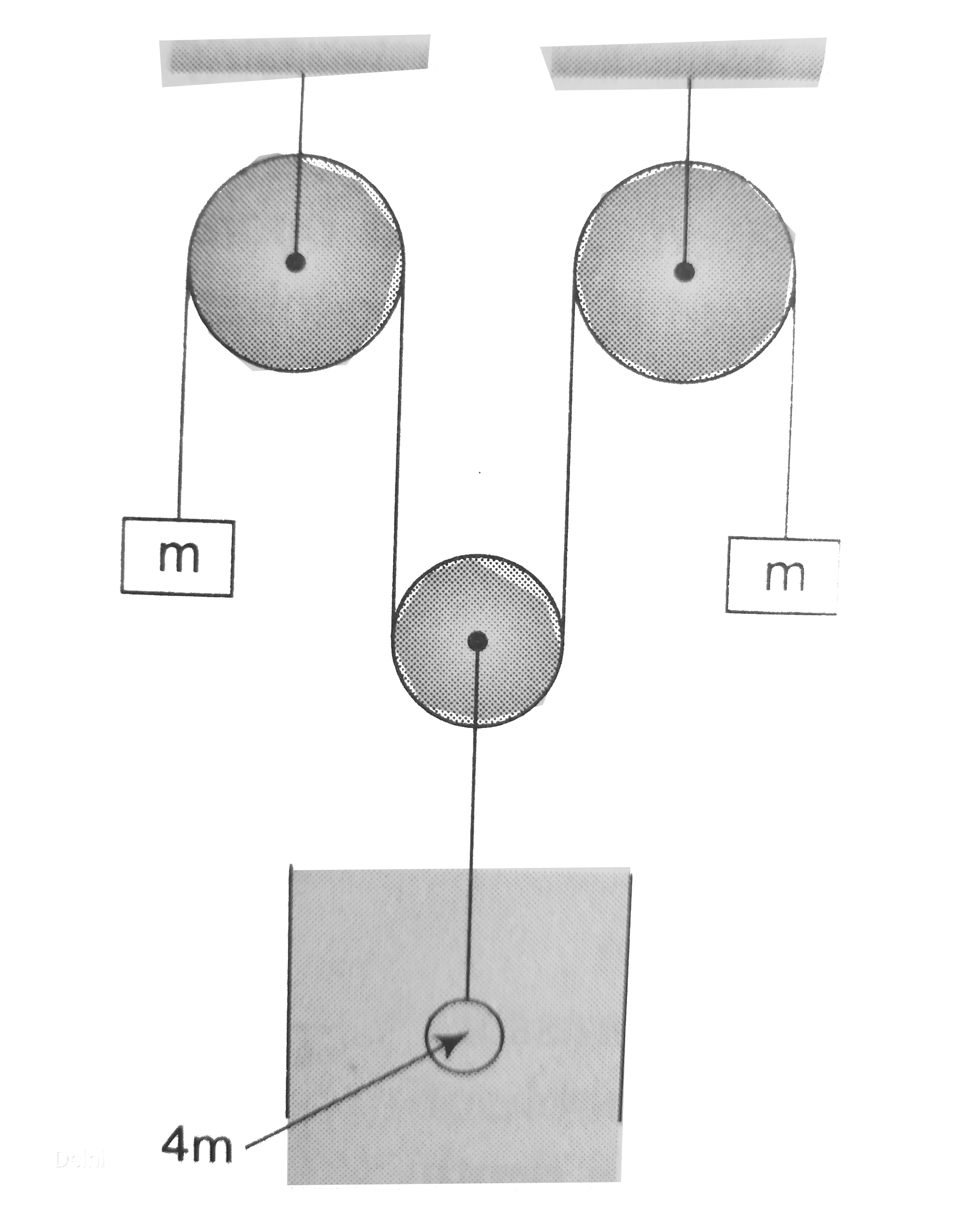
A spherical ball of mass 4m, density `sigma` and radius `r` is attached to a pulley-mass system as shown in figure. The ball is released in a liquid of coefficient of viscosity `eta` and density `rho(lt(sigma)/(2))`. If the length of the liquid column is sufficiently long, the terminal velocity attained by the ball is given by (assume all pulleys to be massless and string as massless and inextensible):

Promotional Banner

Similar Questions

Explore conceptually related problems

A small steel ball of mass m and radius r is falling under gravity through a viscous liquid of coefficient of viscosity eta . If g is the value of acceleration due to gravity. Then the terminal velocity of the ball is proportional to (ignore buoyancy)

A small steel ball of mass m and radius r is falling under gravity through a viscous liquid of coefficient of viscosity eta . If g is the value of acceleration due to gravity. Then the terminal velocity of the ball is proportional to (ignore buoyancy)

A small steel ball of mass m and radius r is falling under gravity through a viscous liquid of coefficient of viscosity eta . If g is the value of acceleration due to gravity. Then the terminal velocity of the ball is proportional to (ignore buoyancy)

A small steel ball of mass m and radius r is falling under gravity through a viscous liquid of coefficient of viscosity eta . If g is the value of acceleration due to gravity. Then the terminal velocity of the ball is proportional to (ignore buoyancy)

A metal sphere of density rho and radius 'a' is failing through an infinite column of liquid of density sigma and coefficient of viscosity eta . Name any two forces acting on the sphere.

Two circular disc having radius R and mass density sigma and 2sigma respectively are placed as shown in figure. Then find out the position of COM of the system.

A small steel ball of radius r is allowed to fall under gravity through a column of a viscous liquid of coefficient of viscosity eta . After some time the velocity of the ball attains a constant value known as terminal velocity upsilon_T . The terminal velocity depends on (i) the mass of the ball m (ii) eta , (iii) r and (iv) acceleration due to gravity g . Which of the following relations is dimensionally correct?

A small steel ball of radius r is allowed to fall under gravity through a column of a viscous liquid of coefficient of viscosity eta . After some time the velocity of the ball attains a constant value known as terminal velocity upsilon_T . The terminal velocity depends on (i) the mass of the ball m (ii) eta , (iii) r and (iv) acceleration due to gravity g . Which of the following relations is dimensionally correct?