

Home
Class 12
PHYSICS
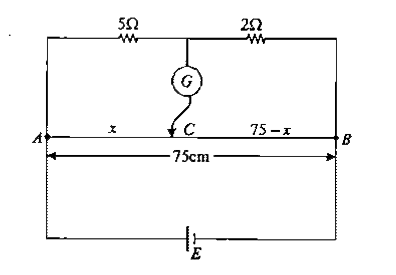
In the meter bridge circuit shown in fig...

In the meter bridge circuit shown in figure-`3.281` find the length AC at null deflection in galvanometer.

Promotional Banner

Similar Questions

Explore conceptually related problems

In the meter bridge circuit shown in figure . Find the length AB for null deflection in galvaometer .

A meter bridge setup is shown in the figure. If there is null deflection in galvanometer when length AC = 20 cm, then the value of resistance R is

Statement I: In the meter bridge experiment shown in figure, the balance length AC corresponding to null deflection of the galvanometer is x. If the radius of the wire AB is doubled, the balanced length becomes 4x. Statement II: The resistance of a wire is inversely proportional to the square of its radius.

Statement I: In the meter bridge experiment shown in figure, the balance length AC corresponding to null deflection of the galvanometer is x. If the radius of the wire AB is doubled, the balanced length becomes 4x. Statement II: The resistance of a wire is inversely proportional to the square of its radius.

STATEMENT-1 : In the meter bridge experimeter shown in figure the balance length AC corresponding to null deflection of the galvanometer is x. If the radius of the wire AB is doubled, the balance length becomes 4x. and STATEMENT-2 : The resistance of a wire a inversely proportional to the square of its radius.

Assertion: In a meter bridge experiment, the balancing length AC corresponding to null deflection of the galvanometer is x. If the radius of the wire AB is doubled then the balanced length becomes 4x. Reason: The resistance of a wire is inversel proportional to the square of its radius. Which one of the following statement is correct?

The resistance wire AB in the balancing setup shown in figure- 3.292 is 10 cm long. When AC= 40 cm , no deflection occurs in the galvanometer. Find the unknown resistance R.

In a meter bridge , as shown in the figure , the point D is a neutral point