Home
Class 12
CHEMISTRY
which of the following graph is correct ...

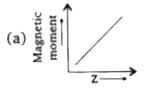
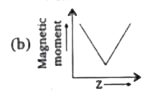
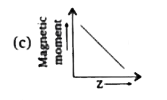
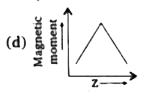
which of the following graph is correct representation between atomic number (Z) and magnetic moment of d-block elements? [outer electronic configuration: `(n-1)d^(x)ns^(1 or 2)`]

A

B

C

D

Text Solution

AI Generated Solution

The correct Answer is:

To determine the correct representation of the relationship between atomic number (Z) and magnetic moment for d-block elements, we can follow these steps: ### Step 1: Understand the Concept of Magnetic Moment The magnetic moment (μ) of an atom is related to the number of unpaired electrons (n) in its outer electronic configuration. The formula for calculating the magnetic moment is: \[ \mu = \sqrt{n(n + 2)} \] where \( n \) is the number of unpaired electrons. ### Step 2: Write the Electronic Configurations For d-block elements, the outer electronic configuration can be represented as \((n-1)d^{x}ns^{1 \text{ or } 2}\). We will look at the electronic configurations starting from Scandium (Z = 21) to Zinc (Z = 30). - **Z = 21 (Sc)**: Configuration: \( [Ar] 4s^2 3d^1 \) → 1 unpaired electron - **Z = 22 (Ti)**: Configuration: \( [Ar] 4s^2 3d^2 \) → 2 unpaired electrons - **Z = 23 (V)**: Configuration: \( [Ar] 4s^2 3d^3 \) → 3 unpaired electrons - **Z = 24 (Cr)**: Configuration: \( [Ar] 4s^2 3d^5 \) → 6 unpaired electrons (due to half-filled stability) - **Z = 25 (Mn)**: Configuration: \( [Ar] 4s^2 3d^5 \) → 5 unpaired electrons - **Z = 26 (Fe)**: Configuration: \( [Ar] 4s^2 3d^6 \) → 4 unpaired electrons - **Z = 27 (Co)**: Configuration: \( [Ar] 4s^2 3d^7 \) → 3 unpaired electrons - **Z = 28 (Ni)**: Configuration: \( [Ar] 4s^2 3d^8 \) → 2 unpaired electrons - **Z = 29 (Cu)**: Configuration: \( [Ar] 4s^2 3d^{10} \) → 1 unpaired electron - **Z = 30 (Zn)**: Configuration: \( [Ar] 4s^2 3d^{10} \) → 0 unpaired electrons ### Step 3: Calculate the Magnetic Moments Using the formula \( \mu = \sqrt{n(n + 2)} \), we can calculate the magnetic moment for each element: - **Sc (Z=21)**: \( \mu = \sqrt{1(1 + 2)} = \sqrt{3} \) - **Ti (Z=22)**: \( \mu = \sqrt{2(2 + 2)} = \sqrt{8} \) - **V (Z=23)**: \( \mu = \sqrt{3(3 + 2)} = \sqrt{15} \) - **Cr (Z=24)**: \( \mu = \sqrt{6(6 + 2)} = \sqrt{48} \) - **Mn (Z=25)**: \( \mu = \sqrt{5(5 + 2)} = \sqrt{35} \) - **Fe (Z=26)**: \( \mu = \sqrt{4(4 + 2)} = \sqrt{24} \) - **Co (Z=27)**: \( \mu = \sqrt{3(3 + 2)} = \sqrt{15} \) - **Ni (Z=28)**: \( \mu = \sqrt{2(2 + 2)} = \sqrt{8} \) - **Cu (Z=29)**: \( \mu = \sqrt{1(1 + 2)} = \sqrt{3} \) - **Zn (Z=30)**: \( \mu = 0 \) ### Step 4: Analyze the Trend From the calculated values, we can observe that the magnetic moment increases initially as we move from Scandium to Chromium, reaches a peak, and then starts to decrease as we go towards Zinc. ### Step 5: Determine the Correct Graph The correct graph representation would show an initial increase in magnetic moment, followed by a decrease after reaching a peak. Therefore, the graph that represents this trend is option D. ### Conclusion The correct representation between atomic number (Z) and magnetic moment of d-block elements is option D, which shows an increase followed by a decrease in magnetic moment as atomic number increases. ---

To determine the correct representation of the relationship between atomic number (Z) and magnetic moment for d-block elements, we can follow these steps: ### Step 1: Understand the Concept of Magnetic Moment The magnetic moment (μ) of an atom is related to the number of unpaired electrons (n) in its outer electronic configuration. The formula for calculating the magnetic moment is: \[ \mu = \sqrt{n(n + 2)} \] where \( n \) is the number of unpaired electrons. ### Step 2: Write the Electronic Configurations ...
Promotional Banner

Topper's Solved these Questions

  • PERIODIC PROPERTIES

    VK JAISWAL|Exercise Level 2|102 Videos
  • PERIODIC PROPERTIES

    VK JAISWAL|Exercise MATCH THE COLUMN|13 Videos
  • PERIODIC PROPERTIES

    VK JAISWAL|Exercise SUBJECTIVE PROBLEMS|22 Videos
  • p-BLOCK ELEMENTS

    VK JAISWAL|Exercise SUBJECTIVE PROBLEMS|36 Videos
  • QUALITATIVE INORGANIC ANALYSIS

    VK JAISWAL|Exercise SUBJECTIVE PROBLEMS|5 Videos

Similar Questions

Explore conceptually related problems

Assign the position of the element having outer electronic configuration (n-1)d^{10}ns^{1} for n=4.

The position of the element having outer electronic configuration ns^2np^4 for n=3 is

(n-1)d^(10)ns^(2) is the electronic configuration of

Which of the following d-block elements has d^(10) configuration ?

The element having the lowest atomic number and a ground state electronic configuration of (n-1) d^(6)ns^(2) is placed in:

Which of the following represents the electronic configuration of d-block elements

The outer expected electronic configuration 5f^(5),6d^(1), 7s^(2) is of the element

VK JAISWAL-PERIODIC PROPERTIES-Level 1
  1. Which of the following metal is highest electropositive (metallic) in ...

    Text Solution

    |

  2. Which of the following species must have maximum number of electrons i...

    Text Solution

    |

  3. which of the following graph is correct representation between atomic ...

    Text Solution

    |

  4. If IUPAC name of an element is "unununium" then correct statement rega...

    Text Solution

    |

  5. Which property decreases from left to right across the periodic table ...

    Text Solution

    |

  6. Consider the following information about element P and Q: {:(,"Perio...

    Text Solution

    |

  7. which must represent an atom in an excited state?

    Text Solution

    |

  8. Which of the following anion has the smallest radius?

    Text Solution

    |

  9. The ionic radii of Li^(+), Be^(2+) and B^(3+) follow the order:

    Text Solution

    |

  10. Largest in size out of Na^(+),Ne and F^(-) is:

    Text Solution

    |

  11. Which of the following atom or ions has the smallest size?

    Text Solution

    |

  12. The single covalent radius of P is 0.11 nm. The single covalent radius...

    Text Solution

    |

  13. Which of the following is arranged in decreasing order of size?

    Text Solution

    |

  14. The correct order of increasing atomic radius of the following element...

    Text Solution

    |

  15. The correct order of increasing radii of the elementsSi,Al,Na and P is

    Text Solution

    |

  16. The size of the species, Pb,Pb^(2+), Pb^(4+) decreases as -

    Text Solution

    |

  17. Incorrect order of radius is:

    Text Solution

    |

  18. The correct order of atomic/ionic radiii is:

    Text Solution

    |

  19. The radius of which is closest to that of the Li^(+) ions?

    Text Solution

    |

  20. The first, second and third ionization energies (E(1),E(2)&E(3)) for a...

    Text Solution

    |
