Home
Class 12
CHEMISTRY
The crystal field theory assumes interac...

The crystal field theory assumes interaction between metal ion and the ligands as a purely electrostatic and ligands are supposed to be point charges.
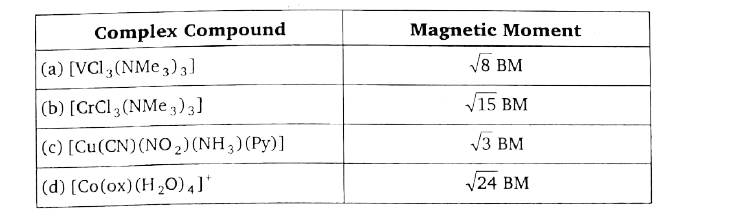
Q. Which of the following match are incorrect?

Text Solution

Verified by Experts

The correct Answer is:

D
Promotional Banner

Topper's Solved these Questions

  • CO-ORDINATION COMPOUNDS

    VK JAISWAL|Exercise ASSERTION-REASON TYPE QUESTIONS|26 Videos
  • CO-ORDINATION COMPOUNDS

    VK JAISWAL|Exercise LEVEL 1|202 Videos
  • CHEMICAL BONDING (BASIC)

    VK JAISWAL|Exercise Level 3 (Passive 11)|6 Videos
  • d-BLOCK ELEMENTS

    VK JAISWAL|Exercise SUBJECTIVE PROBLEMS|6 Videos

Similar Questions

Explore conceptually related problems

The crystal field theory assumes interaction between metal ion and the ligands as a purely electrostatic and ligands are supposed to be point charges. Q. Which of the following order of CFSE in incorrect?

The crystal field theory assumes interaction between metal ion and the ligands as a purely electrostatic and ligands are supposed to be point charges. Q. Amongst the following complexes which has square planar geometry?

Crystal field theory assumes that interaction between the metal ion and ligand is ________.

Valence bond theory for bonding in transition metal complexes was developed by Pauling. From the valence bond point of view, formation of a complex involves reaction between Lewis bases (ligands) and a Lewis acid (metal atom or metal ion) with the formation of coordination covalent (or dative) bonds between them. The model utilizes hybridization of metal s, p and d valence orbitals to account for the observed structures and magnetic properies of complexes. Valence bond theory is able to deal satisfactorily with many stereo chemical and magnetic properies but is has nothing to say about electronic spectra or the reason for the kinetic inertness of chromium (III) and low spin cobalt (III) octahedral complexes. To understand this and more other features of transition metal we must turn to other theories like crystal field theory etc. Pure crystal field theory assumes that the only interaction between the metal ion and the ligands is an electrostatic or ionic one with the ligands being regarded as negative point charges. This theory is quite successful in interpreting many important properties of complexes. Select the correct statement about the crystal field theory.

Valence bond theory for bonding in transition metal complexes was developed by Pauling. From the valence bond point of view, formation of a complex involves reaction between Lewis bases (ligands) and a Lewis acid (metal atom or metal ion) with the formation of coordination covalent (or dative) bonds between them. The model utilizes hybridization of metal s, p and d valence orbitals to account for the observed structures and magnetic properies of complexes. Valence bond theory is able to deal satisfactorily with many stereo chemical and magnetic properies but is has nothing to say about electronic spectra or the reason for the kinetic inertness of chromium (III) and low spin cobalt (III) octahedral complexes. To understand this and more other features of transition metal we must turn to other theories like crystal field theory etc. Pure crystal field theory assumes that the only interaction between the metal ion and the ligands is an electrostatic or ionic one with the ligands being regarded as negative point charges. This theory is quite successful in interpreting many important properties of complexes. The hybridization of [NiCl_(2)(PPh_(3))_(2)]" and "[NiCl_(2).(Pme_(3))_(2)] are respectively (consider PPh_(3) a bulkier ligand than Pme_(3) ) :

VK JAISWAL-CO-ORDINATION COMPOUNDS-LEVEL 3 (PASSAGE TYPE)
  1. Magnetic moment, ionic conductance and colligative properties are usef...

    Text Solution

    |

  2. The crystal field theory assumes interaction between metal ion and the...

    Text Solution

    |

  3. The crystal field theory assumes interaction between metal ion and the...

    Text Solution

    |

  4. The crystal field theory assumes interaction between metal ion and the...

    Text Solution

    |

  5. The magnetic property, dipole moment, plane of symmetry, colour and ab...

    Text Solution

    |

  6. The magnetic property, dipole moment, plane of symmetry, colour and ab...

    Text Solution

    |

  7. The magnetic property, dipole moment, plane of symmetry, colour and ab...

    Text Solution

    |

  8. Ligands are broadly classified into two classes classical and non-clas...

    Text Solution

    |

  9. Ligands are broadly classified into two classes classical and non-clas...

    Text Solution

    |

  10. Ligands are broadly classified into two classes classical and non-clas...

    Text Solution

    |

  11. An isomerr of the complex CoBrCl(2)(en)(2)(H(2)O), on reaction with co...

    Text Solution

    |

  12. An isomerr of the complex CoBrCl(2)(en)(2)(H(2)O), on reaction with co...

    Text Solution

    |

  13. Crystal field theory provides correct electronic distribution of centr...

    Text Solution

    |

  14. Crystal field theory provides correct electronic distribution of centr...

    Text Solution

    |

  15. Crystal field theory provides correct electronic distribution of centr...

    Text Solution

    |

  16. Two important physical evidence support the synergic bonding in non-cl...

    Text Solution

    |

  17. Two important physical evidences supporting the synergic bonding in no...

    Text Solution

    |

  18. Two important physical evidences supporting the synergic bonding in no...

    Text Solution

    |

  19. Complex compounds that have the same molecular formula but have differ...

    Text Solution

    |

  20. Complex compounds that have the same molecular formula but have differ...

    Text Solution

    |
