

Home
Class 12
PHYSICS
A 50-kg ball is attached to one end of a...

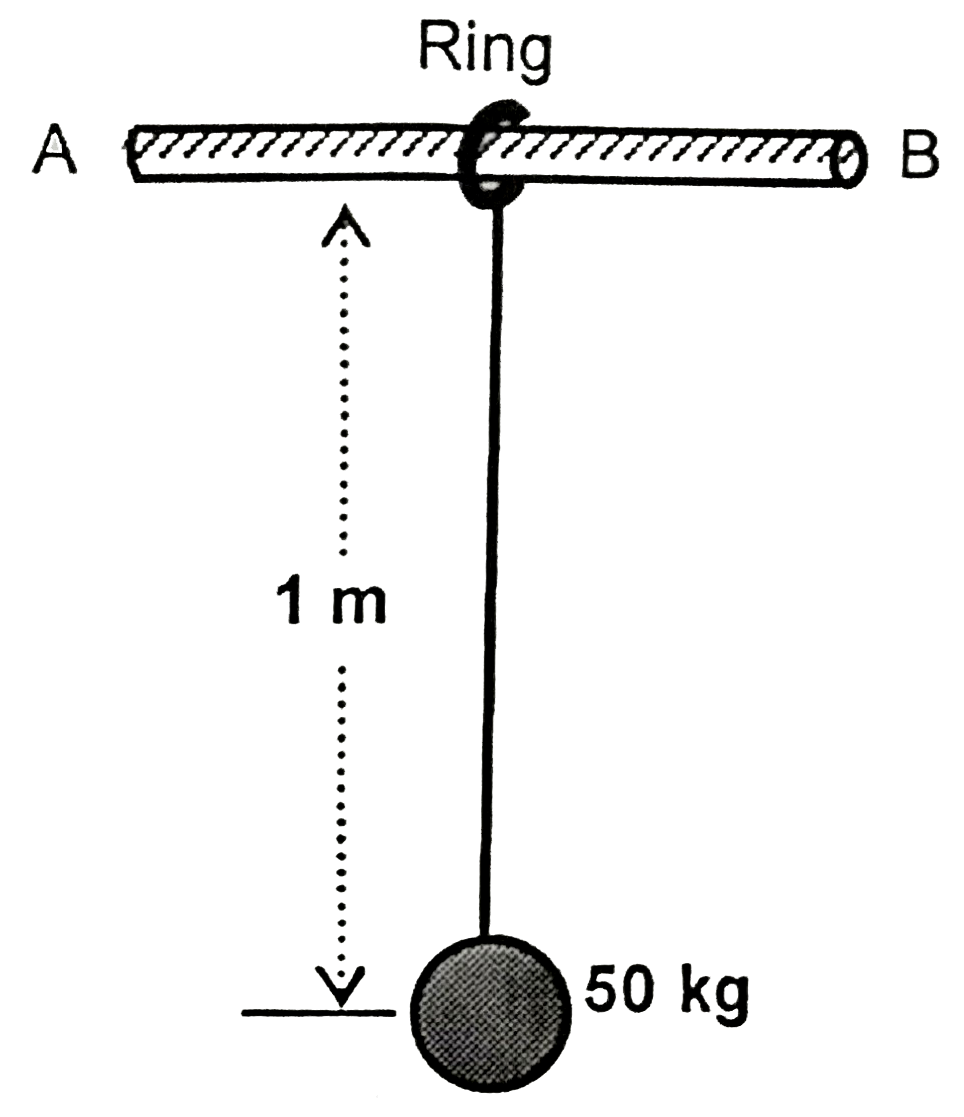
A `50-kg` ball is attached to one end of a `1m` cord that has a mass of `0.10kg`. The other end o the cord is attached to a ring that can slide on a frictionless horizontal shaft `AB`, as shown in the diagram.
A horizontal blow is delivered to the cord and excites the fundamental vibratiion with a maximum transverse velocity of `15m//s`. Assume that the ball remains essentially stationary as the cord vibrates. `[g=9.8m//s^(2)]`

Promotional Banner

Similar Questions

Explore conceptually related problems

What is the tension in a 3m cord, whose mass is 0.15kg, if a transverse wave is observed to travel in the cord with a speed of 20m/s ?

A 10kg ball attached at the end of a rigid massless rod of lengh 1m rotates at constant speed in a horizontal circle of radius 0.5m and period of 1.58s , as shown in the figure. The force exerted by the rod on the ball is (g=10ms^(-2))

A 10kg ball attached at the end of a rigid massless rod of lengh 1m rotates at constant speed in a horizontal circle of radius 0.5m and period of 1.58s , as shown in the figure. The force exerted by the rod on the ball is (g=10ms^(-2))

A 4 kg balls is swing in a vertical circle at the end of a cord 1 m long. The maximum speed at which it can swing if the cord can sustain maximum tension of 163.6 N will be

A shell of mass 1kg is projected with velocity 20m//s at an angle 60^@ with horizontal. It collides inelastically with a ball of mass 1kg which is suspended through a thread of length 1m . The other end of the thread is attached to the ceiling of a trolley of mass 4/3kg as shown in figure. Initially the trolley is stationary and it is free to move along horizontal rails wihtout any friction. What is the maximum deflection of the thread with vertical? String does not slack. Take g=10m//s^2 .

A shell of mass 1kg is projected with velocity 20m//s at an angle 60^@ with horizontal. It collides inelastically with a ball of mass 1kg which is suspended through a thread of length 1m . The other end of the thread is attached to the ceiling of a trolley of mass 4/3kg as shown in figure. Initially the trolley is stationary and it is free to move along horizontal rails wihtout any friction. What is the maximum deflection of the thread with vertical? String does not slack. Take g=10m//s^2 .

Two point masses of 3.0 kg and 1.0 kg are attached to opposite ends of a horizontal spring whose spring constant is 300 N m^(-1) as shown in the figure. The natural vibration frequency of the system is of the order of :

Two point masses of 3.0 kg and 1.0 kg are attached to opposite ends of a horizontal spring whose spring constant is 300 N m^(-1) as shown in the figure. The natural vibration frequency of the system is of the order of :

A heavy block of mass m is supported by a cord C attached to the ceiling, and another cord D is attached to the bottom of the block. If a sudden jerk is given to D, then