

Home
Class 11
PHYSICS
Two springs with negligible masses and f...


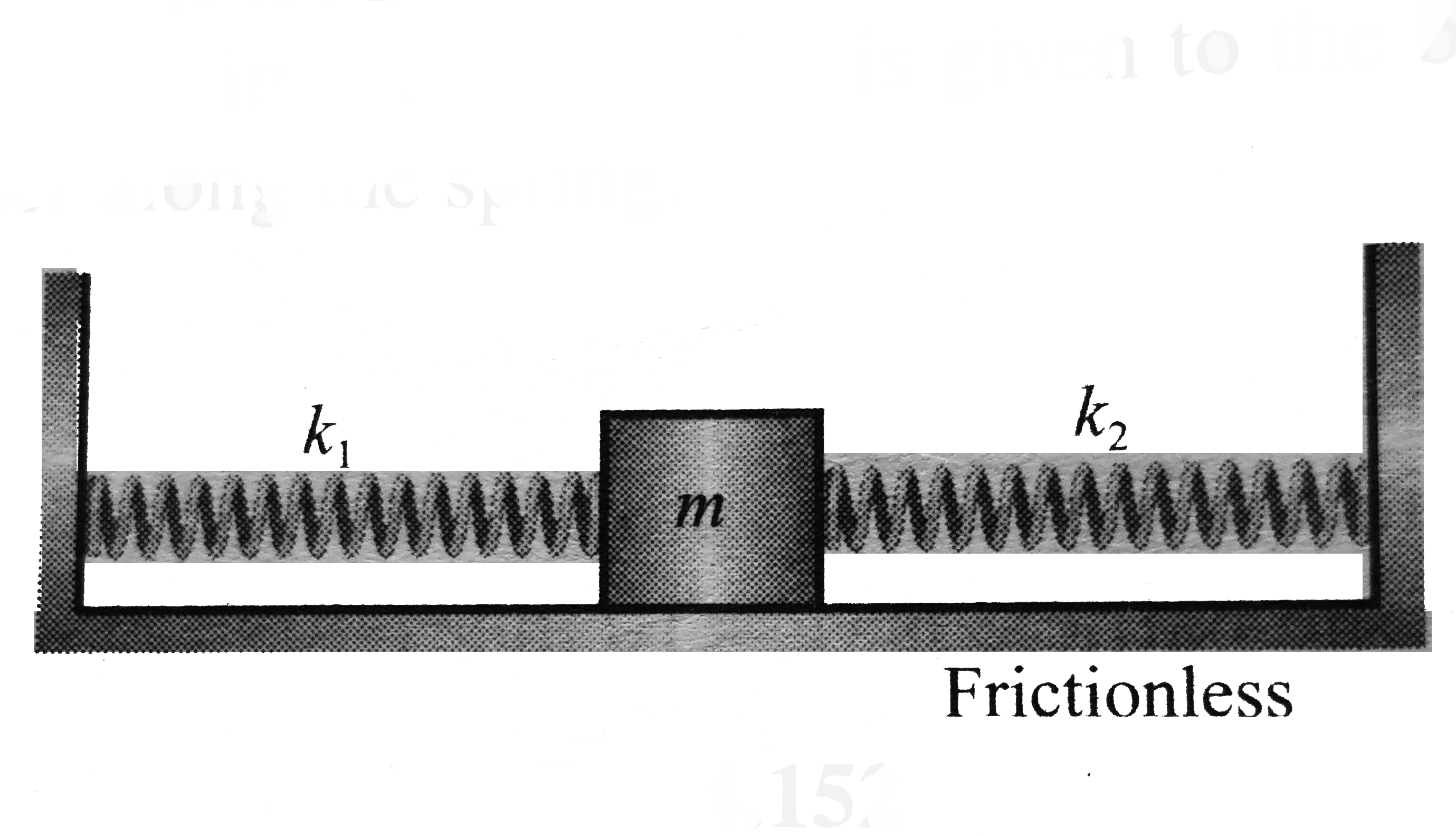
Two springs with negligible masses and force constants `k_1=200(N)/(m)` and `K_2=160(N)/(m)` are attached to the block of mass `m=10kg ` as shown in the fig. Initially the block is at rest, at the equilibrium position which both springs are neither stretched nor compressed. At time `t=0`, sharp impulse of `50Ns` is given to the block with a hammer along the spring.

Promotional Banner

Similar Questions

Explore conceptually related problems

Two springs with negligible massess and force constant of k_(1)= 200 Nm^(-1) and k_(2)=160Nm^(-1) are attached to the block of mass m = 10kg as shown in the figure. Initially the block is at rest at the equilibrium position the block is at rest at the equilibrium position nor compressed. At time t=0, sharp impulse of 50 N-s is given to the block.

Two springs with negligible massess and force constant of k_(1)= 200 Nm^(-1) and k_(2)=160Nm^(-1) are attached to the block of mass m = 10kg as shown in the figure. Initially the block is at rest at the equilibrium position the block is at rest at the equilibrium position nor compressed. At time t=0, sharp impulse of 50 N-s is given to the block.

Two springs with negligible massess and force constant of k_(1)= 200 Nm^(-1) and k_(2)=160Nm^(-1) are attached to the block of mass m = 10kg as shown in the figure. Initially the block is at rest at the equilibrium position the block is at rest at the equilibrium position ir. Which both springs are neither stretched nor compressed. At time t = 0, sharp impulse of 50 N-s is given to the block in horizontal direction.

Two springs with negligible massess and force constant of k_(1)= 200 Nm^(-1) and k_(2)=160Nm^(-1) are attached to the block of mass m = 10kg as shown in the figure. Initially the block is at rest at the equilibrium position the block is at rest at the equilibrium position ir. Which both springs are neither stretched nor compressed. At time t = 0, sharp impulse of 50 N-s is given to the block in horizontal direction.

A 5 kg block in connected with two spring A and B having force constant, K_1 = 200N/m and K_2 = 300 N/m respectively as shown in the figure . The block is released from rest with both the springs in natural length. The maximum energy stored in the spring A will be

The block of mass m_1 shown in figure is fastened to the spring and the block of mass m_2 is placed as against it. Find the compression of the spring in the equilibrium position.

A block of mass m, lying on a smooth horizontal surface, is attached to a spring (of negligible mass) of spring constant k. The other end of the spring is fixed, as shown in the figure. The block is initally at rest in its equilibrium position. If now the block is pulled withe a constant force F, the maximum speed of the block is :

A block of mass m, lying on a smooth horizontal surface, is attached to a spring (of negligible mass) of spring constant k. The other end of the spring is fixed, as shown in the figure. The block is initally at rest in its equilibrium position. If now the block is pulled withe a constant force F, the maximum speed of the block is :

A block of mass m initially at rest is dropped from a height h on to a spring of force constant k . the maximum compression in the spring is x then