

Home
Class 11
PHYSICS
Consider the situation as shown in the f...

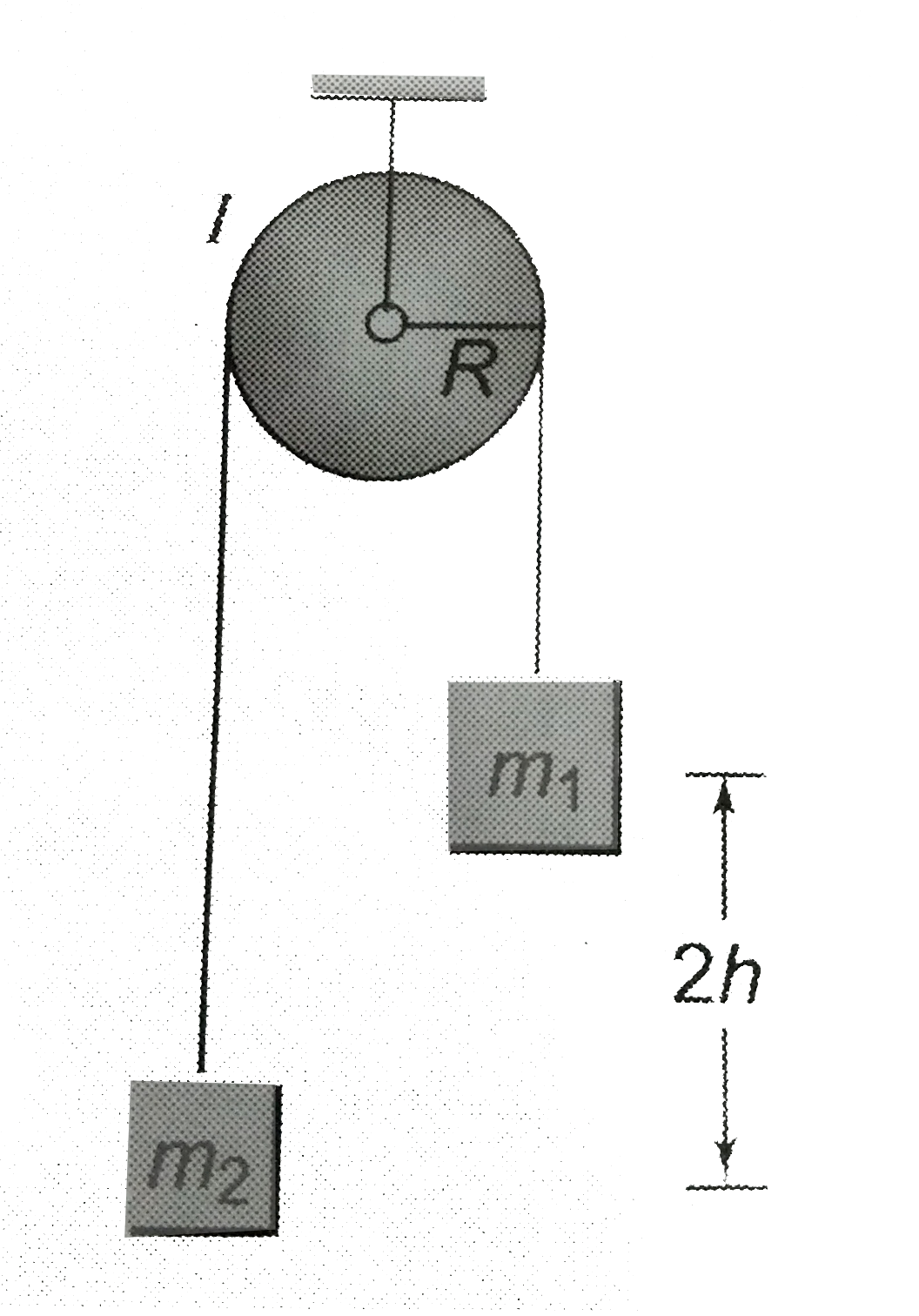
Consider the situation as shown in the figure. If `m_(1)gtm_(2)`, I is the moment of intertia about its axis of rotation, `R` is the radius of pulley. The objects are released from rest separated by a vertical distance `2 h`. Find the translational speed of the objects as they pass each other. Assume no slipping.

Promotional Banner

Similar Questions

Explore conceptually related problems

Consider two object with m_1 gt m_2 connected by a light string that passes over a pulley having a moment of inertia of I about its axis of rotation as shown in figure. The string does not slip on the pulley or strech. The pulley turns without friction. The two objects are released from rest separated by a vertical distance 2 h . The translational speeds of the objects as they pass each other is. .

Consider two masses with m_(1) gt m_(2) connected by a light inextensible string that passes over a pulley of radius R and moment of inertia I about its axis of rotation. The string does not slip on the pulley and the pulley turns without friction. The two masses are released from rest separated by a vertical distance 2h. When the two masses pass each other, the speed of the masses is proportional to

Consider the situation as shown in the figure. The pulley has moment of inertia I and radius r . The table is rough and the coefficient of kinetic friction is mu_(k) . The system is released from the rest. Calculated speed of block of mass 3m as a function of the distance h it has descended. Assume no slipping.

Consider the situation as shown in the figure. The moment of inertia of wheel is 2 kg m^(2) and its radius is 0.25 m . Find the angular acceleration of the wheel, assuming no slipping.

Consider the situation as shown in the figure. The system is released from rest. Find the speed of m when it has traveled a distance d on a rough surface.

A wheel of moment of inertial I and radius R is rotating about its axis at an angular speed omega . It picks up a stationary particle of mass m at its edge. Find the new angular speed of the wheel.

Consider the situation as shown. The pulley has a moment of inertia I, and radius r, the block is in equilibrium. Find the time period of mass m. Assume no slipping.

Consider the situation shown in figure. Initially the spring is unstretched when the system is released from rest. Assuming no friction in the pulley, find the maximum elongation of the spring?