Home
Class 11
PHYSICS
In the previous problem another block C ...

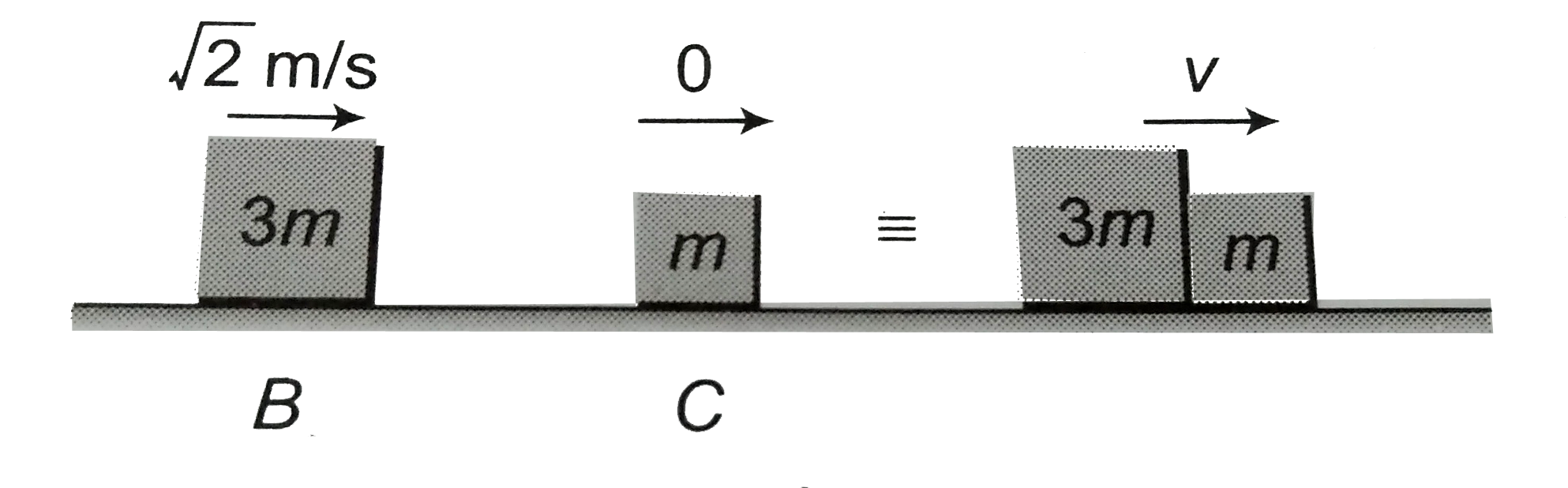
In the previous problem another block `C` of mass `m` is placed at distance `1 m` right of block `B`. Find `(a)` the distance travelled by the combined mass if the collision is completely inelastic and `(b)` separation between the blocks when they stop after head - on elastic collision.

Text Solution

Verified by Experts
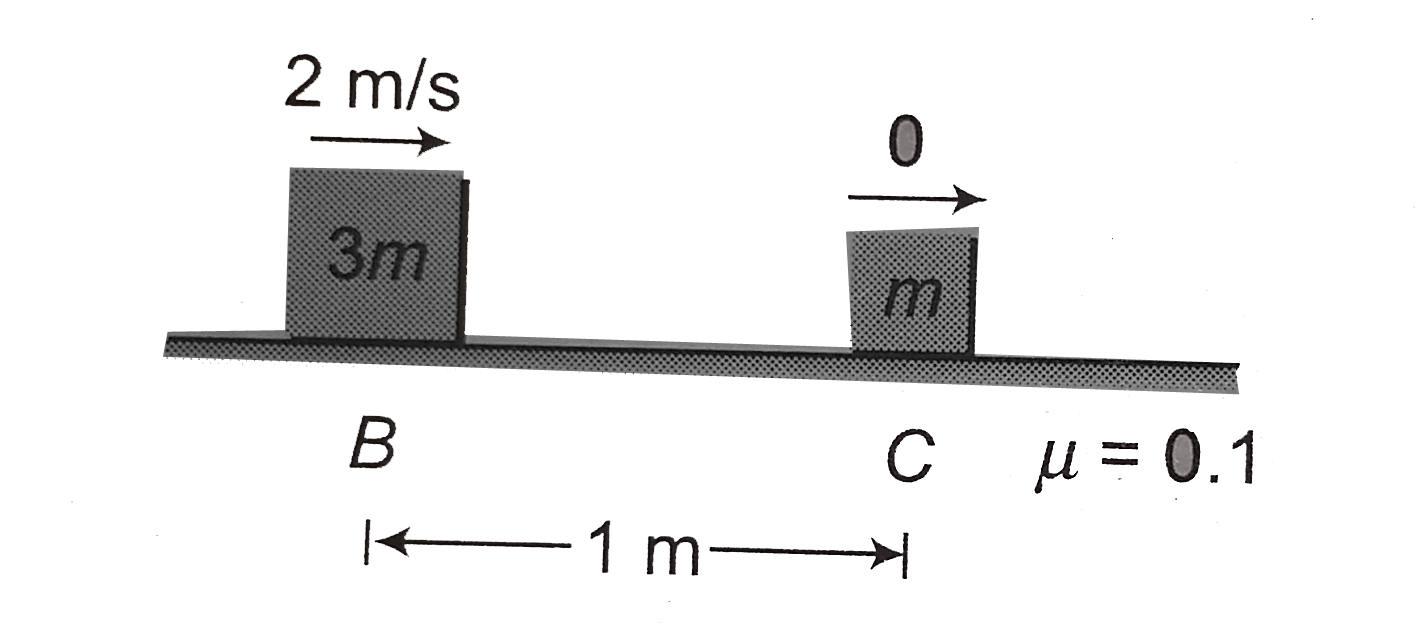
Speed of block `B` after traveling a distance `1 m`.
`u_(1)^(2) = (2)^(2) - 2 as = 4 - 2 xx 1 xx 1 = 2 rArr mu_(1) = sqrt(2) m//s`
`(a = mu g = 0.1 xx 10 = 1 m//s^(2))`
(a) Now , the collision is completely elastic , the blocks move together.
By the momentum conservation
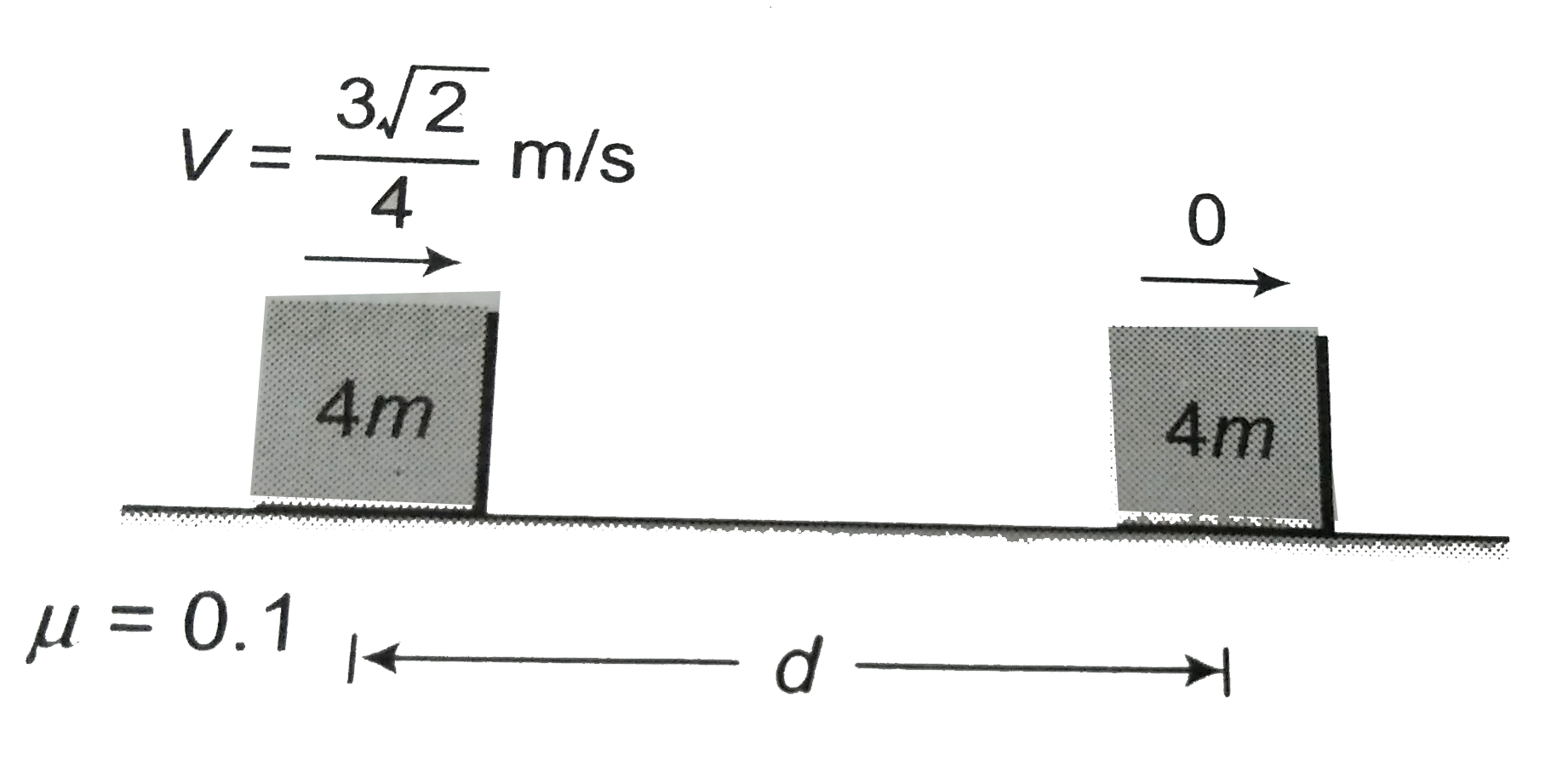
`3m sqrt(2) + m xx 0 = ( 3 m + m) V rArr V = (3 sqrt(2))/(4) m//s`
The distance travelled by the combined mass on a rough surface
`0 = V^(2) - 2ad rArr 0 = ((3 sqrt(2))/(4))^(2) - 2 xx 1 xx d`
`d = (9)/(16) m`
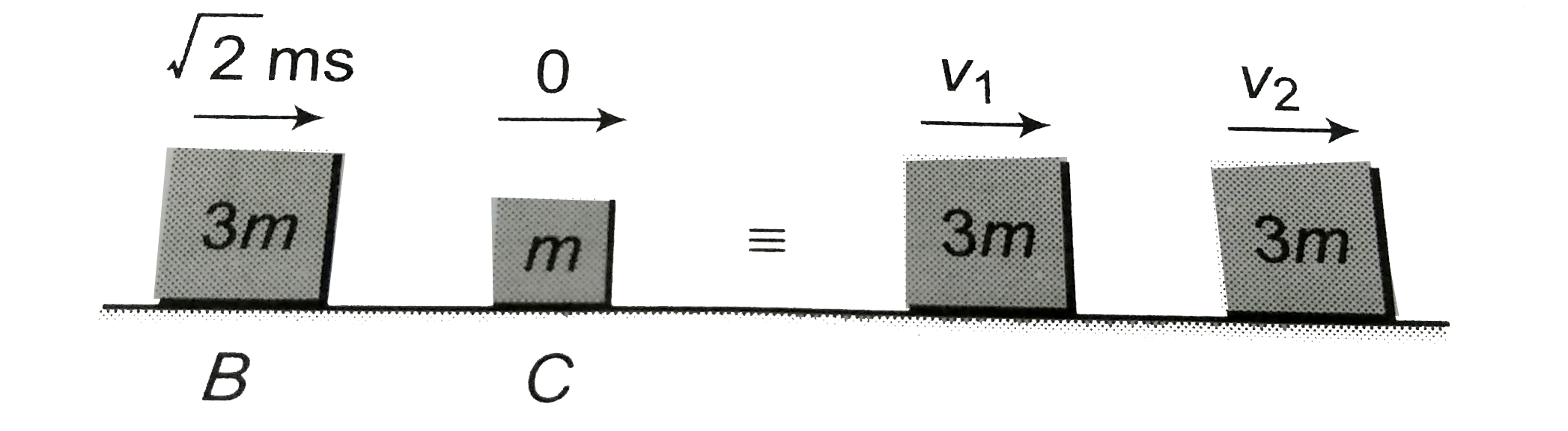
(b) If the collision is head - on elastic , the blocks will move with different velocities
`3m sqrt(2) + m xx 0 = 3mv_(1) + mv_(2)` (i)
`v_(1) + sqrt(2) = v_(2) + 0` (ii)
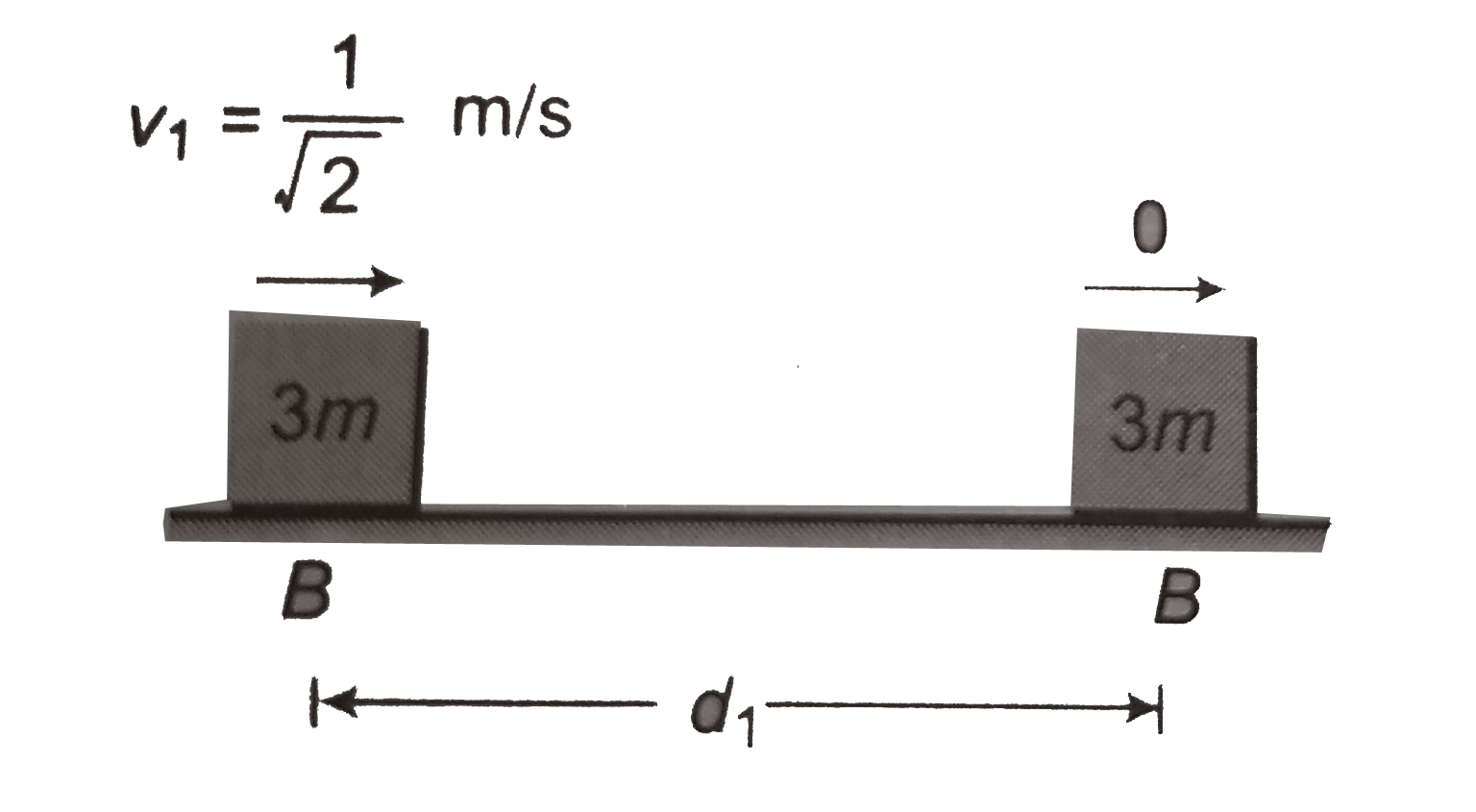
Solving , `v_(1) = (1)/(sqrt(2)) m//s , v_(2) = (3)/(sqrt(2)) m//s`
Let the distance travelled by blocks `B` and `C` are `d_(1)` and `d_(2)` before stop, in the same direction.
`0 = v_(1)^(2) - 2 ad`
`0 = (1)/(2) - 2 xx 1 xx d_(1) rArr d_(1) = (1)/(4) m`
`0 = v_(2)^(2) - 2ad_(2)`
`0 = ((3)/(sqrt(2)))^(2) - 2 xx 1 xx d_(2)`
`rArr d_(2) = (9)/(4) m`
Separation between blocks `= d_(2) - d_(1) = (9)/(4) - (1)/(4) = 2m`


Promotional Banner

Topper's Solved these Questions

Similar Questions

Explore conceptually related problems

In the previous problem , the maximum height attained by the ball and the distance traveled by the block , after collision will be

All surfaces are smooth. The ball of mass m is released from A . Find the distance travelled by the block of mass M .

A small block of mass M moves with velocity 5 m/s towards an another block of same mass M placed at a distance of 2 m on a rough horizontal surface . Coefficient of friction between the blocks and ground is 0.25 . Collision between the two blocks is elastic , the separation between the blocks , when both of them come to rest , is ( g = 10 m//s^(2) )

A block 'A' of mass 2m is placed on another block 'B' of mass 4m which in turn is placed on a fixed table. The two blocks have a same length 4d and they are placed as shown in fig The coefficient of friction (both static and kinetic) between the block 'B' and table is mu . There is no friction between the two blocks. A small object of mass m moving horizontally along a line passing through the centre of mass (cm.) of the block B and perpendicular to its face with a speed v collides elastically with the block B at a height d above the table. (a) What is the minimum value of v(call it v_0 ) required to make the block A topple? (b) If v=2v_0 ,find the distance (from the point P in the figure ) at which the mass m falls on the table after collision. (Ignore the role of friction during the collision).

The collision between both blocks shown in figure is completely inelastic. The total energy of oscillation after collision is

The friction coefficient between the horizontal surface and blocks A and B are (1)/(15) and (2)/(15) respectively. The collision between the blocks is perfectly elastic. Find the separation (in meters) between the two blcoks when they come to rest.

The blocks shown in figure have equal masses. The surface of A is smooth but that of B has a friction coefficient of 0.10 with the floor. Block A is moving at a speed of 10 m/s towards B which is kept at rest. Find the distance travelled by B if a. the collision is perfectly elastic and b. the collision is perfectly inelastic. Take g=10 m/s^2 .

A block of mass m moves with a speed v towards the right block which is in equilibrium with a spring attached to rigid wall. If the surface is frictionless and collisions are elastic, the frequency of collisions between the masses will be:

In the figure shown, the block A of mass m collides with the identical block B and after collision they stick together. Calculate the amplitude of resulatant vibration.

CP SINGH-CENTER OF MASS-Exercises
  1. In the previous problem another block C of mass m is placed at distanc...

    Text Solution

    |

  2. Two blocks of mass 1kg and 3 kg have position v ectors hat(i) + 2 hat...

    Text Solution

    |

  3. All the particles of a body situated at distance d from the origin. Th...

    Text Solution

    |

  4. Particle of masses m, 2m,3m,…,nm grams are placed on the same line at ...

    Text Solution

    |

  5. Three identical metal balls each of radius r are placed touching each ...

    Text Solution

    |

  6. Look at the drawing given in the figure which has been drawn with ink ...

    Text Solution

    |

  7. A circular disc of radius R is removed from a bigger circular disc of ...

    Text Solution

    |

  8. A hemisphere and a solid cone have a common base. The center of mass o...

    Text Solution

    |

  9. If the linear density (mass per unit length) of a rod of length 3 m is...

    Text Solution

    |

  10. The mass per unit length of a non - uniform rod of length L is given m...

    Text Solution

    |

  11. A thin rod of length 'L' is lying along the x-axis with its ends at x...

    Text Solution

    |

  12. Which of the following is true for center of mass ? (i) The center o...

    Text Solution

    |

  13. A cubical block of ice of maas m and edge L is placed in a large tray ...

    Text Solution

    |

  14. Two paricle A and B initially at rest, move towards each other under m...

    Text Solution

    |

  15. A ladder is leaned against a smooth wall and it is allowed to slip on ...

    Text Solution

    |

  16. A pulley fixed to the ceiling carries a string with blocks of mass m a...

    Text Solution

    |

  17. Two balls are thrown simultaneously from top of tower in air as shown ...

    Text Solution

    |

  18. Which of the following statements are true ? (i) A uniform wooden pl...

    Text Solution

    |

  19. Which of the following statements is true ? (i) A car of mass M is t...

    Text Solution

    |

  20. A boy of mass 40 kg stands on a rail road car of mass 60 kg, moving wi...

    Text Solution

    |

  21. A boy (mass of 40 kg) is standing at one end of a boat (mass of 60 kg)...

    Text Solution

    |