Home
Class 11
PHYSICS
A sphere A impinges directly on an ident...

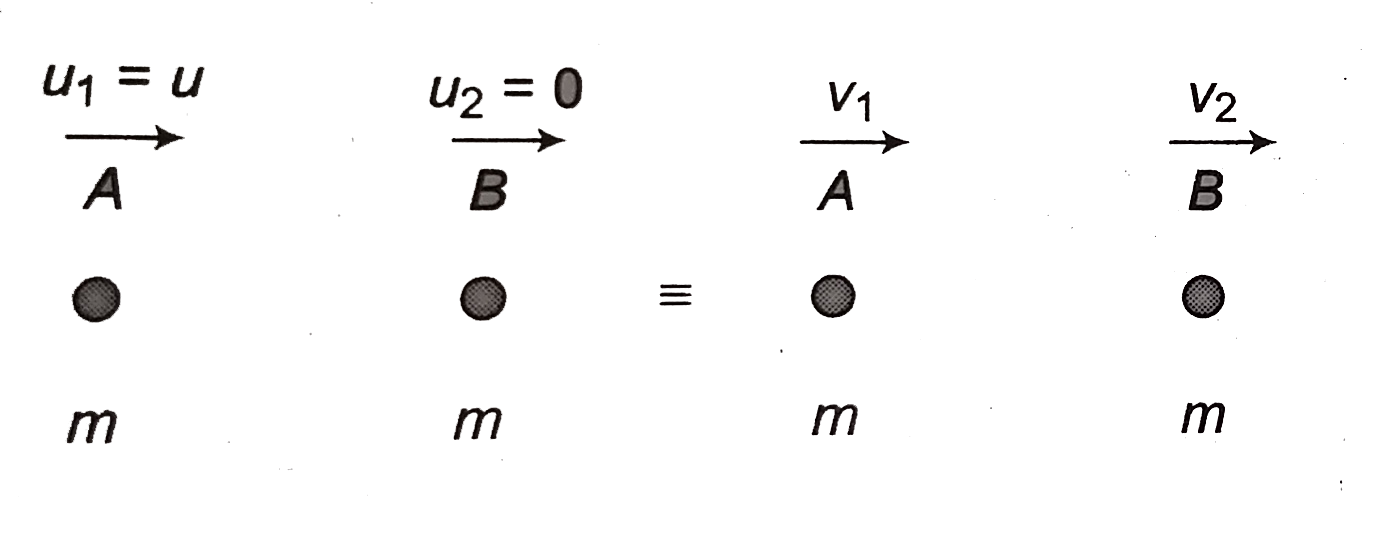
A sphere `A` impinges directly on an identical sphere `B` at rest. If coefficient of restitution is `e` , the ratio of velocities of `A` and `B` after collision is

A

`(1 - e)/(1 + e)`

B

`(1 + e)/(1 - e)`

C

`(e )/(1 + e)`

D

`(2e)/(1 + e)`

Text Solution

Verified by Experts

The correct Answer is:
A

`m u = mv_(1) + mv_(2) rArr v_(1) + v_(2) = u` (i)
`v_(1) - v_(2) = -e(u_(1) - u_(2))`
`v_(1) - v_(2) = -eu` (ii)
Solving the above equation , we get
`v_(1) = ((1 - e)u)/(2) , v_(2) = ((1 + e)u)/(2)`
`(v_(1))/(v_(2)) = (1 - e)/(1 + e)`
Promotional Banner

Topper's Solved these Questions

Similar Questions

Explore conceptually related problems

A sphere of mass m moving with a uniform velocity v hits another identical sphere at rest. If the coefficient of restitution is e, the ratio of the velocities of the two sphere after the collision is (e-1)/(e+1) .

A particle of mass m moving with a constant velocity v hits another identical stationary particle. If coefficient of restitution is e then ratio of velocities of two particles after collision is

A particle of mass m moving with a constant velocity v hits another identical stationary particle. If coefficient of restitution is e then ratio of velocities of two particles after collision is

The first ball of mass m moving with the velocity upsilon collides head on with the second ball of mass m at rest. If the coefficient of restitution is e , then the ratio of the velocities of the first and the second ball after the collision is

A ball of mass m moving with a speed 2v_0 collides head-on with an identical ball at rest. If e is the coefficient of restitution, then what will be the ratio of velocity of two balls after collision?

A ball P is moving with a certain velocity , collides head-on with another ball Q of same mass is rest. The coefficient of restitution is 1/4, then ratio of velocity of P and Q just after the collision is

Sphere A of mass 'm' moving with a constant velocity u hits another stationary sphere B of the same mass. If e is the co-efficient of restitution, then ratio of velocities of the two spheres v_(A):v_(B) after collision will be :

A ball of mass m moving with a constant velocity strikes against a ball of same mass at rest. If e= coefficient of restitution, then what will the the ratio of the velocities of the two balls after collision?

CP SINGH-CENTER OF MASS-Exercises
  1. A set of a identical cubical blocks lies at rest parallel to each othe...

    Text Solution

    |

  2. A ball moving with velocity 2 ms^(-1) collides head on with another st...

    Text Solution

    |

  3. A sphere A impinges directly on an identical sphere B at rest. If coef...

    Text Solution

    |

  4. In the previous problem , sphere A is moving with speed u(1) and spher...

    Text Solution

    |

  5. Two balls of masses 2 m and m are moving with speed 2 v(0) and v(0) to...

    Text Solution

    |

  6. A block of mass m moving with speed v(0) strikes another particle of m...

    Text Solution

    |

  7. In the previous problem , the maximum loss in K.E. will be

    Text Solution

    |

  8. A 2 kg ball , moving at 10 m//s , collides head - on with a 3 kg ball ...

    Text Solution

    |

  9. A ball of mass m moving at speed v makes a head on collision with an ...

    Text Solution

    |

  10. A ball is dropped from a height h onto a floor and rebounds to a heigh...

    Text Solution

    |

  11. A body falling from a height of 10 m rebounds from the hard floor . It

    Text Solution

    |

  12. A ball is dropped from a height of 20 m on a floor for which e = 1//2....

    Text Solution

    |

  13. In the previous problem , time taken by the ball up to the third colli...

    Text Solution

    |

  14. A partical falls from a height h upon a fixed horizontal plane and re...

    Text Solution

    |

  15. A ball hits the floor and rebounds after an inelastic collision. In th...

    Text Solution

    |

  16. A ball of mass m moving with speed v(0) strikes a block of mass 3 m ke...

    Text Solution

    |

  17. In the previous problem , mass of the ball is 10 g and it is moving wi...

    Text Solution

    |

  18. Two blocks of masses 1 kg and 3 kg are moving with velocities 2 m//s a...

    Text Solution

    |

  19. Initially spring is in its natural length . The block of mass 3 kg in ...

    Text Solution

    |

  20. In the previous problem , the maximum elongation of the spring is

    Text Solution

    |

