Home
Class 12
PHYSICS
Two capacitors C(1) and C(2) in a circui...

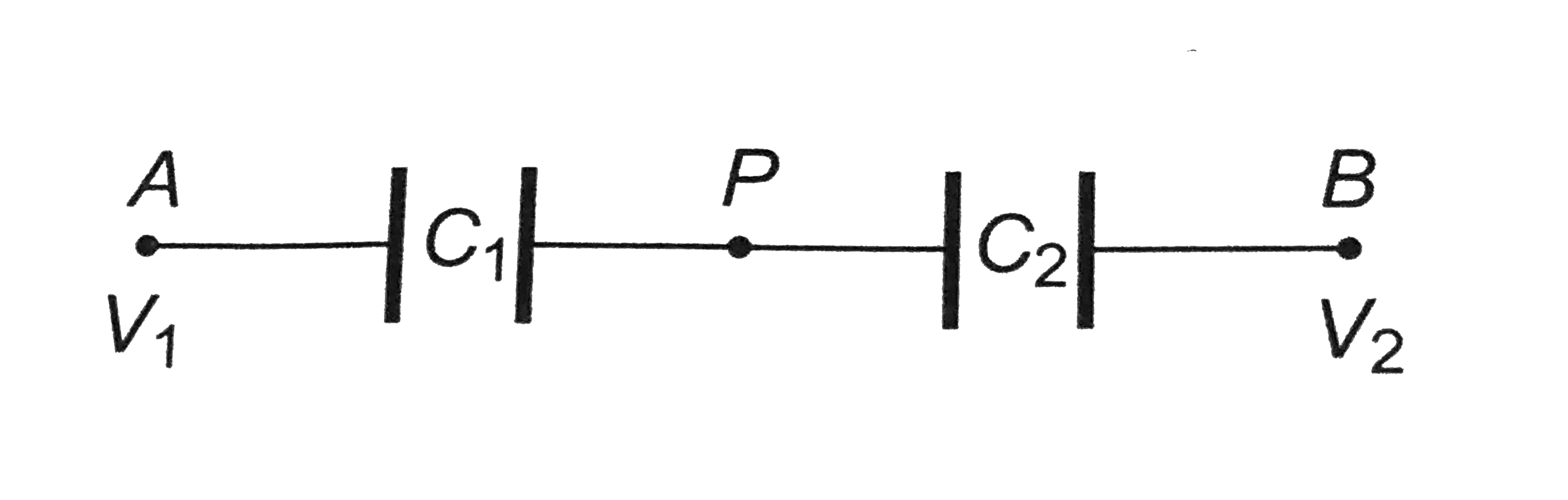
Two capacitors `C_(1)` and `C_(2)` in a circuite are joined as shown. If `V_(A)=V_(1),V_(B)=V_(2)`, the potemntial of point `P` is

A

`(1)/(2)(V_(1)-V_(2))`

B

`(C_(2)V_(1)+C_(1)V_(2))/(C_(1)+C_(2))`

C

`(C_(1)V_(1)+C_(2)V_(2))/(C_(1)+C_(2))`

D

`(C_(2)V_(1)-C_(1)V_(2))/(C_(1)+C_(2))`

Text Solution

Verified by Experts

The correct Answer is:
C

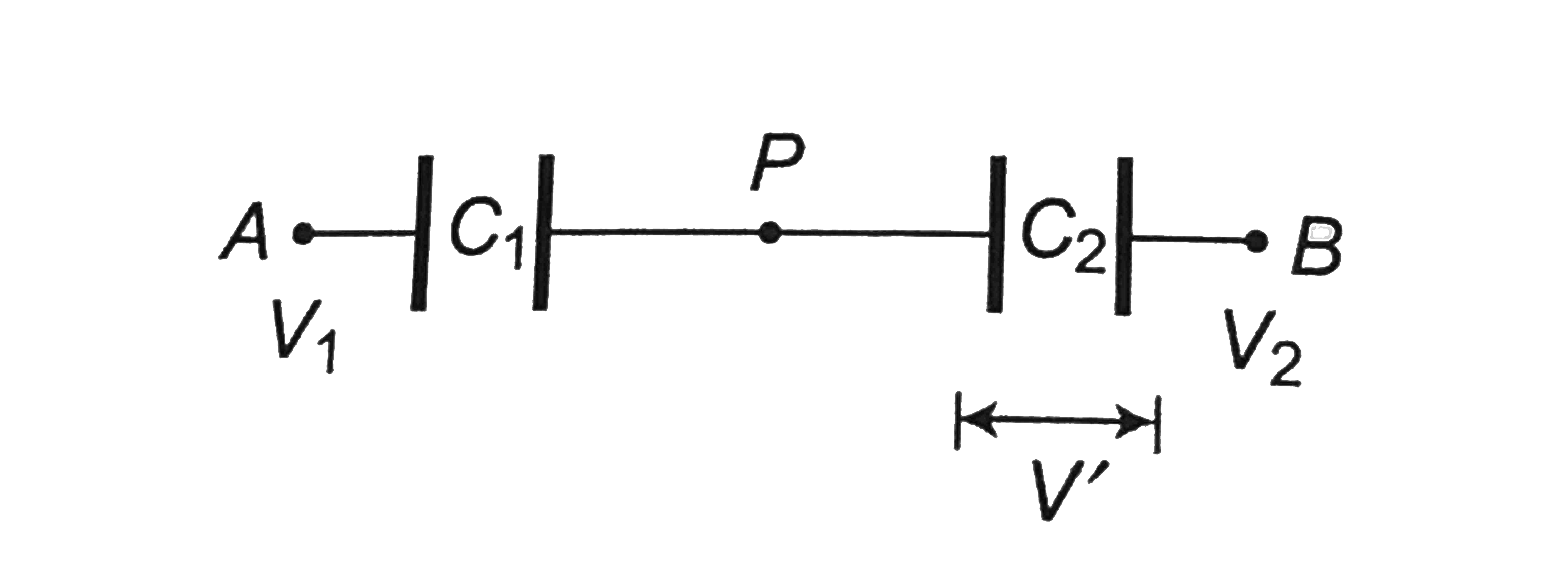
`V'=((C_(1))/(C_(1)+C_(2)))(V_(1)-V_(2))`
`V_(p)-V_(B)=(C_(1)V_(1)-C_(1)V_(2))/(C_(1)+C_(2))`
`V_(p)-V_(2)=(C_(1)V_(1)-C_(1)V_(2))/(C_(1)+C_(2))`
`V_(p)=(C_(1)V_(1)-C_(1)V_(2))/(C_(1)+C_(2))+V_(2)`
`=(C_(1)V_(1)+C_(2)V_(2))/(C_(1)+C_(2))`
Promotional Banner

Topper's Solved these Questions

Similar Questions

Explore conceptually related problems

Two condensers C_(1) and C_(2) in a circuit are jhioned as shown in . The potential fo point A is V_1 and that of B is V_2 . The potential of point D will be

Two capacitors C_(1) and C_(2) are connected in a circuit as shown in figure. The potential difference (V_(A) - V_(B)) is

Four capacitors and two batteries are connected as shown in the diagram. If V_(a) and V_(b) denote the potentials of the points 'a' and 'b' then .

Two cells of unequal emfs, varepsilon_(1) and varepsilon_(2) and internal resistances r_(1) and r_(2) are joined as shown. V_(A) and V_(B) are the potentials at A and B respectively.

The circuit consists of resistors and ideal cells. I_(1) and I_(2) are current through branches indicated in the figure, V_(A) and V_(B) is the potential at points A and B on the circuit The value of V_(A) - V_(B) in volts is:

The p.d (V_(B)-V_(C) between two point from C to B

Two capacitors C_(1) and C_(2) are connected to a battery of 6 V as shown in Fig. Find the charge on each capacitor.

A hollow conducting sphere is placed in an electric field produced by a point charge placed at P as shown in figure. Let V_(A), V_(B), V_(C ) be the potentials at points A, B and C respectively. Then

Three capacitors C_(1),C_(2) and C_(3) are connected as shown in, The potentials of P,Q , and R are V_(1),V_(2), and V_(3) , respectively. Find the potential V_(0) at the function O . .

CP SINGH-CAPACITANCE-Exercise
  1. Three capacitors of capacitances 3 muF, 9 muF and 18 muF are connected...

    Text Solution

    |

  2. In the given circuit if point C is connected to the earth and a potent...

    Text Solution

    |

  3. Two capacitors C(1) and C(2) in a circuite are joined as shown. If V(A...

    Text Solution

    |

  4. 1000 small water drops each of raius r and charge q coalesce together ...

    Text Solution

    |

  5. A battery is used to charge a parallel plate capacitor till the potent...

    Text Solution

    |

  6. An unchanged capacitor is connected to a battery. On charging the capa...

    Text Solution

    |

  7. A parallel plate air capacitor is connected to a battery. The quantiti...

    Text Solution

    |

  8. C,V,U and Q are capacitance, potential difference, energy stored and c...

    Text Solution

    |

  9. A parallel plate capacitor is connected to a cell. A metal plate of ne...

    Text Solution

    |

  10. The capcitance of a parallel plate capacitor is C(0) when the space be...

    Text Solution

    |

  11. The separation between the plates of a parallel plate capacitor is mad...

    Text Solution

    |

  12. A parallel plate capcitor of capacitance C is having charge q(0) on e...

    Text Solution

    |

  13. Two idential parallel plate capacitors are connected in sereis to a c...

    Text Solution

    |

  14. Two condensers, one of capacity C and the other of capacity C//2, are...

    Text Solution

    |

  15. Two capacitors C(1)=3muF and C(2)=6muF in series, are connected in par...

    Text Solution

    |

  16. Two condensers of capacity C and 2C are connected in parallel and thes...

    Text Solution

    |

  17. The plates of a parallel plate capacitor are charged up to 100 v. Now,...

    Text Solution

    |

  18. An isolated charged capacitor with vacuum between its plates is dipped...

    Text Solution

    |

  19. C,Q,V and U are capacitance, charge, potential difference and energy s...

    Text Solution

    |

  20. A parallel plate capcitor has plate area A and separation d. It is cha...

    Text Solution

    |

