Home
Class 12
PHYSICS
An isolated charged capacitor with vacuu...

An isolated charged capacitor with vacuum between its plates is dipped into an oil tank. If the oil is pumped out, the electric field between the plates of capacitor will

A

increased

B

decrease

C

remain the same

D

none of these

Text Solution

Verified by Experts

The correct Answer is:
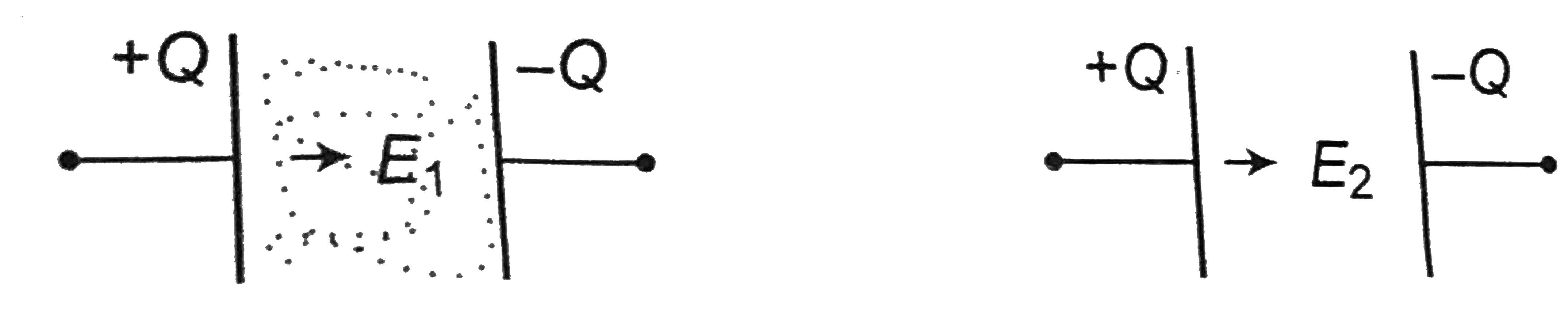
A

`E_(1)=(E_(0))/(K),E_(2)=E_(0)`
`E_(2)gtE_(1)`
Promotional Banner

Topper's Solved these Questions

Similar Questions

Explore conceptually related problems

Two metal plates having charges Q_1-Q face each other at some separation and are dipped into an oil tank .If the oil is pumped out, the eletric field between the plates will

In a parallel plate capacitor, the distance between the plates is d and potential difference across the plate is V . Energy stored per unit volume between the plates of capacitor is

Two parallel metal plates having charges +Q and -Q face each other at a certain distance between them.If the plates are now dipped in kerosene oil tank ,the electric field between the plates will

A parallel plate capacitor is charged to a potential difference V by a dc source. The capacitor is then disconnected from the source. If the distance between the plates in doubled, state with reason how the following will change, (i) electric field between the plates, (ii) capacitance and (iii) energy stored in the capacitor.

Force of attraction between the plates of a parallel plate capacitor is

A parallel plate capacitor with circular plates of radius 0.12m is being charged. A circular loop of radius 0.24 m is concentric with the capacitor and half way between the plates. The displacement current through the loop is 2.0 A. At what rate is the electric field between the plates changing?

A parallel plate capacitor of plate area A and plates separation distance d is charged by applying a potential V_(0) between the plates. The dielectric constant of the medium between the plates is K. What is the uniform electric field E between the plates of the capacitor ?

CP SINGH-CAPACITANCE-Exercise
  1. C,V,U and Q are capacitance, potential difference, energy stored and c...

    Text Solution

    |

  2. A parallel plate capacitor is connected to a cell. A metal plate of ne...

    Text Solution

    |

  3. The capcitance of a parallel plate capacitor is C(0) when the space be...

    Text Solution

    |

  4. The separation between the plates of a parallel plate capacitor is mad...

    Text Solution

    |

  5. A parallel plate capcitor of capacitance C is having charge q(0) on e...

    Text Solution

    |

  6. Two idential parallel plate capacitors are connected in sereis to a c...

    Text Solution

    |

  7. Two condensers, one of capacity C and the other of capacity C//2, are...

    Text Solution

    |

  8. Two capacitors C(1)=3muF and C(2)=6muF in series, are connected in par...

    Text Solution

    |

  9. Two condensers of capacity C and 2C are connected in parallel and thes...

    Text Solution

    |

  10. The plates of a parallel plate capacitor are charged up to 100 v. Now,...

    Text Solution

    |

  11. An isolated charged capacitor with vacuum between its plates is dipped...

    Text Solution

    |

  12. C,Q,V and U are capacitance, charge, potential difference and energy s...

    Text Solution

    |

  13. A parallel plate capcitor has plate area A and separation d. It is cha...

    Text Solution

    |

  14. The space between plates of a parallel plate capacitor is filled by a ...

    Text Solution

    |

  15. A parallel plate capacitor of plate area A and plate separation d is c...

    Text Solution

    |

  16. A parallel-plate capacitor has plates of area A and separation d and i...

    Text Solution

    |

  17. A parallel plate capacitor of capacitance 10muF is charged to potenta...

    Text Solution

    |

  18. Figure shows two identical parallel plate capacitors connected to a sw...

    Text Solution

    |

  19. Consider the situation shown in the figure. The capacitor A has a char...

    Text Solution

    |

  20. Two thin dielectric slabs of dielectric constants K(1) and K(2) (K(1) ...

    Text Solution

    |

