Home
Class 12
PHYSICS
Consider the situation shown in the figu...

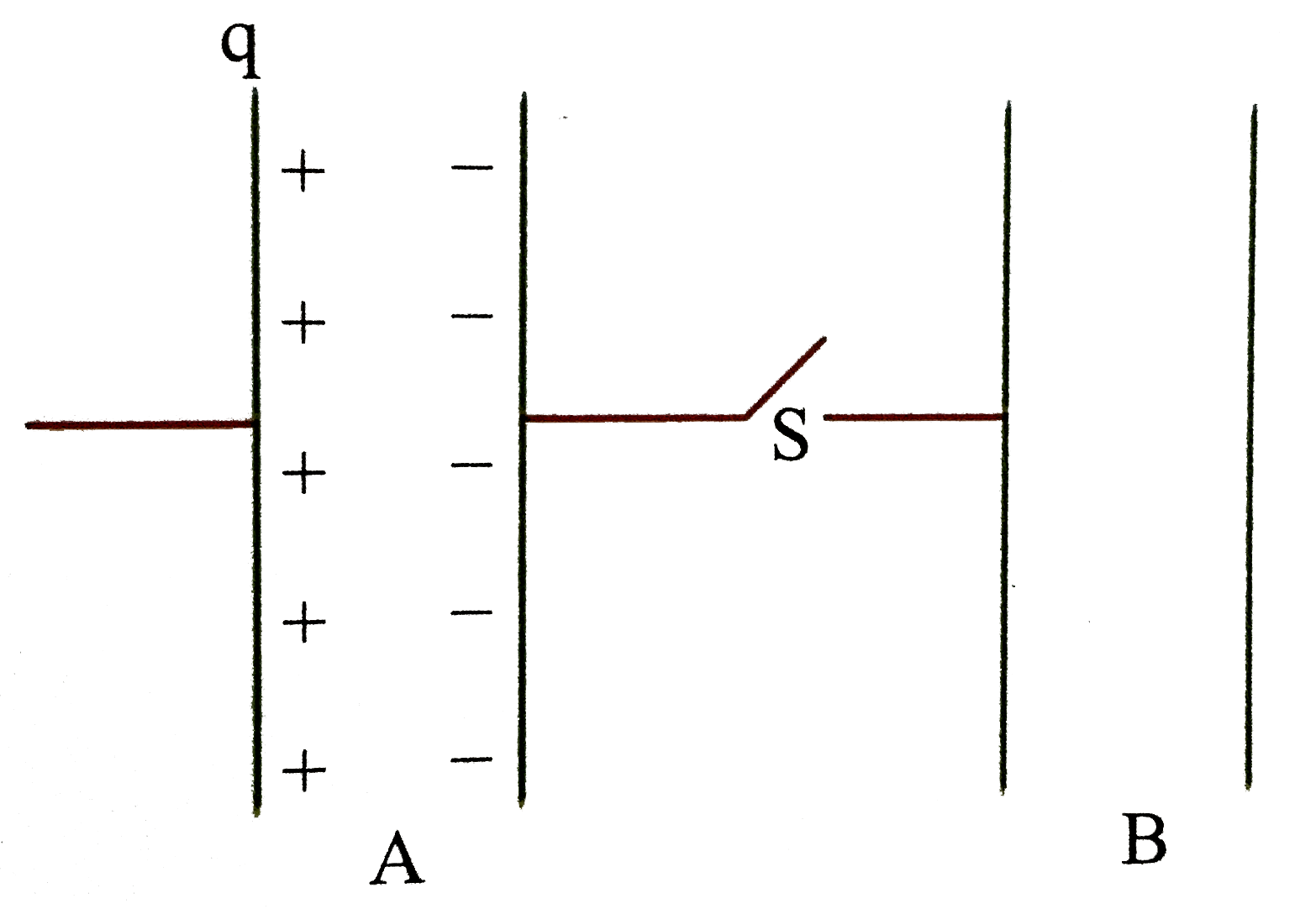
Consider the situation shown in the figure. The capacitor `A` has a charge `q` on it whereas `B` is uncharged. The charge appearing on the capacitor `B` a long `7` time after the switch is closed is :
.

A

zero

B

`q//2`

C

`q`

D

`2q`

Text Solution

Verified by Experts

The correct Answer is:

A

As circuit is not closed, charge will not flow.
Promotional Banner

Topper's Solved these Questions

Similar Questions

Explore conceptually related problems

Conisder the istuation shown in the figure. The capacitor A has a charge q on it whereas B is unchanged. The charge appearing on the capacitor B a long time after the switch is closed is

The charge on each of the capacitors 0.16 ms after the switch S is closed in figure is :

Find the charge on each of the capacitor 0.20ms after the switch S is closed in Figure.

Initially the capacitor is uncharged find the charge on capacitor as a function of time, if switch is closed at t=0.

Find heat produced in the capacitors after long time on closing the switch S

Consider the situation shown in the figure. The switch S is open for a long time and then closed and again steady state reached then (a) Find the charge flown through the battery after the switch S is closed. (b) Find the charge flown through the switch S from B to A. (c) Find the work done by the battery after the switch S is closed. (d) Find the change in energy stored in the system of capacitors. (e) Find the heat developed in the system after the switch S is closed.

Two capacitors of equal capacitance ( C_1 = C_2 ) are shown in the figure. Initially, while the switch S is open, one of the capacitors is uncharged and the other carries charge Q0. The energy stored in the charged capacitor is U0. Sometimes after the switch is colsed, the capacitors C_1 and C_2 carry charges Q_1 and Q_2, respectively, the voltages across the capacitors are V_1 and V_2 , and the energies stored in the capacitors are U_1 and U_2 . Which of the following statements is INCORRECT ?

CP SINGH-CAPACITANCE-Exercise
  1. C,V,U and Q are capacitance, potential difference, energy stored and c...

    Text Solution

    |

  2. A parallel plate capacitor is connected to a cell. A metal plate of ne...

    Text Solution

    |

  3. The capcitance of a parallel plate capacitor is C(0) when the space be...

    Text Solution

    |

  4. The separation between the plates of a parallel plate capacitor is mad...

    Text Solution

    |

  5. A parallel plate capcitor of capacitance C is having charge q(0) on e...

    Text Solution

    |

  6. Two idential parallel plate capacitors are connected in sereis to a c...

    Text Solution

    |

  7. Two condensers, one of capacity C and the other of capacity C//2, are...

    Text Solution

    |

  8. Two capacitors C(1)=3muF and C(2)=6muF in series, are connected in par...

    Text Solution

    |

  9. Two condensers of capacity C and 2C are connected in parallel and thes...

    Text Solution

    |

  10. The plates of a parallel plate capacitor are charged up to 100 v. Now,...

    Text Solution

    |

  11. An isolated charged capacitor with vacuum between its plates is dipped...

    Text Solution

    |

  12. C,Q,V and U are capacitance, charge, potential difference and energy s...

    Text Solution

    |

  13. A parallel plate capcitor has plate area A and separation d. It is cha...

    Text Solution

    |

  14. The space between plates of a parallel plate capacitor is filled by a ...

    Text Solution

    |

  15. A parallel plate capacitor of plate area A and plate separation d is c...

    Text Solution

    |

  16. A parallel-plate capacitor has plates of area A and separation d and i...

    Text Solution

    |

  17. A parallel plate capacitor of capacitance 10muF is charged to potenta...

    Text Solution

    |

  18. Figure shows two identical parallel plate capacitors connected to a sw...

    Text Solution

    |

  19. Consider the situation shown in the figure. The capacitor A has a char...

    Text Solution

    |

  20. Two thin dielectric slabs of dielectric constants K(1) and K(2) (K(1) ...

    Text Solution

    |
