Home
Class 12
PHYSICS
Consider three charges q(1),q(2) and q(3...

Consider three charges `q_(1),q_(2)` and `q_(3)` each equal to `q` at the verticles of an equilateral triangle of side `'l'` what is the force on any charge due to remianing charges.

Text Solution

Verified by Experts
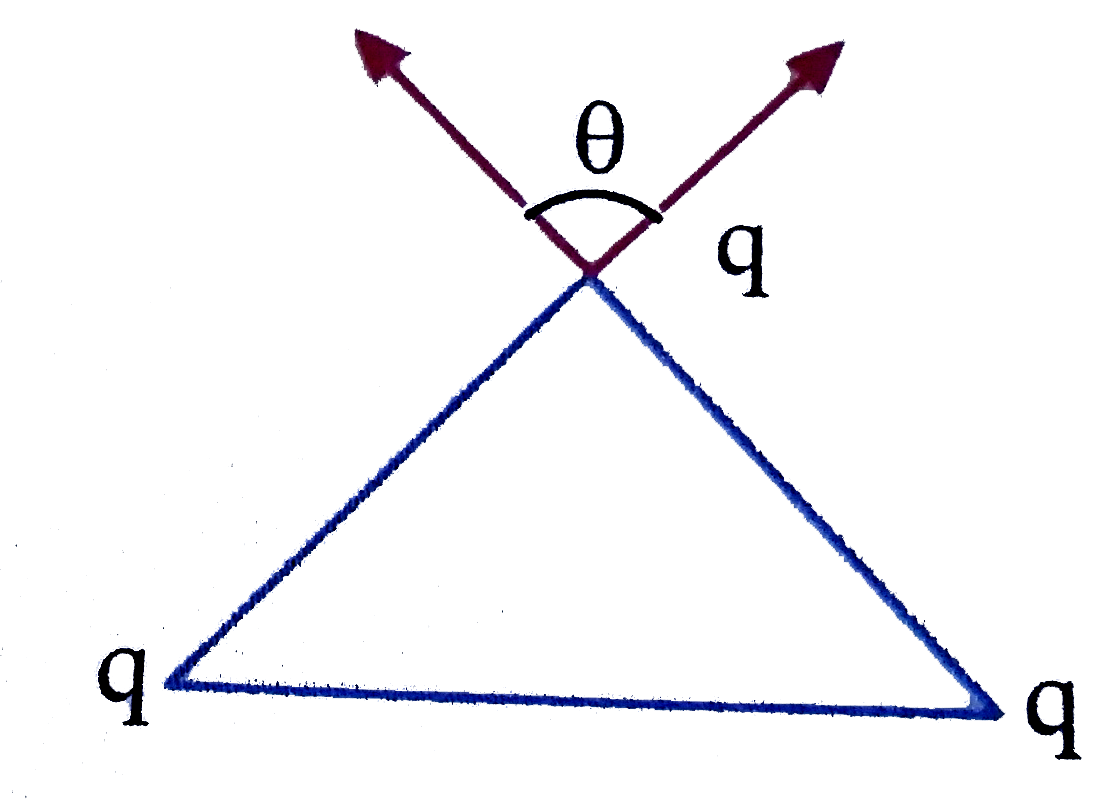
The force acting on the charge `'q'` are

`bar(F)=(1)/(4pi epsilon_(0))(q_(2))/(l^(2))`
` bar(F_(2))=(1)/(4piepsilon_(0))(q^(2))/(l^(2))`
clearly `|vec(F_(1))|=|vec(F_(2))|=|vec(F)|`
The resultant force is
`F^(1)=sqrt(F^(2)+F^(2)+2FF cos60^(@))`
`=sqrt(3F)=sqrt(3)(1)/(4piepsilon_(0))(q^(2))/(l^(2))`
Promotional Banner

Topper's Solved these Questions

  • ELECTROSTATICS AND GAUSS LAW

    NARAYNA|Exercise C.U.Q|133 Videos
  • ELECTROSTATICS AND GAUSS LAW

    NARAYNA|Exercise Level 1(C.W)|24 Videos
  • ELECTROSTATIC POTENTIAL AND CAPACITANCE

    NARAYNA|Exercise ADDITIONAL PROBLEMS|14 Videos
  • EXPERIMENTAL PHYSICS

    NARAYNA|Exercise Comprehension type|6 Videos

Similar Questions

Explore conceptually related problems

Consider the charges q,q and -q placed at the vertices of an equilateral triangle of each side l. What is the force on each charge ?

Three charges 2q, -q, and -q are located at the vertices of an equilateral triangle. At the center of the triangle,

Three charges q_1=1muC, q_2=2muC and q_3=3muC are placed on the vertices of an equilateral triangle of side 1.0 m. Find the net electric force acting on charge q_1

Three point charges q are placed at three vertices of an equilateral triangle of side a. Find magnitude of electric force on any charge due to the other two.

Three charges q_(1) = 1 mu C, q_(2) = -2 muC and q_(3) = 3mu C are placed on the vertices of an equilateral triangle of side 1.0 m. find the net electric force acting on charge q_(1) . How to proceed Charge q_(2) will attract charge q_(1) (along the line joining them) and charge q_(3) will repel charge q_(1) . Therefore, two forces will act on q_(1) , one due to q_(2) and another due to q_(3) . Since , the force is a vector quantity both of these force (say F_(1) and F_(2) ) will be added by vector method. Following are two methods of their addition

(a) Three point charges q,-4q and 2q are placed at the vertices of an equilateral triangle ABC of side 'l' as shown in the figure. Obtain the expression for the magnitude of the resultant electric force acting on the charge q. (b) Find out the amount of the work 4one to separate the charges at infinite distance.

Three charges +q,+q and -q are located at the corners of an equilaterial triangle of side a. Calculate potential energy of the system.

