Home
Class 12
PHYSICS
A block having mass 'm' ad carge q is re...

A block having mass `'m'` ad carge `q` is resting on a fractionless plane at distance `L` from the wall as shown in fig.Discuss the motion of the block when a uniform electric field `E` is applied horizontally towards the wall assuming that collision of the block with the wall is perfectly elastic.

Text Solution

Verified by Experts
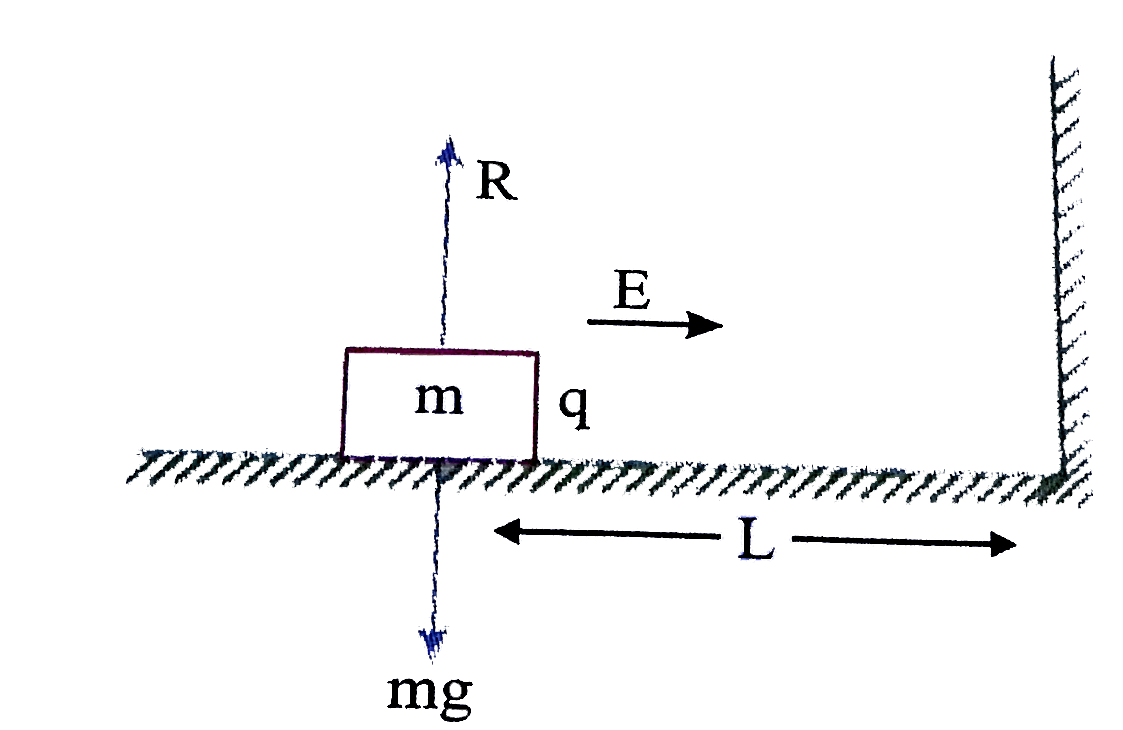
The situation is shown in fig Electric froces `vec(F)=qvec(E)` will accelerate the block towards the wall producing an acceleration
`a=(F)/(m)=(qE)/(m)L=(1)/(2)at^(2)`
i.e, `t=sqrt((2L)/(a))=sqrt((2mL)/(qE))`

As collision with the wall is perfectly elastic the block will rebound with same speed and as now is motion is opposite to the accelereation ,it will come to rest after travelling same distance `L` in same time `t`.After stopping it will begain accelerated towards the wall and so the block will execute oscillatory motion with "sprain" `L` and time period
`T=2t=sqrt((2mL)/(qE))`
However as the restoring force `f=(=qE)` when the block is moving away from the wall is constance and not proportional to displacement `x` the motion is not simple harmonic.
Promotional Banner

Topper's Solved these Questions

  • ELECTROSTATICS AND GAUSS LAW

    NARAYNA|Exercise C.U.Q|133 Videos
  • ELECTROSTATICS AND GAUSS LAW

    NARAYNA|Exercise Level 1(C.W)|24 Videos
  • ELECTROSTATIC POTENTIAL AND CAPACITANCE

    NARAYNA|Exercise ADDITIONAL PROBLEMS|14 Videos
  • EXPERIMENTAL PHYSICS

    NARAYNA|Exercise Comprehension type|6 Videos

Similar Questions

Explore conceptually related problems

A body having specific charge 8 mu C//g is resting on a frictionless plane at a distance 10 cm from the wall (as shown in the figure). It starts moving towards the wall when a uniform electric field of 100 V/m is applied horizontally towards the wall. If the collision of the body with the wall is perfectly elastic, then the time period of the motion will be ______ s.

A block having mass m and charge Q is resting on a frictionless plane at a distance d from fixed large non-conducting infinite sheet of uniform charge density -sigma as shown in Figure. Assuming that collision of the block with the sheet is perfectly elastic, find the time period of oscillatory motion of the block. Is it SHM ?

Describe the motion of the mass m shown in figure. The walls and the block are elastic.

A block of mass n containing a net positive charge q is placed on a smooth horizontal table which terminates in a vertical wall as shown in figure(29-E2). The distance of the bolck from the wall is d. A horizontal electric field E to towards right is switched on. Assuming elastic collisions find the time period of the resulting oscillatory motio. Is it a simple harmonic motion?

A block of mass m is at rest under the action of force F against a wall as shown in figure. Which of the following statement is incorrect?

A block of mass 0.9 kg attached to a spring of force constant k is lying on a frictionless floor. The spring is compressed to sqrt(2) cm and the block is at a distance 1//sqrt(2) cm from the wall as shown in the figure. When the block is released, it makes elastic collision with the wall and its period of motion is 0.2 sec . Find the approximate value of k

A small block of mass M moves on a frictionless surface of an inclined plane, as shown in the figure. The angle of the incline suddenly changes from 60^(@) to 30^(@) at point B . The block is many at rest at A . Assume that collisions between the block id the incline are totally inelastic. The speed of the block at point C , immediately before it leaves the second incline

A sphere of mass m slides with velocity v on as frictionless surface towards a smooth inclined wall as shown in figure. If the collision with the wall is perfectly elastic find a. the impulse imparted by the wall on the sphere b the impulse imparted by the floor on the sphere.

A block of mass m & charge q is released on a long smooth inclined plane magnetic field B is constant, unifrom, horizontal and parallel to surface a shown Find the time from start when block loses contact with the surface .

