Home
Class 12
PHYSICS
In (Fig. 3.73), if the inner shell has c...

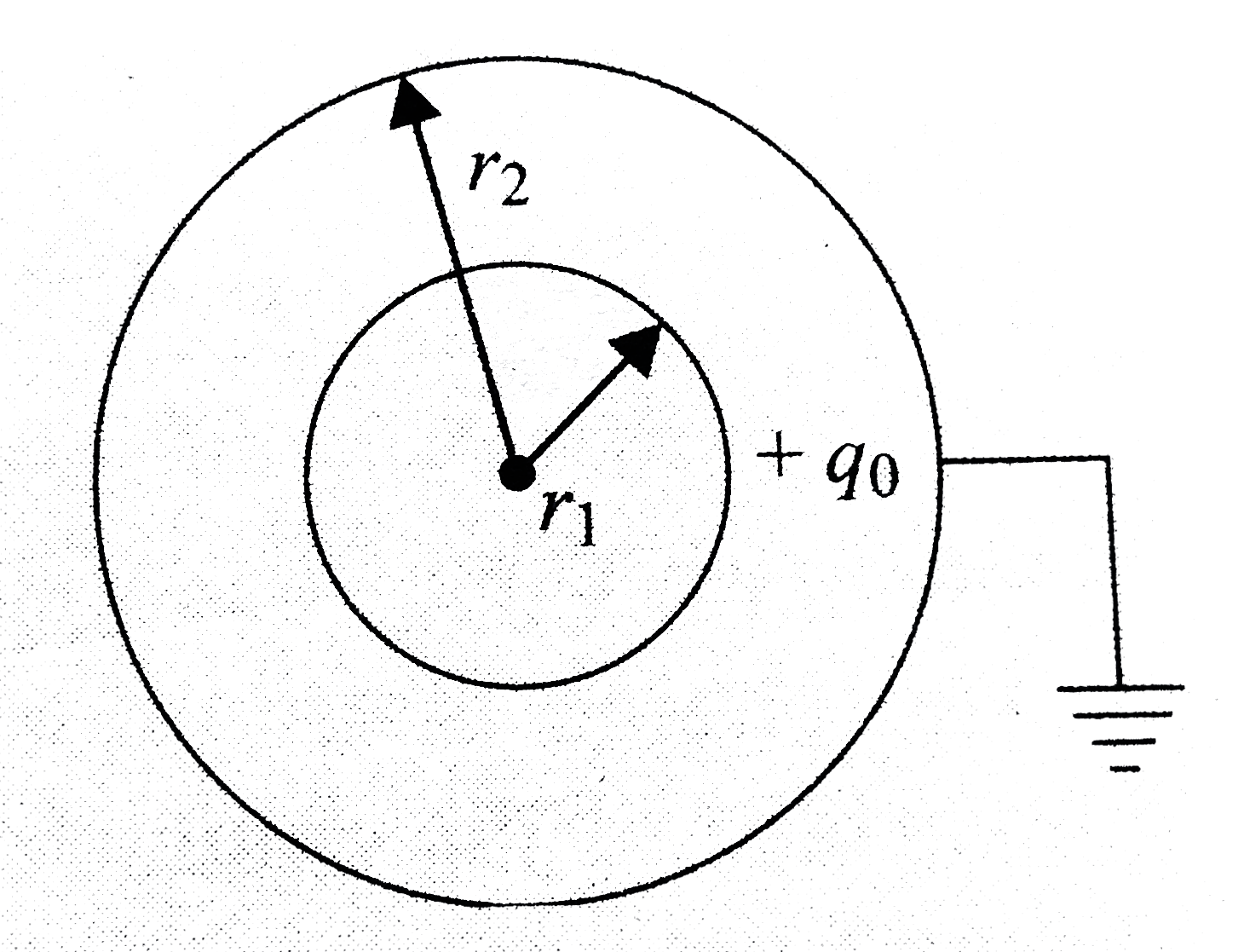
In (Fig. 3.73), if the inner shell has charge `+q_0` and the outer shell is earthed, then
.
i. determine the charge on the outer shell, and
ii. find the potential of the inner shell.

Text Solution

Verified by Experts

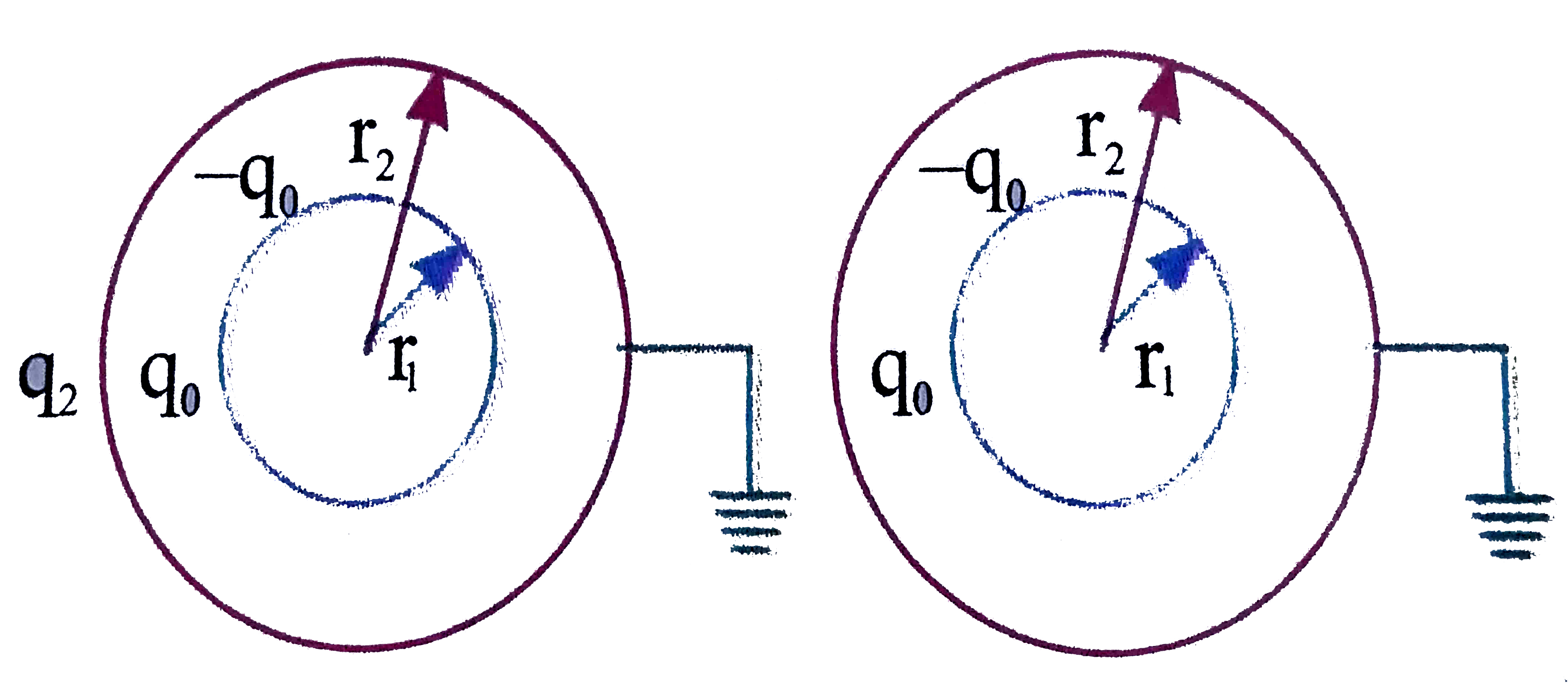
We know that charge on facing surfaces is equal and opposite,So if charge on inner sphere is `q_(0)` then charge on inner surface of shell should be `-q_(2)`,As the shell is earthed.So its potential should be zero So,

`V_("Shell")=(kq_(0))/(r_(2))+(k(-q_(0)))/(r_(2))+(kq_(2))/(r_(2))=0rArrq_(2)=0`
Here,charge on outer surface of shell is zero.Final charges appearing are shown in fig.
(b) Potenital of inner sphere:
`V_(1)=(kq_(0))/(r_(2))+(k(-q_(0)))/(r_(2))=(q_(0))/(4piepsilon_(0))[(1)/(r_(1))-(1)/(r_(2))]`
Promotional Banner

Topper's Solved these Questions

  • ELECTROSTATICS AND GAUSS LAW

    NARAYNA|Exercise C.U.Q|133 Videos
  • ELECTROSTATICS AND GAUSS LAW

    NARAYNA|Exercise Level 1(C.W)|24 Videos
  • ELECTROSTATIC POTENTIAL AND CAPACITANCE

    NARAYNA|Exercise ADDITIONAL PROBLEMS|14 Videos
  • EXPERIMENTAL PHYSICS

    NARAYNA|Exercise Comprehension type|6 Videos

Similar Questions

Explore conceptually related problems

Three conducting spherical shells have radii (a, b, and c) such that a lt b lt c (Fig. 3.113). Initially, the inner shell is uncharged, the middle shell has a positive charge Q, and the outer shell has a negative charge -Q . . a. Find the electric potential of the three shells. b. If the inner and outer shells are now connected by a wire that is insulated as it passes through the middle shell, what is the electric potential of each of the three shells ? Also, what is the final charge on each shell ?

Two thin conducting shells of radii R and R ar shown in figure . The outer shell carries a charge +Q and the inner shell is neutral. The inner shell is earthed with the help of switch S . Find the charge attained by the inner shell. .

Consider two concentric spherical metal shells of radii 'a' and bgt a .The outer shell has charge Q but the inner shell has no charge.Now the inner shell is grounded ,This means that the inner shell will come at zero potential and that electric fields lines leave the outer shell and end on the inner shell.(a) Find the charge on the inner shell Find the potential on outer sphere.

There are two concentric metal shells of radii r_(1) and r_(2) ( gt r_(1)) . If initially, the outer shell has a charge q and the inner shell is having zero charge and then inner shell is grounded. Find : (i) Charge on the inner surface of outer shell. (ii) Final charges on each sphere. (iii) Charge flown through wire in the ground.

A small conducting spherical shell with inner radius a and outer radius b is concentric with a larger conducting spherical shell with inner radius c and outer radius d ( as shown in Fig . 2.121). The inner shell has a total charge + 2 q , and the outer shell has a total charge + 4 q . Calculate the electric field in terms of q and the distance r from the common center of the two shells for The graph of the radial component of E as a function of r will be

A small conducting spherical shell with inner radius a and outer radius b is concentric with a larger conducting spherical shell with inner radius c and outer radius d ( as shown in Fig . 2.121). The inner shell has a total charge + 2 q , and the outer shell has a total charge + 4 q . Calculate the electric field in terms of q and the distance r from the common center of the two shells for a lt r lt b

A small conducting spherical shell with inner radius a and outer radius b is concentric with a larger conducting spherical shell with inner radius c and outer radius d ( as shown in Fig . 2.121). The inner shell has a total charge + 2 q , and the outer shell has a total charge + 4 q . Calculate the electric field in terms of q and the distance r from the common center of the two shells for b lt r lt c

A small conducting spherical shell with inner radius a and outer radius b is concentric with a larger conducting spherical shell with inner radius c and outer radius d ( as shown in Fig . 2.121). The inner shell has a total charge + 2 q , and the outer shell has a total charge + 4 q . Calculate the electric field in terms of q and the distance r from the common center of the two shells for r gt d

A small conducting spherical shell with inner radius a and outer radius b is concentric with a larger conducting spherical shell with inner radius c and outer radius d ( as shown in Fig . 2.121). The inner shell has a total charge + 2 q , and the outer shell has a total charge + 4 q . Calculate the electric field in terms of q and the distance r from the common center of the two shells for r lt a

A small conducting spherical shell with inner radius a and outer radius b is concentric with a larger conducting spherical shell with inner radius c and outer radius d ( as shown in Fig . 2.121). The inner shell has a total charge + 2 q , and the outer shell has a total charge + 4 q . Calculate the electric field in terms of q and the distance r from the common center of the two shells for c lt r ltd