Home
Class 12
PHYSICS
A magnetic field directed into the page ...

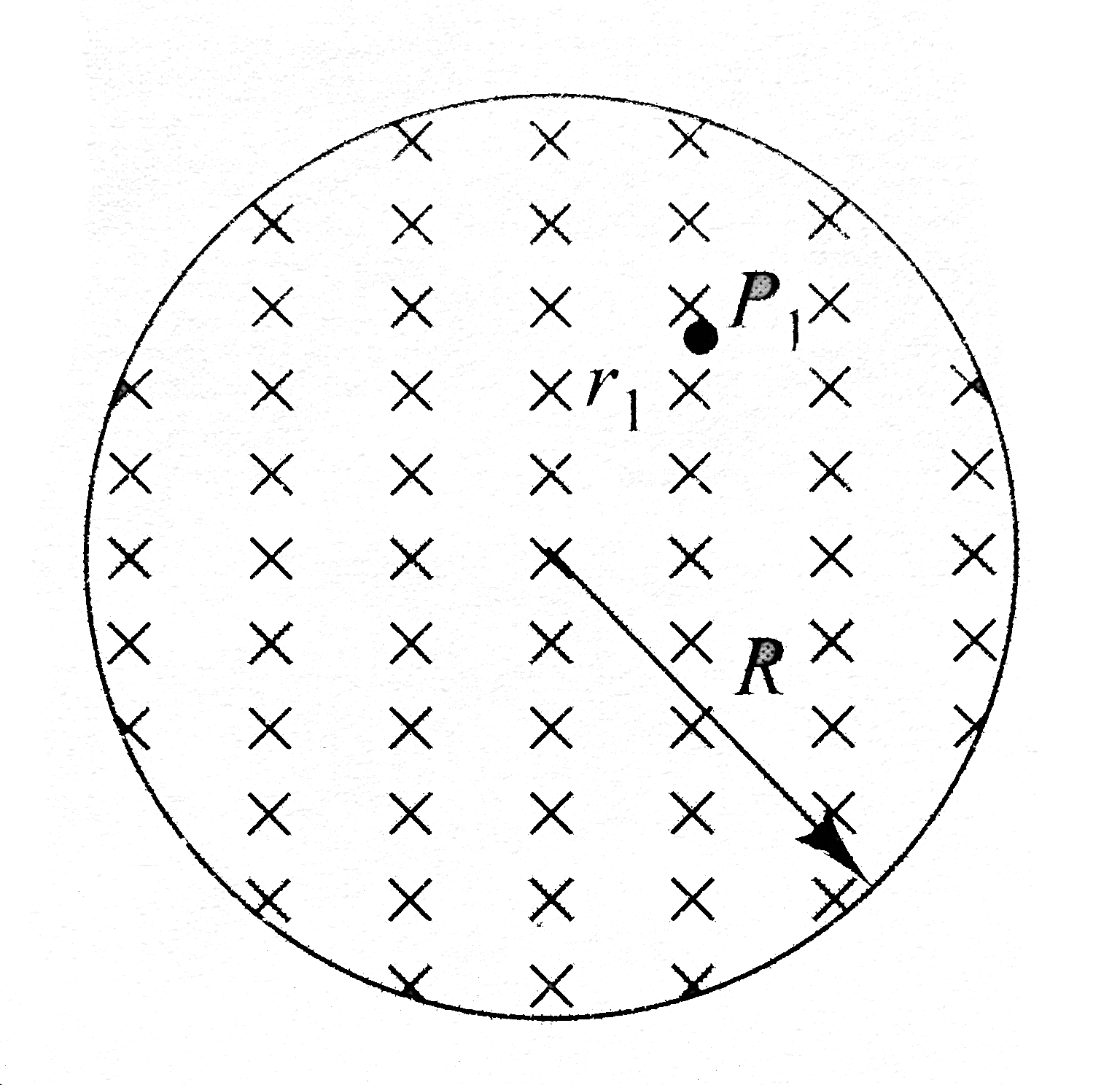
A magnetic field directed into the page changes with time according to `B = (0.0300t^(2) + 1440)T`, where `t` is in seconds. The field has a circular cross section of radius `R = 2.50 cm`. What are the magitude and direction of the electric field at point `P_(1)` when `t = 3.00 s` and `r_(1) = 0.0200 m`?

Text Solution

Verified by Experts

`e = oint E.dl = (+d phi)/(dt)`
`E = (2pir) = A.(dB)/(dt) = pi r^(2) xx (d)/(d t)(0.03t^(2)+1.4)`
`E = (pi r^(2))/(2pi r) xx (0.06 t) = (r )/(2)(0.06 t)`
`|E| = (0.02)/(2) xx 0.06 xx 3 = 18 xx 10^(-4) N//C`
Promotional Banner

Topper's Solved these Questions

  • ELECTRO MAGNETIC INDUCTION

    NARAYNA|Exercise C.U.Q 1|51 Videos
  • ELECTRO MAGNETIC INDUCTION

    NARAYNA|Exercise Assertion & Reason|11 Videos
  • ELECTRIC CHARGES AND FIELDS

    NARAYNA|Exercise EXERCISE -4|43 Videos
  • ELECTRO MAGNETIC WAVES

    NARAYNA|Exercise LEVEL-II(H.W)|14 Videos

Similar Questions

Explore conceptually related problems

A magentic field directed into the page changes with time according to B = (0.0300t^(2) + 1.4.40)T , where t is in seconds. The field has a circular cross section of radius R = 2.50 cm . What are the magitude and direction of the electric field at point P_(1) when t = 3.00 s and r_(1) = 0.0200 m ?

For the situation described in figure, the magnetic field changes with time according to B=(2.00t^3-4.00t^2+0.8)t and r_2=2R=5.0cm (a) Calculate the force on an electron located at P_2 at t = 2.00 s (b) What are the magnitude and direction of the electric field at P_1 when t = 3.00 s and r_1= 0.02 m .

As seen in Fig. 30-47, a square loop of wire has sides of length 3.0 cm. A magnetic field is directed out of the page, its magnitude is given by B = 5.0t^(2)y , where B is in teslas, t is in seconds, and y is in meters. At t = 2.5 s, what are the (a) magnitude and (b) direction of the emf induced in the loop?

A uniform but time varying magnetic field B=(2t^3+24t)T is present in a cylindrical region of radius R =2.5 cm as shown in figure. In the previous problem, the direction of circular electric lines at t=1 s is

The magnetic field in a certain cylindrical region is changing with time according to the law B=[16-4t^(2)] Tesla . The magnitude of induced electric field at point P at time t= time =2 sec , is

Induced emf and current due to a changing uniform B field Figure 30-8 shows a conducting loop consisting of a half-circle of radius r = 0.20 m and three straight sections. The halfcircle lies in a uniform magnetic field vecB that is directed out of the page, the field magnitude is given by B = 4.0t^(2) + 2.0t + 3.0 , with B in teslas and tin seconds. An ideal battery with emf E_("bat") = 2.0 V is connected to the loop. The resistance of the loop is 2.0 Omega . (a) What are the magnitude and direction of the emf E_("ind") induced around the loop by field vecB at t = 10 s? (b) What is the current in the loop at t = 10 s?

In a cylinder region of radius R , a uniform magnetic field is there which is increasing with time, according as B = B_(0)t^(2) . A positive point charge q is released from rest at P(OP = (R )/(2)) at t = 0 [the instant the field is switched on] The force experienced by, the point charge at t = 1s , is (R = 2m)

A uniform but time varying magnetic field B(t) exist in a circular region of radius a and is directed into the plane of the paper as shown. The magnitude of the induced electric field at point P at a distance r form the centre of the circular region.

Figure shows a circular region of radius R-sqrt3m which has a uniform magnetic field B=0.2T directed into the plane of the figure. A particle having mass m =2g, speed v = 0.3 m//s and charge q = 1 mC is projected along the radius of the circular region as shown in figure. Calculate the angular deviation produced in the path of the particle as it comes out of the magnetic field. Neglect any other force apart from the magnetic force.

NARAYNA-ELECTRO MAGNETIC INDUCTION-Level-II (H.W)
  1. A magnetic field directed into the page changes with time according to...

    Text Solution

    |

  2. A coil of 30 turns of wire each of 10 cm^(2) area is placed with its p...

    Text Solution

    |

  3. A square coil of side 0.5 m has movable sides. It si placed such that ...

    Text Solution

    |

  4. A uniform magnetic field existsin region given by vec(B) = 3 hat(i) + ...

    Text Solution

    |

  5. Two identical conducting rings A and B of radius R are rolling over a ...

    Text Solution

    |

  6. A flexible wire loop in the shape of a circle has a radius that grows ...

    Text Solution

    |

  7. A square loop PQRS of side 'a' and resistance 'r' is placed near an in...

    Text Solution

    |

  8. A rectangular loop with a sliding connector of length l = 1.0 m is sit...

    Text Solution

    |

  9. A straight rod of length l si rotating about axis passing through O is...

    Text Solution

    |

  10. A rod of length 10 cm made up of conducting and non-conducting materia...

    Text Solution

    |

  11. A triangular wire frame (each side =2m) is placed in a region of time ...

    Text Solution

    |

  12. A uniform magnetic field of induction B is confined to a cyclindrical ...

    Text Solution

    |

  13. The e.m.f. induced in a secondary coil is 20000 V when the current bre...

    Text Solution

    |

  14. A small square loop of wire of side l is placed inside a large square ...

    Text Solution

    |

  15. A straight solenoid of length 1 m has 5000 turns in the primary and 20...

    Text Solution

    |

  16. Two coaxial circular loops of radius 0.5 m and 5 xx 10^(-2)m are separ...

    Text Solution

    |

  17. The mutual inductance between the rectangular loop and the long straig...

    Text Solution

    |

  18. An infinite long straight conducting cylinderical shell of radius a is...

    Text Solution

    |

  19. A mu F capacitor is charged by a 400 V supply through 0.1 M Omega resi...

    Text Solution

    |

  20. A resistance with an inductor of 8 H has the same time constant as it ...

    Text Solution

    |

  21. The cell in the circuit shows in Fig is ideal. The coil has an inducta...

    Text Solution

    |
