Home
Class 12
PHYSICS
Two thick rods AB, CD are placed paralle...

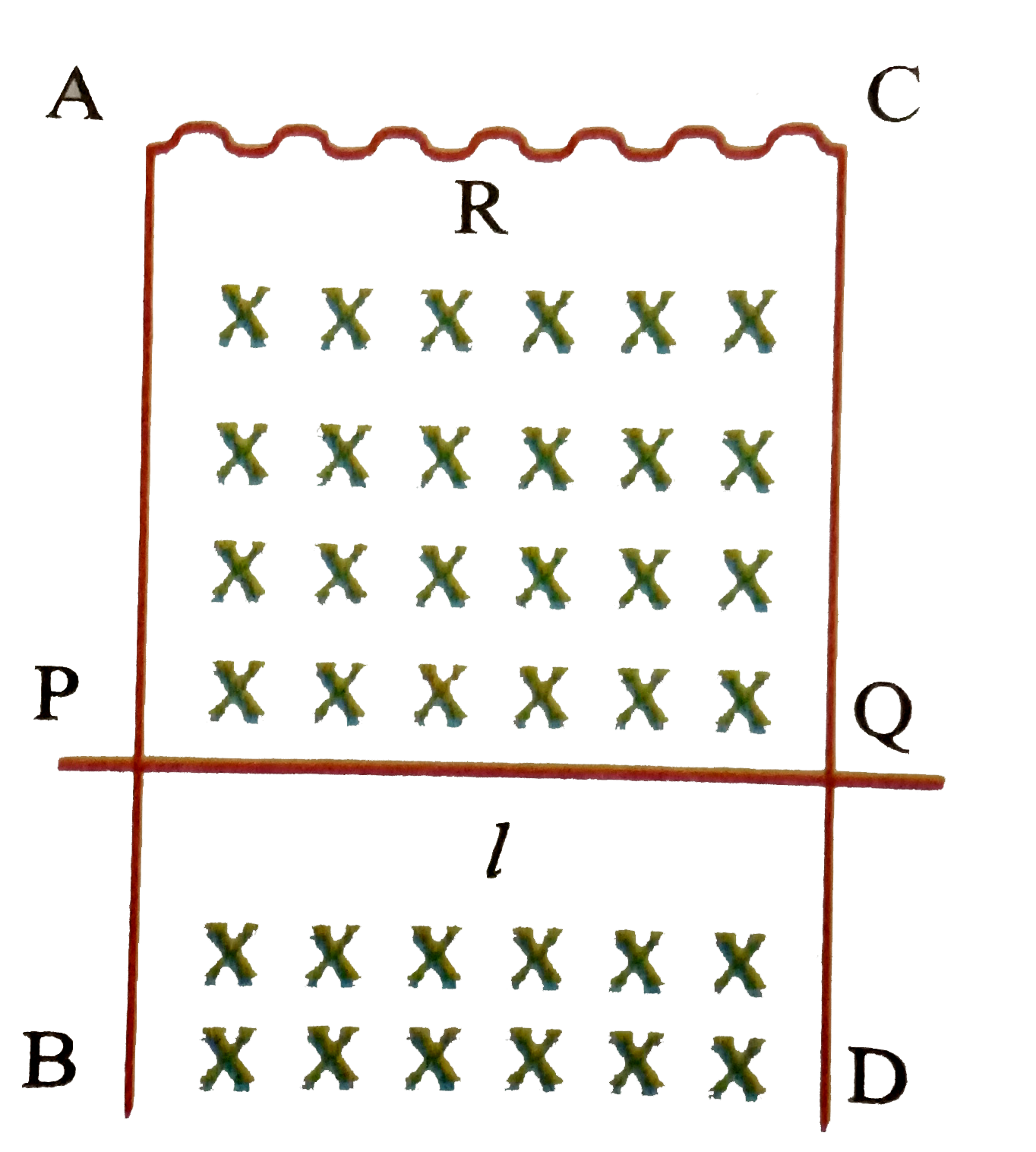
Two thick rods `AB, CD` are placed parallel to each other at a distance `l`. their ends are joined to a resistance `R`. A magnetic field of induction `B` is applied perpendicular to the plane contaning the rods. If the rods are vertical, the terminal uniform velocity of the rod `PQ` of mass `m` is given by

A

`(mg.R)/(B^(2)l^(2))`

B

`(mg.R)/(Bl)`

C

`(mg)/(BlR)`

D

`(mg l)/(BR)`

Text Solution

Verified by Experts

The correct Answer is:

A

`mg = Bil` and `i = (Blv_(T))/(R )`
Promotional Banner

Topper's Solved these Questions

  • ELECTRO MAGNETIC INDUCTION

    NARAYNA|Exercise Level-II (C.W)|28 Videos
  • ELECTRO MAGNETIC INDUCTION

    NARAYNA|Exercise Level - III|64 Videos
  • ELECTRO MAGNETIC INDUCTION

    NARAYNA|Exercise Assertion & Reason|11 Videos
  • ELECTRIC CHARGES AND FIELDS

    NARAYNA|Exercise EXERCISE -4|43 Videos
  • ELECTRO MAGNETIC WAVES

    NARAYNA|Exercise LEVEL-II(H.W)|14 Videos

Similar Questions

Explore conceptually related problems

Two parallel vertical metallic bars X X^(1) and Y Y^(1) , of negligible resistance and separated by a length 'l' , are as shown in Fig. The ends of the bars are joined by resistance R_(1) and R_(2) . A uniform magnetic field of induction B exsits in space normal to the plane of the bars. A horizontal metallic rod PQ of mass m starts falling vertically, making contact with the bars. It is oberved that in the steady state the powers dissipated in the resistance R_(1) and R_(2) and the terminal velocity attained by the rod PQ .

A copper rod of mass m slides under gravity on two smooth parallel rails l distance apart set at an angle theta to the horizontal. At the bottom, the rails are joined by a resistance R . There is a uniform magnetic field perpendicular to the plane of the rails. the terminal valocity of the rod is

A rod PQ is connected to the capacitor plates. The rod is placed in a magnetic field (B) directed downwards perpendicular to the plane of the paper. If the rod is pulled out of magnetic field with velocity vec(v) as shown in Figure.

Shows a rod of length l and resistance r moving on two rails shorted by a resistance R . A uniform magnetic field B is present normal to the plane of rod and rails. Show the electrical equivalence of each branch.

A pair of parallel horizontal conducting rails of negligible resistance shorted at one end is fixed on a table. The distance between the rails is L . A conducting massless rod of resistance R can slide on the rails frictionlessly. The rod is tied to a massless string which passes over a pulley fixed to the edge of the table. A mass m tied to the other end of the string hangs vertically. A constant magnetic field B exists perpendicular to the table. If the system is released from rest, calculate a. the terminal velocity achieved by the rod and b. The acceleration of the mass of the instant when the velocity of the rod is half the terminal velocity.

Two long parallel horizontal rails a, a distance d aprt and each having a risistance lambda per unit length are joing at one end by a resistance R. A perfectly conduction rod MN of mass m is free to slide along the rails without friction (see figure). There is a uniform magnetic field of induction B normal to the plane of the paper and directed into the paper. A variable force F is applied to the rod MN such that, as the rod moves a constant current flows through R. (i) Find the velocity of the rod and the applied force F as function of the distance x of the rod from R. (ii) What fraction of the work done per second by F is converted into heat?

A metal rod of length l cuts across a uniform magnetic field B with a velocity v. If the resistance of the circuit of which the rod forms a part is r, then the force required to move the rod is

Rod PQ of length 2l is rotating about one end P in a uniform magnetic field B which is perpendicular to the plane of rotation of the rod . Point M is the mid- point of the rod. Find the induced emf between M and Q if the potential between P and Q is 100 V .

NARAYNA-ELECTRO MAGNETIC INDUCTION-Level -I (C.W)
  1. The horizontal component of the earth's magnetic field at a place is 3...

    Text Solution

    |

  2. A metal bar of length 1 m falls from rest under the action of gravity ...

    Text Solution

    |

  3. A thin semicircular conducting ring of radius R is falling with its pl...

    Text Solution

    |

  4. Two thick rods AB, CD are placed parallel to each other at a distance ...

    Text Solution

    |

  5. A conducting ring of radius 'r' is rolling without slipping with a con...

    Text Solution

    |

  6. A cycle wheel with 64 spokes is rotating with N rotations per second a...

    Text Solution

    |

  7. A uniform circular metal disc of radius R is rotating about a vertical...

    Text Solution

    |

  8. a copper disc of diameter 20 cm makes 1200 r.p.m. about its natural ax...

    Text Solution

    |

  9. In an AC generator, a coil with N turns, all of the same area A and to...

    Text Solution

    |

  10. A flat circular coil having N turns (tightly wound D) is placed in a t...

    Text Solution

    |

  11. A uniform but time-varying magnetic field B(t) exists in a circular re...

    Text Solution

    |

  12. A coil has self inductance of 0.01 H. The current through it is allowe...

    Text Solution

    |

  13. The average self-induced emf in a 25m H solenoid when the current in i...

    Text Solution

    |

  14. Two inductors each of inductance L are joined in parallel. Their equiv...

    Text Solution

    |

  15. A coil of 100 turns with a current of 5A produce a magnetic flux of 1 ...

    Text Solution

    |

  16. In an inductance coil the current increases from zero to 6 ampere in 0...

    Text Solution

    |

  17. Two coils are at fixed location: When coil 1 has no corrent and the cu...

    Text Solution

    |

  18. A coil of inductance 0.20 H is connected in series with a switch and a...

    Text Solution

    |

  19. Two inductance coils made of difference metal wires are haivng the sam...

    Text Solution

    |

  20. The time constant of an inductor is tau(1). When a pure resistor of R ...

    Text Solution

    |
