Home
Class 12
PHYSICS
A conducting bar mass m and length l mov...

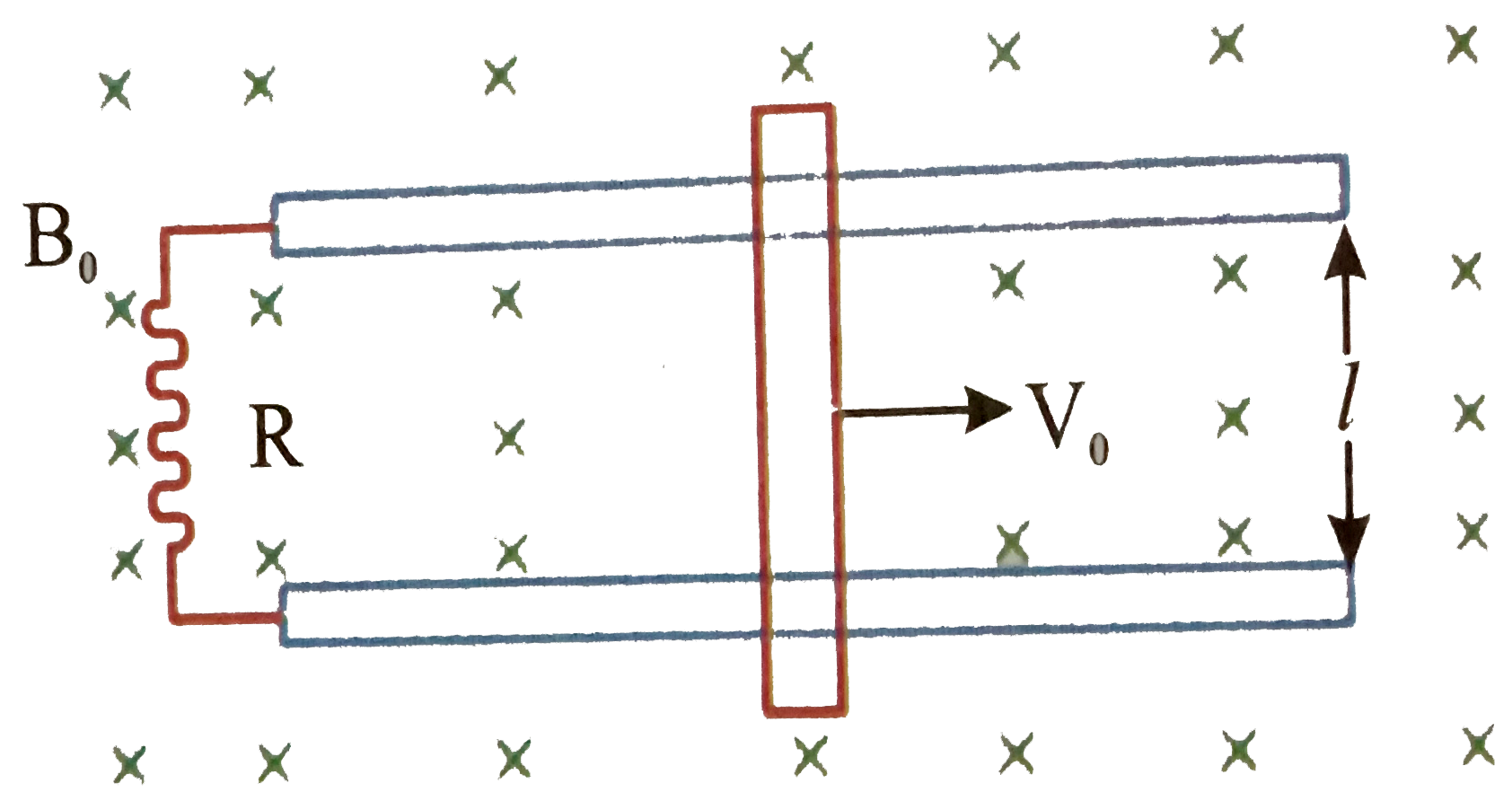
A conducting bar mass `m` and length `l` moves on two frictionless parallel conducting rails in the presence of a uniform magnetic field `B_(0)` directed into the paper. The bar is given an initial velocity `v_(0)` to the right and is released at `t = 0`. The velocity of the bar as a function of time is given by

A

`v_(0) xx (mRt)/(B_(0)^(2)l^(2))`

B

`v_(0)e^(-(B_(0)^(2)l^(2)t)/(mR)`

C

`v_(0) xx e^((-2B_(0)^(2)l^(2)t)/(mR)`

D

`v_(0)e^(-(B_(0)^(2)l^(2)t)/(2mR)`

Text Solution

Verified by Experts

The correct Answer is:
B

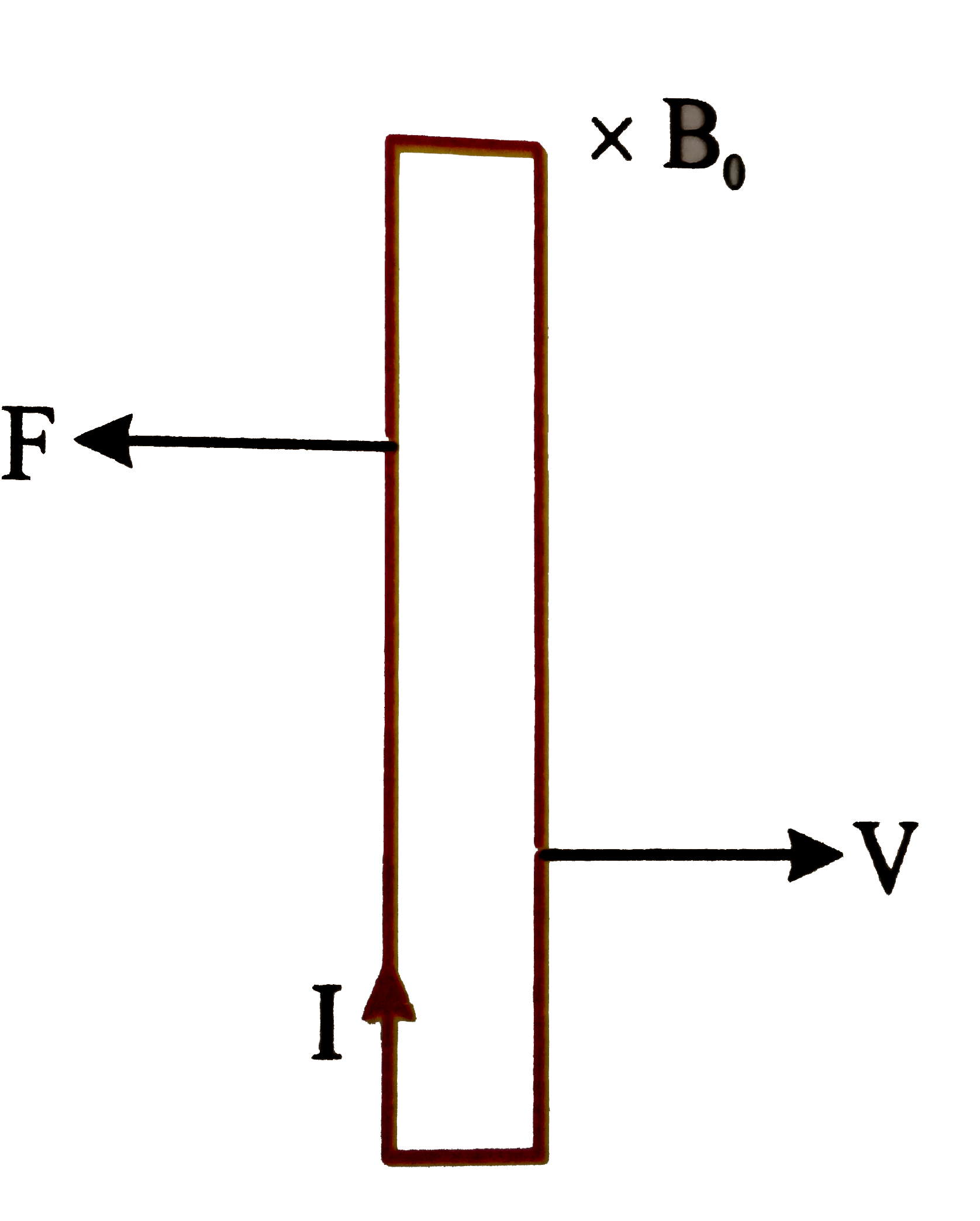
Let at any time `t`, velocity of rod be `v`, then emf developed across its ends is `e = B_(0)vl`. Due to this induced emf, a current will establish in circuit given by, `I = (B_(0) v l)/(R )`.

For rod,
`m(d v)/(dt) = - IB_(0)l = -(B_(0)^(2)l^(2))/(R )v`
`rArr underset(v_(0))overset(v)(int)(dv)/(v) = -underset(0)overset(t)(int)(B_(0)^(2)l^(2))/(mR)dt rArr v = v_(0)e^(-(B_(0)^(2)l^(2))/(mR))`
Promotional Banner

Topper's Solved these Questions

  • ELECTRO MAGNETIC INDUCTION

    NARAYNA|Exercise Comprehension Type Questions|22 Videos
  • ELECTRO MAGNETIC INDUCTION

    NARAYNA|Exercise Single Answer Questions Level -VI|13 Videos
  • ELECTRO MAGNETIC INDUCTION

    NARAYNA|Exercise NCERT Based Questions|10 Videos
  • ELECTRIC CHARGES AND FIELDS

    NARAYNA|Exercise EXERCISE -4|43 Videos
  • ELECTRO MAGNETIC WAVES

    NARAYNA|Exercise LEVEL-II(H.W)|14 Videos

Similar Questions

Explore conceptually related problems

A conducting bar of mass m and length l moves on two frictionless parallel rails in the presence of a constant uniform magnetic field of magnitude B directed into the page as shown in the figure . The bar is given an initial velocity v_(0) towards the right at t = 0. Then the

A conducting rod shown in figure of mass m and length l moves on two frictionless horizontal parallel rails in the presence of a unifom magnetic field directed into the page., The rod is given an initial velocity v_0 to the right and is released at t=0 . Find s a function of time a. the volocity of the rod b. the induced current and c. the magntitude of the induced emf.

A bar of mass m and length l moves on two frictionless parallel rails in the presence of a uniform magnetic field directed into the plane of the paper. The bar is given and initial velocity v_(i) to the right and released. Find the velocity of bar, induced emf across the bar and the current in the circuit as a function of time

A conducting wire xy of lentgh l and mass m is sliding without friction on vertical conduction rails ab and cd as shown in figure. A uniform magnetic field B exists perpendicular to the plane of the rails, x moves with a constant velocity of

A conducting rod of length is moved at constant velocity v_(0) on two parallel, conducting, smooth, fixed rails, that are placed in a uniform constant magnetic field B perpendicular to the plane for the rails as shown in Fig. A resistance R is connected between the two ends of the rails. Then which of the following is/are correct:

A conducting rod PQ of length l=1.0m is moving with a uniform speed v2.0m//s in a uniform magnetic field B=4.0T directed into the paper. A capacitor of capacity C=10muF is connected as shown in figure. Then

A long conducting wire AH is moved over a conducting triangular wire CDE with a constant velocity v in a uniform magnetic field vec(B) directed into the plane of the paper. Resistance per unit length of each wire is rho . Then

Two parallel long smooth conducting rails separated by a distance l are connected by a movable conducting connector of mass m . Terminals of the rails are connected by the resistor R and the capacitor C as shown in figure. A uniform magnetic field B perpendicular to the plane of the rail is switched on. The connector is dragged by a constant force F . Find the speed of the connector as a function of time if the force F is applied at t = 0 . Also find the terminal velocity of the connector.

