Home
Class 12
PHYSICS
PQ is an infinite current carrying condu...

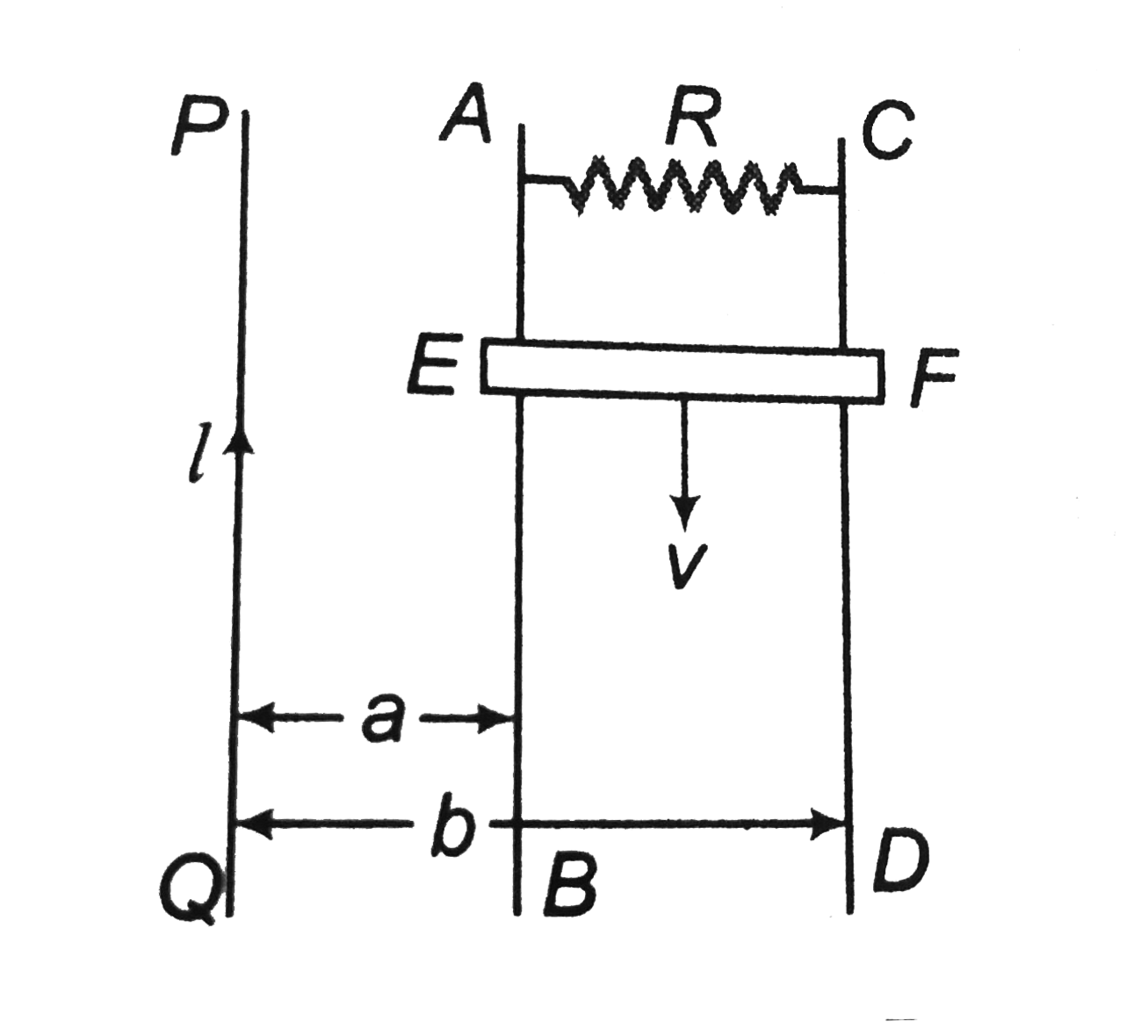
`PQ` is an infinite current carrying conductor. `AB` and `CD` are smooth conducting rods on which a conductor `EF` moves with constant velocity `v` as shown. The force needed to maintain constant speed of `EF` is

A

`(1)/(VR)[(mu_(0)IV)/(2pi)ln((b)/(a))]^(2)`

B

`[(mu_(0)IV)/(2pi)ln((b)/(a))]^(2) (1)/(VR)`

C

`[(mu_(0)IV)/(2pi)ln((b)/(a))]^(2) (V)/( R)`

D

`(V)/(R )[(mu_(0)IV)/(2pi)ln((b)/(a))]^(2)`

Text Solution

Verified by Experts

The correct Answer is:

A

Induced emf `underset(a)overset(b)int BV dx = underset(a)overset(b)int(mu_(0)I)/(2pi x)BV dx`
`rArr` Induced e.m.f. `= (mu_(0)IV)/(2pi)In((b)/(a))`
`rArr` Power dissipated `= (E^(2))/(R )`
Also, power `= FV rArr F = (E^(2))/(VR)`
`rArr F = (1)/(VR)[(mu_(0)IV)/(2pi)In((b)/(a))]^(2)`
Promotional Banner

Topper's Solved these Questions

  • ELECTRO MAGNETIC INDUCTION

    NARAYNA|Exercise Integer type questions|2 Videos
  • ELECTRO MAGNETIC INDUCTION

    NARAYNA|Exercise Level-I(H.W)|23 Videos
  • ELECTRO MAGNETIC INDUCTION

    NARAYNA|Exercise Comprehension Type Questions|22 Videos
  • ELECTRIC CHARGES AND FIELDS

    NARAYNA|Exercise EXERCISE -4|43 Videos
  • ELECTRO MAGNETIC WAVES

    NARAYNA|Exercise LEVEL-II(H.W)|14 Videos

Similar Questions

Explore conceptually related problems

A conducting circular loop of radius a and resistance per unit length R is moving with a constant velocity v_0 , parallel to an infinite conducting wire carrying current i_0 . A conducting rod of length 2a is approaching the centre of the loop with a constant velocity v_0/2 along the direction 2 of the current. At the instant t = 0 , the rod comes in contact with the loop at A and starts sliding on the loop with the constant velocity. Neglecting the resistance of the rod and the self-inductance of the circuit, find the following when the rod slides on the loop. (a) The current through the rod when it is at a distance of (a/2) from the point A of the loop. (b) Force required to maintain the velocity of the rod at that instant.

A conducting rod is moved with a constant velocity v n a magnetic field. A potential difference appears across the two ends

The end B of the rod AB which makes angle theta with the floor is being pulled with a constant velocity v_(v) as shown. The length of the rod is l .

A conductor PQ , with PQ=r , moves with a velocity v in a uniform magnetic field of induced B . The emf induced in the rod is

Two parallel long straight conductors lie on a smooth plane surface. Two other parallel conductors rest on them at right angle so as to form a square of side a. A uniform magnetic field B exists at right angle to the plane containing the conductors. Now, conductors starts moving outward witha constant velocity v_0 at t=0 . Then, induced current in the loop at any time is (lamda is resistance per unit length of the conductors)

In the above question find the force required to move the rod with constant velocity v , and also find the power delivered by the external agent.

A conductor AB of length l carrying a current i is placed perpendicular to a long straight conductor XY carrying a current I , as shown. The force on AB will act

In the figure shown a long conductor carries constant current I . A rod PQ of length l is in the plane of the rod.The rod is rotated about point P with constant angular velocity omega as shown in the figure.Find the e.m.f induced in the rod in the position shown.Indicate which points is at high potential.

A conducting rod of resistence r moves uniformely with a constant speed v. If the rod keeps moving uniformly, then the amount of force required is -
