Home
Class 12
PHYSICS
The maximum values of the phasors (curre...

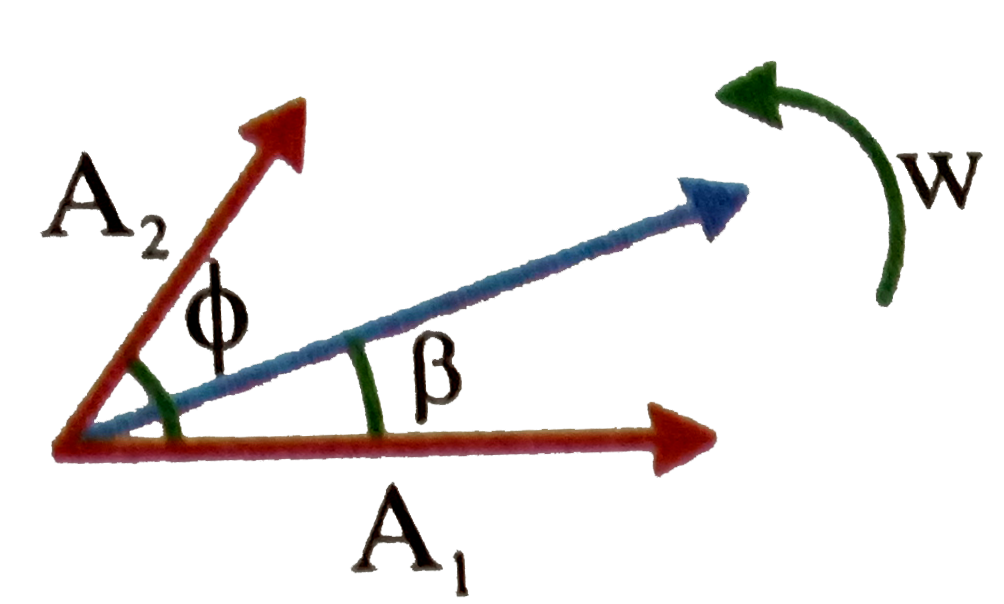
The maximum values of the phasors (currents and voltage) in `AC` circuits can be treated as vectors rotating with an angular frequency equal to the angular frequency of the rotor of the generator. If the phase difference between two phasors `vec(A_(1))` and `vec(A_(2))` is `phi` the resultant phasor is :

`A = sqrt(A_(1)^(2) + A_(2)^(2) + 2A_(1)A_(2) cos phi)`
and the phase of `vec(A)` with respects to `A_(1)` is
`beta = "tan"^(-1) (A_(2) sin phi)/(A_(1) + A_(2) cos phi)`
`RHS` value
The rms value of `y = f (t)` is
`y_("rms") = {(int_(0)^(T) [f(t)]^(2) dt)/(T)}^((1)/(2))`
Average value
The average value of `y = f (t)` is `y_(av) = (int_(0)^(T) ydt)/(T)`
Using the above concept, answer the following questions.
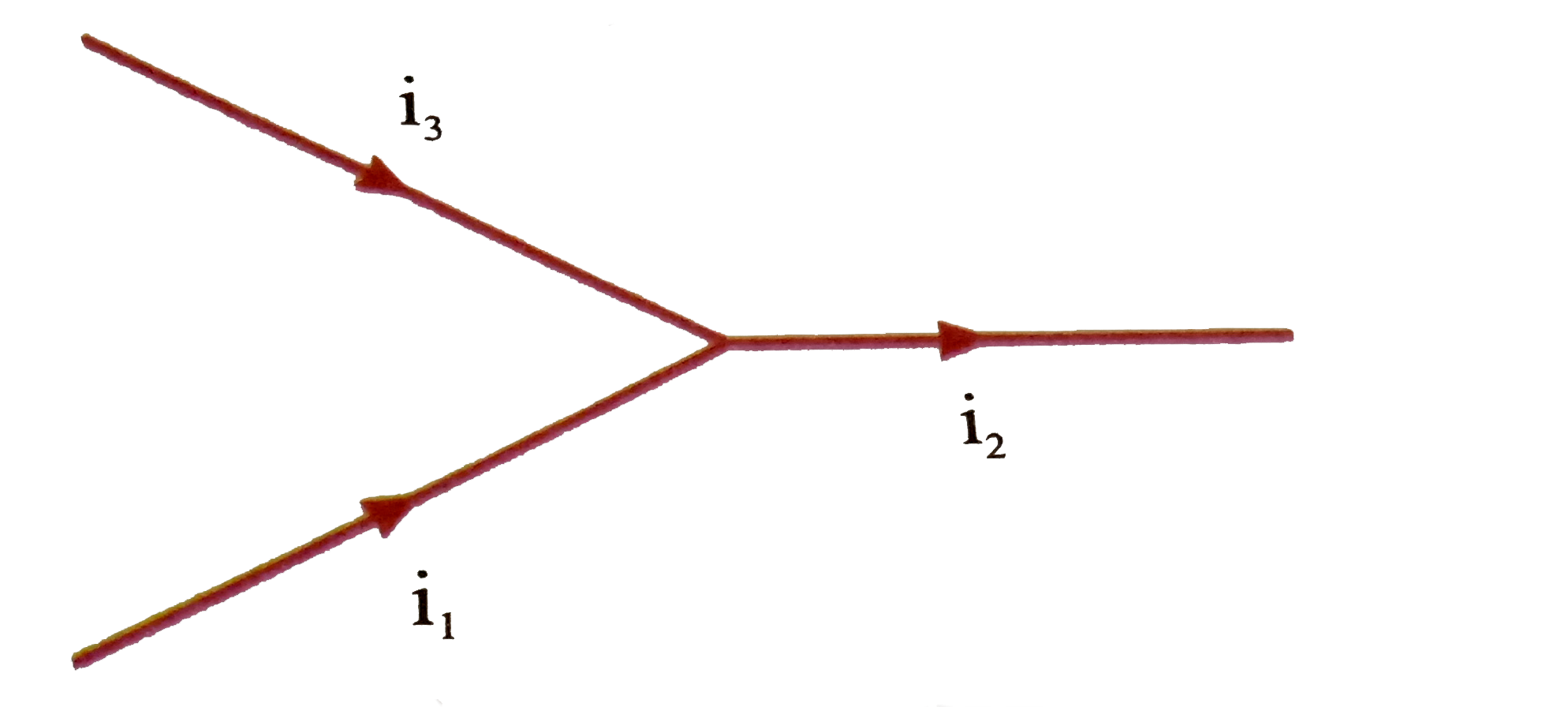
The current `i_(1)` and `i_(2)` in `A.C` circuit are given as: `i_(1) = 4 sin (omega t - (pi)/(3))` and `i_(2) = 4 sin (omega t + (pi)/(3))`
The current `i_(3)` can be given as :

A

`4 sqrt(3) sin (omega t - (2 pi)/(3))`

B

`2 sqrt(3) cos (omega t + (pi)/(3))`

C

`4 sin (omega t)`

D

`4 cos (omega t)`

Text Solution

Verified by Experts

The correct Answer is:

C
Promotional Banner

Topper's Solved these Questions

  • ALTERNATING CURRENT

    NARAYNA|Exercise LEVEL - I (H.W)|23 Videos
  • ALTERNATING CURRENT

    NARAYNA|Exercise LEVEL - II(H.W)|13 Videos
  • ALTERNATING CURRENT

    NARAYNA|Exercise LEVEL - V|83 Videos
  • ATOMIC PHYSICS

    NARAYNA|Exercise LEVEL-II (H.W)|14 Videos

Similar Questions

Explore conceptually related problems

The maximum values of the phasors (currents and voltage) in AC circuits can be treated as vectors rotating with an angular frequency equal to the angular frequency of the rotor of the generator. If the phase difference between two phasors vec(A_(1)) and vec(A_(2)) is phi the resultant phasor is : A = sqrt(A_(1)^(2) + A_(2)^(2) + 2A_(1)A_(2) cos phi) and the phase of vec(A) with respects to A_(1) is beta = "tan"^(-1) (A_(2) sin phi)/(A_(1) + A_(2) cos phi) RHS value The rms value of y = f (t) is y_("rms") = {(int_(0)^(T) [f(t)]^(2) dt)/(T)}^((1)/(2)) Average value The average value of y = f (t) is y_(av) = (int_(0)^(T) ydt)/(T) Using the above concept, answer the following questions. The rms value of i_(3) is

The maximum values of the phasors (currents and voltage) in AC circuits can be treated as vectors rotating with an angular frequency equal to the angular frequency of the rotor of the generator. If the phase difference between two phasors vec(A_(1)) and vec(A_(2)) is phi the resultant phasor is : A = sqrt(A_(1)^(2) + A_(2)^(2) + 2A_(1)A_(2) cos phi) and the phase of vec(A) with respects to A_(1) is beta = "tan"^(-1) (A_(2) sin phi)/(A_(1) + A_(2) cos phi) RHS value The rms value of y = f (t) is y_("rms") = {(int_(0)^(T) [f(t)]^(2) dt)/(T)}^((1)/(2)) Average value The average value of y = f (t) is y_(av) = (int_(0)^(T) ydt)/(T) Using the above concept, answer the following questions. The average value of i in i - t graph (Semi circular) is

The path difference between the two waves y_(1)=a_(1) sin(omega t-(2pi x)/(lambda)) and y(2)=a_(2) cos(omega t-(2pi x)/(lambda)+phi) is

Two vectors vec A_(1) and vec A_(2) each of magnitude A are inclinded to each other such that their resultant is equal to sqrt(3) A. What is the magnitude of the resultant of vec A_(1) and -vec A_(2) is

What is a phasor ? What is the phase difference between current and voltage in a purely capacitive AC circuit ? Show the phase difference through a phasor diagram .

If A_(1) and A_(2) are two A.M.'s between a and b, prove that (i) (2A_(1)-A_(2))(2A_(2)-A_(1))=ab (ii) A_(1)+A_(2)=a+b

If A_(1),A_(2) are between two numbers, then (A_(1)+A_(2))/(H_(1)+H_(2)) is equal to

The equation of the plane containing the lines vec r=a_(1)+lambdavec b and vec r=vec a_(2)+muvec b is

The resultant amplitude, when two waves of two waves of same frequency but with amplitudes a_(1) and a_(2) superimpose at phase difference of pi//2 will be :-

A_(1) and A_(2) are two vectors such that |A_(1)| = 3 , |A_(2)| = 5 and |A_(1)+A_(2)| = 5 the value of (2A_(1)+3A_(2)).(2A_(1)-2A_(2)) is

NARAYNA-ALTERNATING CURRENT-LEVEL - VI
  1. A series circuit connected across a 200 V, 60 Hz line consists of a ca...

    Text Solution

    |

  2. A series circuit connected across a 200 V, 60 Hz line consists of a ca...

    Text Solution

    |

  3. The maximum values of the phasors (currents and voltage) in AC circuit...

    Text Solution

    |

  4. The maximum values of the phasors (currents and voltage) in AC circuit...

    Text Solution

    |

  5. The maximum values of the phasors (currents and voltage) in AC circuit...

    Text Solution

    |

  6. A series R-L-C circuit has R = 100 ohm. L = 0.2 mH and C = (1)/(2) mu ...

    Text Solution

    |

  7. A series R-L-C circuit has R = 100 ohm. L = 0.2 mH and C = (1)/(2) mu ...

    Text Solution

    |

  8. A series R-L-C circuit has R = 100 Ohm. L = 0.2 mH and C = (1)/(2) mu ...

    Text Solution

    |

  9. The potential difference across a 2 H inductor as a function of time i...

    Text Solution

    |

  10. The potential difference a 2 H inductor as a function of time is shown...

    Text Solution

    |

  11. In the given arrangement the square loop of area 10 cm^(2) rotates wit...

    Text Solution

    |

  12. In the given arrangement the square loop of area 10 cm^(2) rotates wit...

    Text Solution

    |

  13. In the given arrangement the square loop of area 10 cm^(2) rotates wit...

    Text Solution

    |

  14. A 20 V 5 watt lamp is used in ac main 220 V and frequency 50 c.p.s. ...

    Text Solution

    |

  15. A 20 V 5 watt lamp is used in ac main 220 V and frequency 50 c.p.s. ...

    Text Solution

    |

  16. A 20 V 5 watt lamp is used in ac main 220 V and frequency 50 c.p.s. ...

    Text Solution

    |

  17. In the circuit shown in the figure R = 50 Omega, E(1) = 25 sqrt(3) vol...

    Text Solution

    |

  18. In the circuit shown in the figure R = 50 Omega, E(1) = 25 sqrt(3) vol...

    Text Solution

    |

  19. In the circuit shown in the figure R = 50 Omega, E(1) = 25 sqrt(3) vol...

    Text Solution

    |

  20. A physics lab is designed to study the transfer of electrial energy fr...

    Text Solution

    |
